
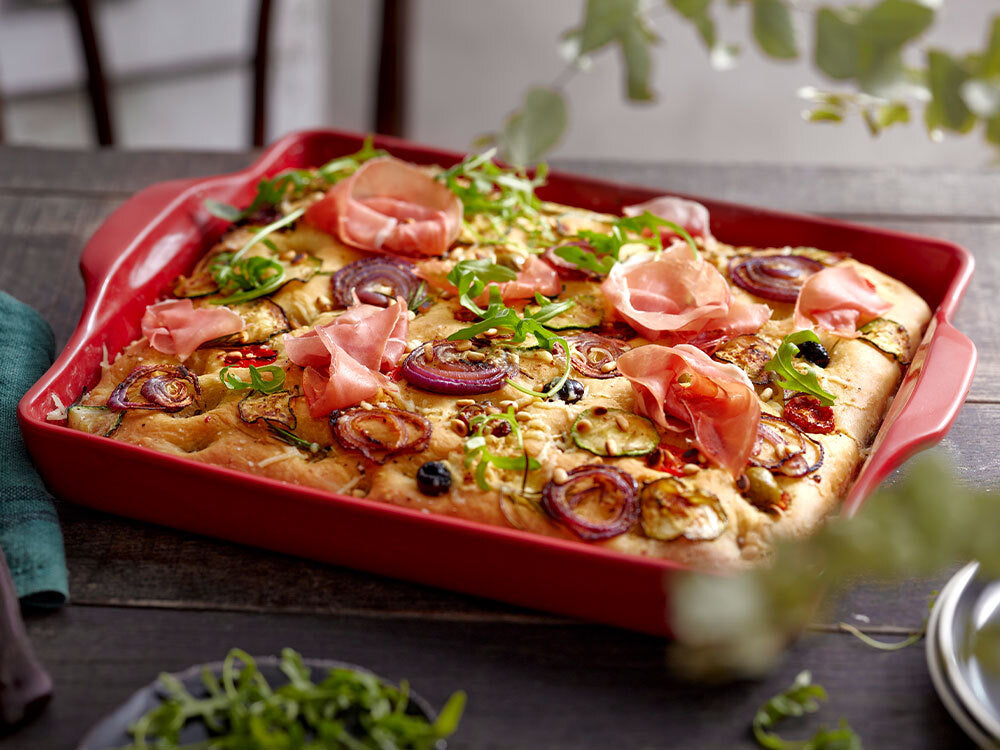
I confess I'm in love with focaccia, no matter how it's seasoned. Dressed only with extra virgin olive oil, a bit of salt and rosemary, it's delicious both to accompany cheeses or a salad, and to eat on its own. If you like it as much as I do, I invite you to make this recipe for Mediterranean focaccia, which with the touch of ham is exquisite.
If there's something that characterizes focaccia, besides its simple preparation, it's the number of variations it has and the endless adaptations that have been made, can be made and will continue to be made. It's a dish with a lot of history, more than pizza!, and with a bright future. There are so many combinations that can be made that I'm sure I'll never get tired of eating it.
For that reason and so that it turns out as it should, with a golden crust and a soft, airy interior, nothing better than the Emile Henry ceramic focaccia tray to bake it. An ideal tray because of its rectangular shape and excellent heat transmission, which is also beautiful for serving it freshly baked at the table and where you can even cut portions without worry.
Here is the recipe for this delicious Mediterranean focaccia, which I'm going to take a bite of mine, which I just took out of the oven.
Ingredients
For the focaccia dough
- 400 g bread flour
- 230 ml water
- 6 g dry yeast
- 1 teaspoon of sugar
- 1/2 tablespoon sea salt
- Extra virgin olive oil
For the brine
- 50 ml extra virgin olive oil
- 50 ml water
- 1 tablespoon salt
To season the Mediterranean focaccia
- 1 red onion
- 10 green olives (your favorites)
- 1 handful arugula
- 6 thin slices Serrano ham
Preparation
To prepare the dough:
- Slightly warm the water so it's lukewarm.
- Dissolve the yeast in a little lukewarm water together with the sugar and stir until well mixed to activate it.
- In the rest of the water add the salt and stir to dissolve it.
- Put the flour in a bowl, add the water with the yeast and sugar and then the water with the salt and mix well until everything is fully combined.
- Knead by hand or in a mixer with the dough hook until you get a uniform dough. To make it easier, you can alternate kneading with resting like this: about 3 minutes of kneading and about 10–12 minutes of rest. Repeat several times as needed until the dough looks smooth and soft. During rests, cover it with a kitchen cloth to prevent it from drying out.
- When the dough is ready, form it into a ball, put it back in the bowl, add a drizzle of oil and let it rest for about 30 minutes or until it has almost doubled in volume, covered with a kitchen cloth.
- After the time has passed, oil the Emile Henry ceramic focaccia tray and spread the oil with your fingers or using a brush.
- Deflate the dough by pressing it gently with your knuckles and place it in the pan, stretching it so it covers the tray.
- Cover it again with the kitchen cloth and let it rest for another 30 minutes.
To prepare the brine:
- While the dough rests in the pan, prepare the brine by putting the water, olive oil and salt in a jar.
- Stir to emulsify. You can use a fork or the Tellier emulsifying and whisking spoon, which is fantastic for these uses.
To season and bake the focaccia:
- Peel and slice the onion into thin rings and set aside.
- When the 30 minutes have passed, use your fingers to make small indentations all over the dough.
- Brush the entire surface with the brine.
- Distribute the onion rings over the dough and place the olives, pressing lightly so they don't move.
- Cover the dough with the kitchen cloth and let it rest for another 30 minutes.
- Preheat the oven to 210 °C.
- When the 30 minutes have elapsed, pour a drizzle of oil over the entire surface of the dough.
- Put the focaccia in the oven and bake at 210 °C for 15 to 20 minutes.
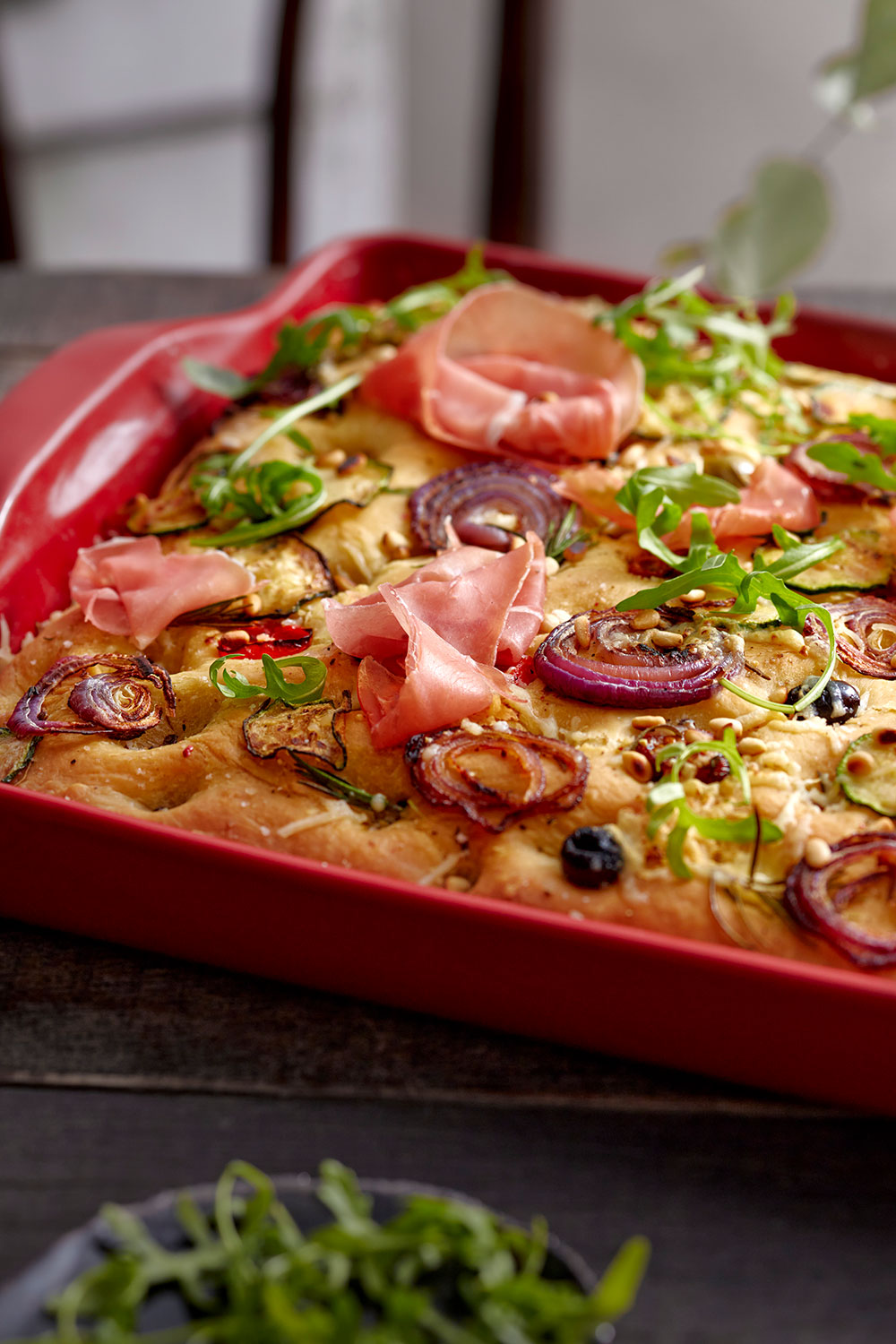
- When it's done, take the tray out of the oven and scatter the arugula leaves and slices of ham over the focaccia.
- Bring it to the table without unmolding, beautifully presented on the same ceramic focaccia tray you baked it in.
Notes
- This same focaccia will be equally exquisite if you swap the Serrano ham for lacón, cooked ham or Italian mortadella. In any case, slice it as thinly as possible.
- Although the recipe indicates green olives, if you prefer black ones, it will be delicious as well.
- Season the focaccia to your taste: add a bit of black pepper or grated garlic to the brine or chop some cherry tomatoes and distribute them when you place the olives, scatter sage, rosemary or thyme if you like their aroma, or when adding the ham add a bit of burrata, mozzarella or any fresh or soft cheese you like, or pinches of sobrasada!


Comments
Claudia&Julia said:
Hola Elena,
Esperamos que pruebes la receta. Ya nos contarás qué tal :)
¡Un saludo!
Claudia&Julia said:
Hola M.L.,
Muchas gracias por avisarnos; por error no aparecía indicado el momento de añadir el agua con la levadura y el azúcar. Hay que añadirla a la harina junto con el agua con la sal. Lo verás en el paso número 4.
¡Un saludo y esperamos que te guste la receta!
M.L. Perez said:
No sé cuándo incorporar el agua con la levadura. ¿Después de integrar la harina con la sal? Gracias
Elena said:
🤩💖💐