
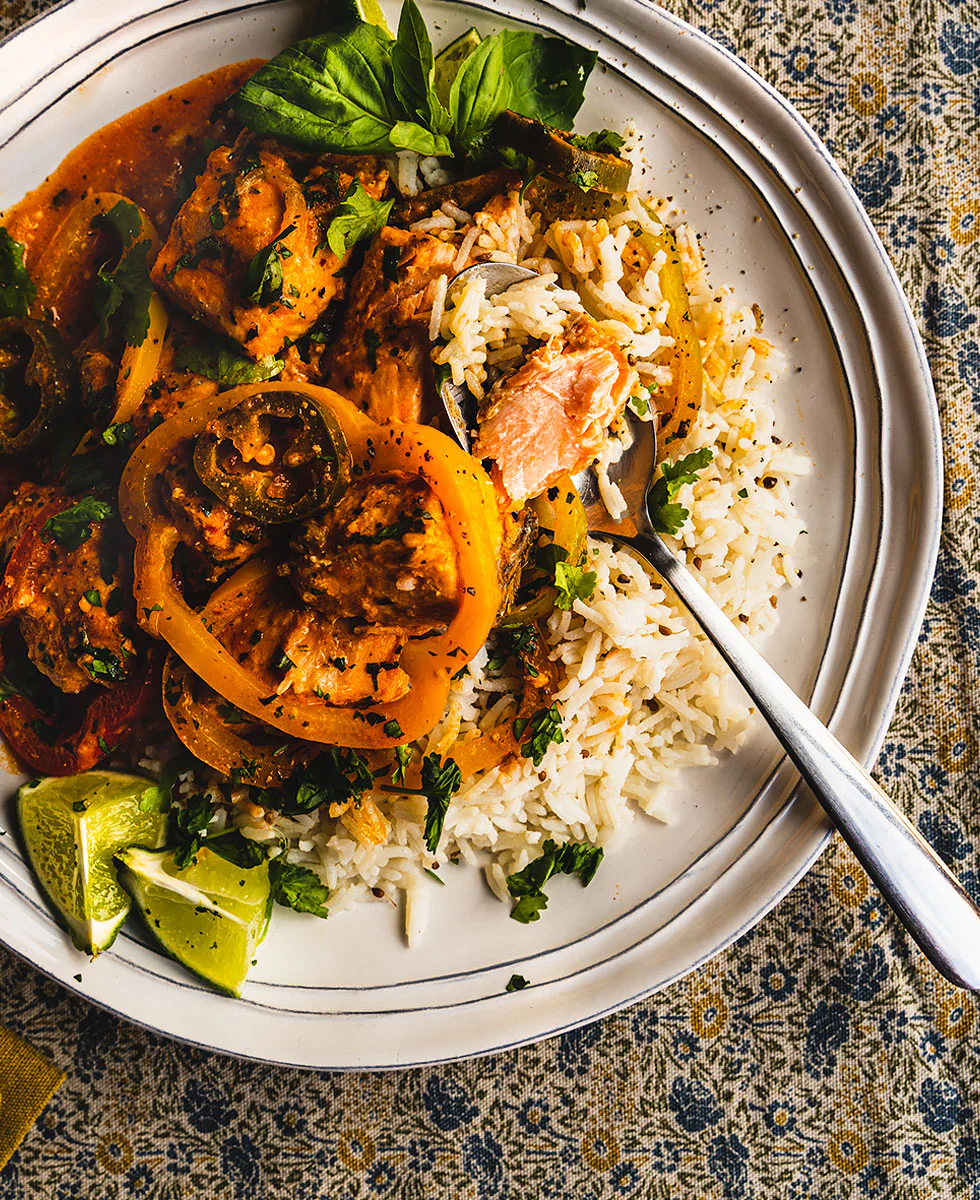
Those of you who love intense, bold and different flavors, close your eyes and travel with me to Brazil to enjoy this wonderful Salmon moqueca.
One of the fish stews that, if you haven't tried it yet, I recommend you do as soon as possible.
The moqueca or muqueca de peixe in Portuguese, is a very simple recipe, with accessible ingredients and that you won't take long to prepare (as long as you already have the tomato sauce prepared). The stew is made with fish in pieces or chunks; traditionally it's made with white fish, but in my case I leave you this version with salmon, tomato sauce, coconut milk, onion, pepper, cilantro and palm oil (dendê), although we will use olive oil. Apparently, this variety of oil gives the stew a very particular and pleasant flavor and aroma.
The moqueca, a word that derives from pokeka, is of Brazilian indigenous origin, and originally the fish was roasted between leaves of different trees.
There are two types of moqueca; the moqueca baiana, from the state of Bahia in the northeast of Brazil, has African influences. It is made with coconut milk and palm oil. And the moqueca capixaba, from the state of Espírito Santo in the southeast, has Portuguese influence. This one is made with olive oil and urucum (achiote) seed. Some time ago I left you a recipe that used this ingredient, this soup Vegetable minestrone.
There are two sayings about this preparation:
- Moqueca é capixaba, o resto é peixada! - 'moqueca is capixaba, the rest is fish stew!'
- moqueca baiana, essa só engana! - 'moqueca baiana, that one only deceives!'
The first written mention of the moqueca is found in a historical document, a letter from the Portuguese priest Luís de Grã, dated 1554. In 1584, another priest, Fernão de Cardim, comments that fish, potatoes, and mangará (plantain flower), among other foods, were roasted. Nowadays moqueca is not roasted, it is cooked on stoves.
This dish can be served with rice or beans, although it is very common to find it accompanied by cassava.

Ingredients for 3 servings
- 1 kg of fresh salmon, loin and cut into pieces
- 2-3 tablespoons of olive oil
- 1 medium sweet onion, sliced
- 2 large garlic cloves, sliced
- 285 g homemade tomato sauce (recipe below)
- 145 g high-fat coconut milk
- 1 yellow pepper, bell pepper type
- 1 red pepper, bell pepper type
- 1 green pepper, bell pepper type
- 1 jalapeño chili (optional)
- juice of half a lime
- salt and black pepper to taste
- fresh chopped cilantro
- fresh chopped basil (optional)
FOR THE HOMEMADE TOMATO SAUCE:
- 1 kg tomatoes for frying
- 1 roasted red pepper, ideally homemade
- 3 tablespoons of olive oil
- 15 g unsalted butter
- 20-25 g sugar
- salt to taste
FOR THE ANISE-INFUSED RICE:
The amount of rice detailed is per person
- 50 g basmati rice
- 135 g water
- 1 bay leaf
- 1 teaspoon anise seeds
- ½ spoon of olive oil
- flower of salt

Preparation
Blanch the tomatoes.
- Fill a large pot with water, place over medium heat and leave until it reaches a boil.
- Meanwhile, make a cross cut in the base of each tomato.
- Once the water reaches a boil, carefully introduce the tomatoes and blanch for 1 minute.
- Take the tomatoes out of the water and let cool until you can handle them without burning yourself. We can also put them under a stream of cold water.
- Remove the skin, chop and put back into the pot.
Prepare the tomato sauce.
- Add to the chopped tomatoes the olive oil along with the sugar and a little salt.
- Place over medium-high heat and leave until the tomato reaches a boil.
- At that moment, reduce to medium-low heat. As the tomato begins to cook, it will start to release water. We will cook until we notice that most of that water has evaporated, which may take about 35-45 minutes.
- At that moment, add the roasted red pepper in strips and cook for 10 more minutes.
- Remove from heat and use an immersion blender to achieve a smooth and creamy tomato sauce.
- Return to the heat and incorporate the butter. Cook until you obtain the desired thickness for your tomato sauce.
- Taste, adjust salt and sugar if desired.
- Set aside.

Prepare the anise-infused rice.
- Rinse the rice very well with cold water to remove excess starch. Drain.
- Place a pot over medium heat, add the oil and, once it heats up, sauté the rice for a few seconds.
- Add to the rice the anise and bay leaf along with the water, leave over medium-high heat until it begins to boil.
- Once it begins to boil, reduce to medium-low heat, cover the pot and cook for 5 minutes.
- After this time, reduce to low heat and cook for 8-9 minutes. All the water should have been absorbed. It is important not to uncover the pot during the cooking time.
- Remove the pot from the heat.
- After 2-3 minutes, open the lid and move the rice with a wooden spoon.
Prepare the salmon moqueca
- Place the Balti Dish on the heat over medium.
- Add the olive oil and let it heat, without letting the oil smoke.
- Add the onion along with the garlic and cook, stirring occasionally, for 5 minutes or until it becomes translucent.
- Add the tomato sauce along with the coconut milk. Mix very well with the help of a wooden spoon and cook for 2-3 more minutes.
- Place the pieces of salmon in the Balti Dish allowing them to be submerged in the broth.
- Distribute over the surface the colored peppers cut into slices along with the sliced jalapeño chili.
- Cook for 18-20 minutes, the temperature of the salmon should not exceed 60 °C in the center of the piece. We can place a lid over the Balti Dish to help retain some of the steam. The lid does not cover the entire pot because of the shape of the handles, but it does help ensure optimal cooking.
- Remove from heat, drizzle the surface with the juice of half a lime and sprinkle generously with fresh chopped cilantro.
Serve the moqueca.
- On a large plate, place a base of aromatic basmati rice and, on top of it, place pieces of salmon with a little broth and vegetables.
- Sprinkle a little black pepper, more fresh cilantro (if you wish) and fresh basil. Accompany with lime wedges
- Serve immediately.

NOTES:
- Traditional moqueca is made with white fish, but this version with salmon gives us a very surprising and tasty result.
- I advise you to use fresh salmon instead of frozen, if possible. In this case it is not necessary to freeze it, since we are going to cook the fish completely.
- If we buy the whole salmon loin, we can cut the pieces to the size we prefer. If we ask our fishmonger to do it, try to make sure they are not very small pieces.
- There's no comparison between making the tomato sauce at home and buying it ready-made… I recommend spending a little time preparing the sauce at home.
- The size of the roasted red pepper is that of a red pepper for roasting. I advise you not to omit it (and to roast it at home), whenever possible, because it not only provides a very vivid color but also a wonderful flavor.
- The butter in the tomato sauce is an ingredient that not only provides wonderful flavor but also texture. The tomato sauce becomes creamier and richer.
- The jalapeño is optional, but I recommend including it. It adds a very light and pleasant spicy note.
- If you don't like coconut milk, you can use cream instead. The result won't be the same in flavor, but it will be similar in consistency and texture.
- This dish is ideal to serve with rice. In my case I offer the option of accompanying it with anise-infused basmati rice, but you can use the variety of rice you prefer.
- This salmon stew can be frozen in an airtight container for 2 months.
I am sure that this Brazilian fish stew, Salmon moqueca, slightly modified from its origins, will fascinate you. It is a perfect recipe for cold days, although it is also true that we can enjoy it at any time of the year.
For my part I suggest serving it with anise-infused basmati rice; at home we love to serve this rice as a side for many dishes. Also, you can vary the spices and adjust according to the recipe you are going to prepare, for example cardamom, cumin, fennel… A truly versatile accompaniment.
Sources: Vox Localis


Comments
a said: