

I bring you a basic kitchen tip, roasted garlic, an essential preparation both to enjoy them as-is and to boost the flavor and result of any dish you use them in. Both the roasted garlic and the oil in which we will store them! Making roasted garlic is very easy and straightforward. Here you will find how to make roasted garlic, how to use it in your recipes, and also ideas to make the most of the wonderful garlic-flavored oil that results from preserving roasted garlic in oil.
Once you discover the flavor and value of roasted garlic you won't forget to put a head or two in the oven every time you turn it on for anything.
Roasted garlic is made in a kind of little packets, cooking them en papillote in their own juices, which is why they become so soft and tasty. Roasted, the garlic is very tender, in fact almost buttery, not overpowering but intense in flavor. A taste that moves between roasted with caramelized and smoky notes, and therefore will help intensify the flavor of any recipe you apply it to. I hope you feel encouraged to try them with the ideas we bring.

Recipe to make roasted garlic and preserve it in oil
- Preheat the oven* to 160 - 185 ºC*
- Place the heads of garlic you are going to roast on a wooden board. Cut the tips off the heads of garlic with a sharp knife, leaving the cloves exposed.
- Open some sheets of baking paper (or aluminum foil if unavailable), and place the heads of garlic inside. Pour a drizzle of oil into each head, coating all the cloves. Then sprinkle salt on top.
- Close the papers with kitchen twine, making little parcels or pouches. Arrange them on a small tray and put them in the oven.
- Baking time will vary depending on the oven heat and the size of the garlic, but they will be ready in about half an hour, even a little less.
- After the time has passed, remove from the oven and open the packets to let them cool.
- When you can handle them, start extracting the garlic cloves from their heads. If they are done, you'll see that by pressing from the bottom of the head and squeezing upward they will come out very easily.
- Place all the garlic in an airtight jar (the Luigi Bormioli ones are wonderful) and fill it with olive oil, covering the garlic. Close the jar and store it in the fridge until you want to use them.
Notes:
- *Garlic takes up so little space that it's worth preparing it when you're baking a cake or roasting vegetables or fish in the oven - there's always room for some roasted garlic, and you'll save energy.
- Some people don't cut the tips off the garlic and roast them as-is. Cutting the tips ensures they won't explode from the initial heat and, especially, makes extracting them very easy.
- Garlic in oil will keep perfectly for two months (and longer).
- Some people turn the garlic into a paste and, together with the oil, fill an ice cube tray to freeze them. They will keep indefinitely, and when you want to use them you can take out the cubes you need and put them in the pan. In the heat the cubes will melt in a moment and you'll have the flavored oil and the garlic ready to cook.
- Remember that the longer the garlic stays in the oil, the more aroma the oil will absorb (and you can use it in many ways, I tell you about it below).
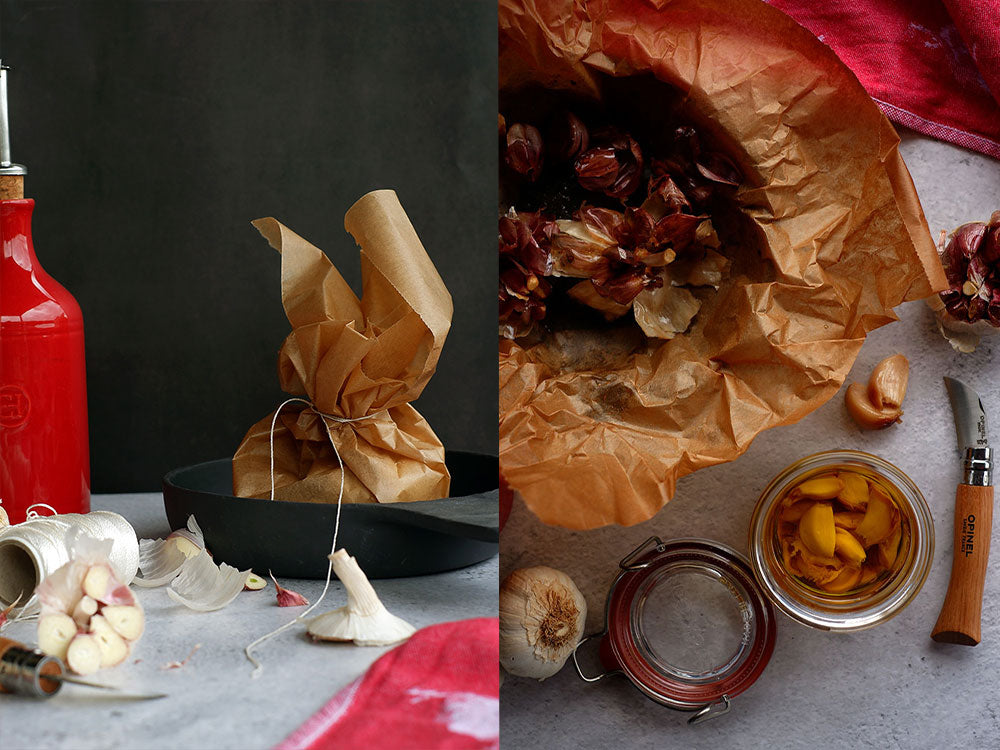
Revol slate cazuelita and Gefu kitchen twine
Note for the lazy about how to make roasted garlic:
You can also make roasted garlic loose on a tray, drizzled with oil and salt. The biggest risk is controlling the baking time: very often they end up dry and too dry because they cook too quickly and the oven air dries them out. They lose that pleasant, classic creaminess of roasted garlic, but if you're in a hurry or feeling lazy you can put them on the tray as-is. Sure you can.

Garlic knife Opinel and Naturels Nordic Ware trays
How to use roasted garlic
In texture, roasted garlic is tender and even spreadable, and in flavor it has smoky notes but also caramelized and sweet hints. Make the most of it in countless dishes, I assure you it will turn a dish into something spectacular:
Eat it as-is: you can put it on a snack platter, next to a meat or fish, roasted garlic delights anyone who tries it.
- For a snack spread: skewer it with a bit of cheese, a cube of ham, or a small piece of omelette... it will be a mini skewer, a delicious mini-skewer!
- To spread on bread: whether toasted or soft bread, spread the garlic on the bread and eat it as-is or top it with some cold cuts, salami, chicken or some sardines. It will be a perfect dinner.
- For creamy soups: add some roasted garlic to your usual soups, blend and you'll see how the flavor changes. A mushroom soup, pumpkin, leek, cauliflower... add roasted garlic and discover a new world!
-
Use it in gazpacho instead of raw garlic, that way it won't upset your stomach.
- In purees: you can add one or two cloves to potato or vegetable purées, enriching them.
-
Try it when you make hummus and also in olive paste. Replace raw garlic with two or three roasted cloves. You'll love the touch it gives.
-
Use it together with the oil to prepare a different aioli that will surely surprise you (and that aioli is great for accompanying roasted potatoes, hhmmm!).
- For flatbreads, toasts and pizzas: as you add olives or peppers, add roasted garlic to these preparations, the roasted and smoky touch works wonderfully in them.
- In stews and casseroles: add a couple of cloves to your stews, you'll see how they bring an unusual and delightful flavor.
- Roasted meats and fish: add a few cloves when roasting any food, they will melt into the juices that baste the food and the result is extraordinary. If any remain whole even after that second roasting, the cleverest person will eat them.
- To make croquettes: add roasted garlic to your croquette mixture, you'll appreciate it. Likewise, for the béchamel of cannelloni if you want it with a different touch.
- For filling empanadas or fresh pasta fillings: when you prepare the filling for your ravioli or little packets and for empanadas, remember the roasted garlic you have in the fridge. Add it to those fillings because it will give them a delicious distinct touch.
How to use roasted garlic oil
The oil that preserves roasted garlic takes on the garlic flavor, becoming intensely aromatic. It will solidify in the fridge, but will quickly return to liquid if you remove it or add spoonfuls to a hot pan. Remembering this, use it whenever you can. It's rich in flavor (what a thing to say—it's a wonderful oil!)
- For bread, toasts and sandwiches: sandwiches with cheese and cold cuts are fine, but with the flavor of roasted garlic oil they are superior.
- For griddle cooking: when you're going to cook fish or meat on the griddle, use the roasted garlic oil for the grill before putting the food on. You'll see what an easy way to give them flavor! You can also brush the meat directly with the oil; you'll make sure the whole piece tastes amazing.
- For pizzas and focaccias: it won't be a spicy pizza oil, but it will be a garlic oil for pizza that will improve every bite.
- For pasta: use a drizzle of roasted garlic oil to season your pasta dishes, you'll love the result. You can also use it in the dough process as the oil for making the dough (what a twist of flavor you'll give it!).
- For vegetables, sauté mushrooms and cook corn on the cob on the griddle: pour a few tablespoons of roasted garlic oil into the pan or grill when roasting or sautéing them, or brush them directly before putting them on the griddle. You'll see!

I hope you dare to put some heads of garlic in the oven the next time you turn it on. Your life will improve when you always have a jar of roasted garlic in the fridge!
NOTE: One of the reasons we introduced the Naturels Nordic Ware trays in the shop is to bake small-sized foods or things you make in small quantities. These small trays are super practical for roasting garlic, doing a bit of onion in the oven, quickly preparing spiced chickpeas, roasting peppers or making escalivada... The juices are collected, you can separate flavors, place the tray in the oven while you bake other things... I hope you find them extremely useful!


Comments
ISABEL said:
Buenos días. Que receta más fantástica! Se podría sustituir el papel de horno por una bolsa de asar? O no quedarán igual? Muchas gracias. Besos
Isabel said:
Otra forma más de consumir ajos. 😋Buenísimos. Gracias por la receta.
Annabel said:
Pero cuando dices de hacer un corte, a qué te refieres?? Si mantenemos la cabeza para asar, dl corte donde lo haces?? Arriba de la cabeza pero sin abrirla?? Por la parte inferior tambien lo cortas? Gracias por la información. Saludos
Claudia said:
Muchas gracias, MAria, me alegro mucho! ¡Saludos!
Maria said:
Me encanta!
Claudia said:
Hola Liliana, tienes razónq ue tal vez no esté bien detallado, disculpa y gracias por comentarlo, ahora lo revisaré en texto. Pero la idea es que se tienem que quitar los ajos de la cabeza de ajos y yo ya los retiro de su piel: como están blanditos y la tapita de los ajos está cortada, solo “escurriéndolos desde la base” van saliendo y los guardas sin piel en el frasco, listos para usar.
Saludos y gracias!
Claudia said:
Hola Blanca, muy feliz de leer tus palabras, muy agradecida! Espero que te guste como para que siempre haya un botecito de ajos asados en la nevera . ¡Saludos!
Liliana said:
Me encantó la receta!!!
No obstante, tengo una duda respecto a la misma: En el punto 7, cuando hablás de extraer los ajos de su cabeza, te referís a sacarlos con su piel y todo? Y luego los disponés en un frasco también con su piel o se le quita en algún momento?
Desde ya, muchas gracias y un cordial saludo!
Blanca said:
Me encantan vuestras recetas, voy a empezar a llevar a la práctica. Mil gracias.