

Today we present a dish that is as hearty as it is bold, flavorful and surprising. It's brought to us by Eva, author of Bake-Street, who prepares a Duck Pie for us in a black sesame pastry that you can use for many other tarts.
The duck pie is a pastry with a unique flavor, also unusual since we don't usually eat duck in everyday life. This recipe has all the qualities to be ideal for family gatherings!
Many times we need to host friends or family at home and struggle to decide what to prepare, not to mention that we have to get up early so the food is ready when they arrive.
And what if I tell you, this wonderful Duck Pie can be prepared the day before, or even two days if you count the meat marinating, and on the big day we’ll only need to spend a few minutes to decorate it? As you read, a perfect main course (because as a first course I find it heavy), different, tasty, aromatic and very eye-catching.
To present it this Emile Henry ceramic mold is perfect, it has a good diameter and considerable height, allowing us to make a generous filling. Also we can cut the pie in the same mold and remove portions without the pastry sticking to it. Not to mention how beautiful it looks for serving.
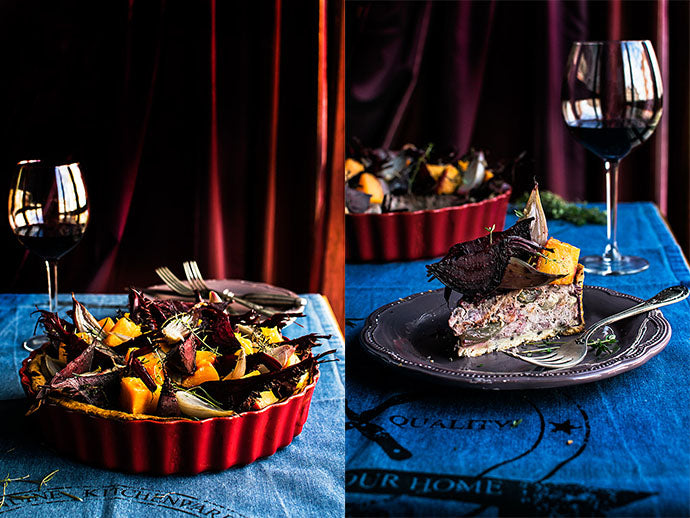
This Bertinet recipe was very well received at home; in fact it reminds them a lot of pâté. If by chance we have some leftover pie, we can refrigerate it and consume it within 6-7 days without problems.
Ingredients (for a 28 cm diameter mold, 12 servings)
FOR THE BLACK SESAME PASTRY:
300 g of wheat flour
150 g of cold butter
6 g of sea salt
1 L egg
40 g of very cold water
4 teaspoons of black sesame (approx. 11 g)
FOR THE FILLING:
500 g of duck thigh, cleaned and deboned, we will need about 800 g approx. (2 thighs)
500 g of lean pork
300 g of cured bacon
6 juniper berries
8 allspice berries crushed in a mortar
1 teaspoon of freshly ground green pepper
1 teaspoon of sweet paprika
1 teaspoon of fresh thyme leaves
200 g of port or sherry
18 unpeeled shallots
olive oil for confiting the shallots, about 700 g approx.
2 L eggs
150 g of light single cream
sea salt and freshly ground pepper
FOR THE GELATIN
4 sheets of neutral gelatin
200 g of homemade chicken stock
100 g of port or sherry
TO DECORATE:
3 large purple beets
3 slices of squash, about 600 g
Sprigs of lemon thyme, thyme and fresh rosemary
Sea salt flakes
Extra virgin olive oil
METHOD
FIRST DAY
Prepare the black sesame pastry:
In a bowl combine the flour with the salt and black sesame, set aside.
Grate the cold butter to integrate it better. Once ready, add it to the flour mixture and begin integrating with your fingertips until you obtain a sandy mixture.
Add the egg and mix slightly. Add the very cold water and mix again.
Transfer the dough to a work surface and finish working the dough by performing fraisage. I'll explain how to do it.
Place the “heel” of your hand on the dough and slide forward little by little so that the dough comes together but without becoming elastic. We do not want to develop the gluten to avoid it puffing up.
Once homogeneous, form a disk, cover with cling film and place in the refrigerator for at least 1 hour. Ideally make it the day before.
Marinate the meat:
We will work with duck thighs, so if we trust our poulterer (and don't know how to debone well!) we'll ask them to debone both and remove the skin. It will save work and we won't damage the meat.
Cut the duck, lean pork and cured bacon into cubes. Add to a large bowl and incorporate all the spices, the port or sherry (your choice), a little salt and the thyme. Mix very well to season all the meat, cover with plastic film and place in the refrigerator until the next day.
Confit the shallots:
To confit the shallots we will need a large Shallow Casserole, about 700 g of olive oil, and the unpeeled shallots.
Wash the shallots very well with water to remove dust and any dirt, and dry them. Place them in a large Shallow Casserole and cover with olive oil; the amount of oil will depend mainly on the size of the shallots.
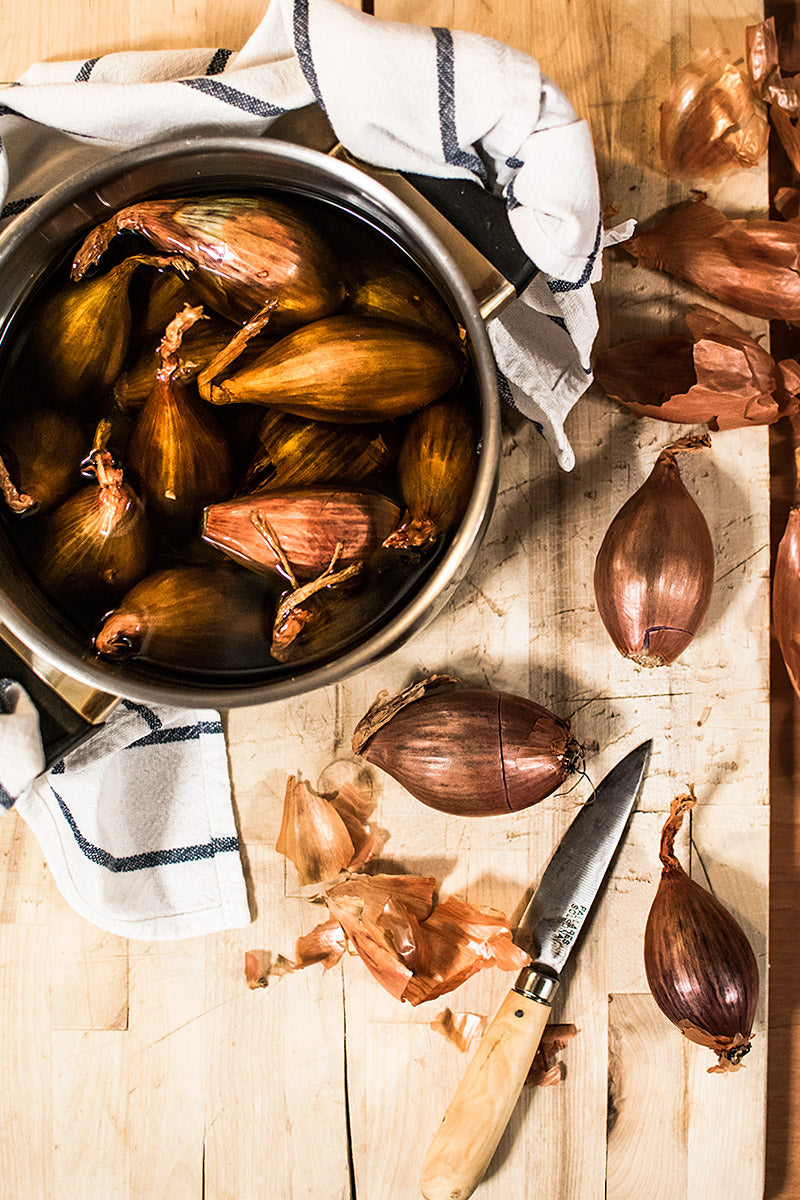
Pallarès iron knife with boxwood handle
Set over very low heat; on an induction cooktop with values from 1–9, set it to 3, cover the Shallow Casserole lightly, and let them confit very slowly. It will take about 40–45 minutes.
To know if our shallots are ready, simply poke them with a knife. If it enters smoothly, they are ready.
Remove from the heat, take out with a slotted spoon and let cool completely on a dish.
Note: The oil in which we confited the shallots can be reused without problems to fry potatoes for example; it will add a very distinctive flavor.
SECOND DAY
Prepare the pastry:
Temper the pastry a few minutes before rolling it out, so take it out about 30 minutes before working it.
Place two sheets of baking paper and the dough between them; this will make it very easy to roll the dough without it sticking to the work surface and transfer it to the mold. With a rolling pin roll the dough until it exceeds the mold diameter by about 4-5 cm.
Remove the top paper, lightly dust the dough with flour, place the mold on the dough trying to center it and flip it over as if it were an omelette. This way we will place the dough without handling it too much and avoid stretching it or having it stick to our hands.
Remove the paper and let the pastry fit the mold. Do not press it to stick to the mold, just adjust the edges and remove the excess.
Place in the fridge while we prepare the filling.
Prepare the meat for the filling:
Take the marinated meat out of the fridge and proceed to grind it in a meat grinder. If you don't have one at home you can do two things: ask for it to be ground when buying it so it is ready, or cut it very finely with a very sharp knife.
Place in a large bowl, set aside.
In a small bowl mix the cream with the eggs, beat until homogeneous. Pour over the meat, adjust salt and pepper, and mix again.
To know if it is well seasoned we can taste the mixture directly or cook a small amount in a small frying pan, wait for it to cool and then taste it.
Preheat the oven to 180ºC with top and bottom heat.
Meanwhile clean half of the shallots, reserving the rest to decorate the top.
Remove the outer skin and slice the shallots in half lengthwise. Set aside.
Remove the mold from the fridge and proceed to fill it. Place a little meat and arrange the shallots as you fill the mold. Do not mix the shallots with the meat mixture, because stirring it will separate the segments and when cutting the pie it won't look as striking. They will be like dispersed onion layers.
Once the mold is filled, cover with a sheet of baking paper and place in the oven for 1½ to 1¾ hours. We must ensure before removing that the meat is fully cooked.
When there are 30 minutes left of cooking, remove the baking paper so the crust can brown.
Remove the mold from the oven and let cool completely. It may take around 2 hours.
Prepare the port gelatin:
Fill a small bowl with very cold water and soak the gelatin sheets to hydrate them.
In a saucepan combine the chicken stock, homemade is better, with the port. Place over medium heat and bring to a boil. Remove from heat.
Remove the gelatin sheets, squeeze very well and add to the hot mixture. Mix very well with the help of a whisk until completely dissolved.
Let the mixture cool slightly before pouring it over the pie.
You will notice that the meat has separated a bit from the pastry, it's fine. Pour the gelatin over the pie, and that gap will be filled by the gelatin. Place the mold in the refrigerator until the gelatin sets, it will take about 4 hours.
We can leave it until the next day; the flavor will improve greatly thanks to maturation.
THIRD DAY
Prepare the top decoration:
In a Shallow Casserole, add the beets whole and unpeeled, cover with water, and cook over medium heat for about 25 minutes. We should cook them but without letting them get too soft, when inserting a knife, it should enter but offer a little resistance.
Remove from the heat, take them out of the Shallow Casserole, and let them cool on a platter.
In another separate Shallow Casserole, cook the pumpkin. Cut it into thick slices without removing the skin, cover with water, and set over medium heat. It will take less time to be ready, about 18–20 minutes. Be careful not to let it soften too much.
Remove and let cool on a dish.
Preheat the oven to 200ºC with top and bottom heat. Prepare a large baking tray and line with paper.
Cut the beet in half and from this half cut 4 segments. Repeat the process with the rest of the beet.
Prepare the squash, remove the rind and cut the slice in half. Then cut into cubes.
Arrange on the baking tray, drizzle with a splash of olive oil (it can be the oil reserved from the shallots), season with sea salt flakes and place some sprigs of lemon thyme, thyme and rosemary.
Bake for around 17-20 minutes. Remove and let temper.
Meanwhile clean the remaining shallots, remove the outer skin and slice in half lengthwise. Set aside.
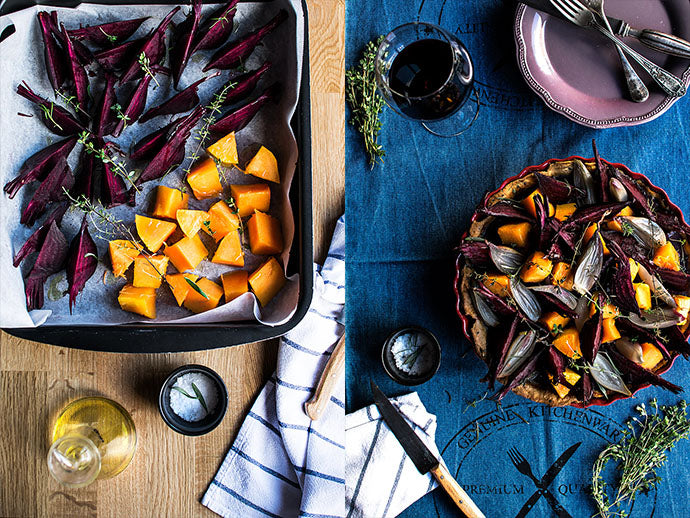
Emile Henry ceramic mold and Pallarès kitchen knife with beech handle
Decorate the tart:
Arrange alternately over the surface the beet segments, the squash and the confited shallots. Decorate with some sprigs of thyme and rosemary and our Duck Pie is ready to enjoy.
Enjoy your meal!


Comments
Roda said:
Receta espectacular !
Pero entiendo que este pastel de carne se come frío?
Claudia said:
Tienes razón Jesus, pero con el paso a paso verás qué bien te sale, y el esfuerzo habrá valido la pena :) ¡Saludos!
Jesus said:
Ultramaratoniana receta pero espectacular
Habrá que intentarla con tiempo
Muchas gracias