
Rosa, author of Pemberley Cup&Cakes, takes us to England with this version of the classic British chicken pie. Rosa presents a truly tasty version, but I encourage you to view it with your investigative cook mode switched on, since by playing with other ingredients, the ones you like best, it will become one of your most versatile recipes.
Today's recipe is a sure success at home. And no, it's not sweet! But we'll need to use the oven either way, and that's already enough for me. It's perfect when temperatures start to drop and you feel like reaching for a spoon and enjoying a comforting, piping-hot meal full of flavor. This is a dish with a long tradition in British cooking: chicken pie. However, thanks to how popular and common its ingredients are and the fantastic combination they create, it's a really tasty bite for practically any palate, no matter where in the world it is.
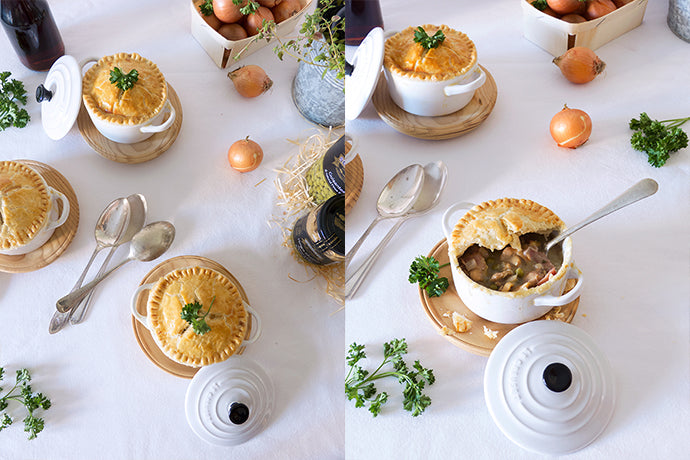
Generally, it is usually prepared in a single ovenproof dish from which each guest is served, but this time I've chosen to make it in individual portions using these beautiful and hugely versatile Le Creuset mini-cocottes; they not only ensure perfect cooking of the ingredients, but their look as an individual dish is ideal for enjoying this simple delicacy with all the senses.
Needless to say, making your own shortcrust pastry at home is really a win, although it's not essential, since nowadays you can find ready-made, good-quality versions in practically any supermarket, either frozen or fresh. However, if you decide to make it at home for the first time, I assure you it's very easy; it only requires some chilling time —we need to keep it cold throughout the process— and minimal handling. No rising, no kneading, and with very basic ingredients: flour, butter, and very cold water. Really, there are almost as many versions of shortcrust pastry as there are people who make it, but the old 3:2:1 formula always works perfectly for me, that is, 3 parts flour, 2 parts butter, and 1 part water. Easy as can be, right?
As for the filling ingredients, whichever ones you choose, it's important to use quality products, whether fresh or canned (I invite you to check out the new Claudia&Julia Pantry, because the preserves are in many cases artisanal and made from fresh fruit of excellent quality), like the ones I used in this recipe. The ratio given here is the combination I usually use, but nothing is set in stone when it comes to chicken pie. This is a highly adaptable recipe that can be tailored to the consumer's taste. Bacon is entirely optional; I usually include it because it adds juiciness to the chicken, which generally tends to be the opposite. The same goes for the mushrooms (you can add them or not), the leeks (perfectly replaceable with celery, for example), or the type of herbs used (tarragon, sage, thyme, coriander, parsley, etc.); it all depends a little on each person's personal taste. I'm dying to know what your preferred version of chicken pie would be…
INGREDIENTS (for 6 mini-cocottes or ramekins about 10 cm Ø)
For the homemade shortcrust pastry:
- 180 g all-purpose wheat flour (+ extra flour for kneading)
- ½ teaspoon salt
- 120 g unsalted butter, very cold, even frozen, cut into about 2 cm cubes
- 60-75 ml approx. ice water
- 1 egg for brushing
For the filling:
- 150 g smoked bacon
- 350 g free-range chicken, boneless and skinless, trimmed of fat (preferably thigh and drumstick)
- 2 small scallions
- 1 garlic clove
- 2 leeks
- 150 g boletus mushrooms
- 80 g peas
- 2 level tablespoons fine cornstarch (Maizena type)
- 500 ml chicken stock
- 125 ml white wine
- 3 tablespoons cooking cream
- 2 sprigs fresh thyme
- Curly or flat-leaf parsley
- Salt and ground black pepper
- Extra virgin olive oil
*1 tablespoon=15 ml; 1 teaspoon=5 ml*

Method
For the shortcrust pastry:
(If you're going to use ready-made shortcrust pastry, go straight to the filling method)
1. To make our own homemade shortcrust pastry, start by placing the flour and salt in a large bowl and mix well with whisks until fully combined.
2. Next, add the cold butter, cut into little cubes, and work it lightly with your fingertips or with the help of two knives, just enough until it is more or less incorporated and coated with flour; you'll end up with a handful of uneven "crumbs," but there should still be visible bits of butter and flour that haven't combined. It's very important not to overmix so that the butter doesn't warm up and soften.
3. Then add the ice water; start by adding 3 tablespoons gradually while mixing everything with your hands until a dough forms that holds together reasonably well and comes away easily from the sides and bottom of the bowl. If necessary, you can add the rest of the water, always little by little (you may not need it all), until you can compact the dough into a block.
4. Finally, shape into a ball and flatten slightly, wrap in plastic wrap, and chill for at least 2 hours (or even overnight).
For the filling:
1. Meanwhile, we can prepare the filling. Start by cutting the bacon into strips and fry it directly without oil in a large skillet over medium heat for about 4–5 minutes until lightly browned but not crisp. Drain off as much fat as possible and transfer to a medium saucepan. Set aside.
2. Next, cut the chicken into fairly small pieces, season with salt and pepper, and fry (if using the same skillet, it must be free of fat) with a couple of tablespoons of olive oil for about 5-7 minutes, stirring occasionally until all the pieces are evenly cooked. Set aside with the bacon in the same saucepan.
3. Then finely chop the onion and sweat it in another 3-4 tablespoons of olive oil along with a pinch of salt until translucent. Next, add the garlic, also very finely chopped, and the leeks, sliced. Sauté everything together for about 5 minutes until fully softened.
4. Add the mushrooms, previously cut up, and keep cooking until all the flavors have blended well (about 3 more minutes), stirring occasionally.
5. Now add the peas and sauté everything for 1 more minute. Once everything is well softened, add it to the saucepan with the bacon and chicken and set aside.
6. In a small bowl, dissolve the cornstarch in about 60 ml (about 4 tablespoons) of the chicken stock, making sure there are no lumps.
7. Then add the remaining liquid ingredients (the rest of the chicken stock, the white wine, and the cooking cream) to the saucepan, along with the dissolved cornstarch, and simmer everything together over medium heat, stirring often with a wooden spoon.
8. Finally, season with salt and pepper to taste, add the thyme and parsley (just the leaves), finely chopped, and bring to a boil for about 10 minutes until the sauce reduces, the alcohol evaporates, and it thickens slightly, stirring constantly to prevent it from sticking to the bottom. Turn off the heat and let cool completely.
Assembly and baking:
1. When the filling starts to cool down a bit, take the dough out of the fridge (if it's too cold and hard to handle, let it sit at room temperature for about 5 minutes to warm slightly). On a floured work surface, roll out the dough directly, without stretching or kneading, with a rolling pin, always from the center outward, until you get a thickness of about 0.5 cm.
To prevent the dough from sticking to the work surface, dust it lightly with flour as you go and turn it as you roll. It's very important not to use too much flour so you don't ruin the final texture of the dough. You can also place the dough between two sheets of parchment paper or plastic wrap (in this case, you'll need to peel them away often to prevent folds from forming in the dough).
2. Next, using a very sharp knife, cut out the pieces of dough needed to cover our individual pies. The best guide is the same containers in which we'll bake them (mini-cocottes or ramekins), but leave an extra 1 cm margin all around so it can be sealed easily later. Place the pastry rounds on a flat tray, cover with plastic wrap, and refrigerate again for at least 20 minutes.
3. Meanwhile, preheat the oven (electric and without fan) to 200°C and place the oven tray, previously lined with parchment paper, on the middle rack.
4. Then divide the filling, already cold, among the containers up to just below the rim and, using a pastry brush, brush the edges of the containers with the beaten egg.
5. Next, remove the pastry rounds from the fridge and place them over the containers, making sure they are well sealed. If you prefer, you can decorate the edges however you like: with the tines of a fork or by shaping the edge decoratively, scalloped, braided, etc. (In this case, it's a good idea to add a little extra dough around the edge for easier shaping).
6. Brush the pastry surface again with the egg and, using a very sharp knife, cut two or three slits in the center top to let steam escape during baking so the pastry doesn't soften too much.
7. Finally, place the mini-cocottes on the oven tray and bake for about 35-40 minutes or until the pastry has turned a beautiful golden color and the filling juices are bubbling through the slits.
8. Let cool for about 10 minutes on a wire rack and serve while still hot.

Notes:
- If you've decided to make the shortcrust pastry at home, congratulations! Your chicken pie will be hard to beat. And since you're at it, and given how versatile this pastry is and how well it freezes (always before baking), why not double the quantities and have some ready for future recipes? To keep it frozen (it holds perfectly for 2-3 months, depending on the freezer), it should be wrapped well to prevent the cold from damaging it, first in plastic wrap and then in aluminum foil. When you're ready to use it, leave it in the fridge overnight until thawed. Then roll it out and proceed according to the recipe you choose.
- In this recipe, I only use the shortcrust pastry to cover the pie, since it's quite a hearty dish. However, if you prefer to line the base as well and close it completely, you'll only need to double the ingredient quantities and fully line the inside of the containers with another, larger pastry round.
- Although the result will vary, you can replace the shortcrust pastry with puff pastry. Delicious either way.
- You may prefer to make one single pie for everyone to serve themselves from; that's fine, you'll need to use an ovenproof dish and increase the baking time by about 5-10 minutes or until you see it has taken on that lovely golden color and the filling juices are bubbling through the slits.
- If there are leftovers, you can keep them well covered with plastic wrap and refrigerated for up to 2 days. To reheat, place it in the lower third of the oven, preheated to 160ºC, for about 15 minutes. If you see the top browning too much, you can cover it loosely with a little aluminum foil, placed loosely over the container(s).
- As a side, nothing beats a rich and generous fresh salad.
Enjoy and have a happy weekend!
Rosa


Comments
Kuqui said:
Probaré este finde¡ pero como no tengo moldes individuales lo haré en uno grande para todos. ,! Buen finde!
Tarde de Hadas said:
Qué rica receta y que bonita así presentada ideal para días fríos de otoño
Rosa M Lillo said:
Muchas gracias, Olga, por lo que a mí me toca. Encantada de que te haya inspirado :)
Un beso
Olga Navarro said:
Qué buenísima receta, tengo que hacerla este finde. Me apunto a la presentación en mini cocotte, queda genial.
Las fotos son preciosas, Rosa!!!
Feliz finde!!!