
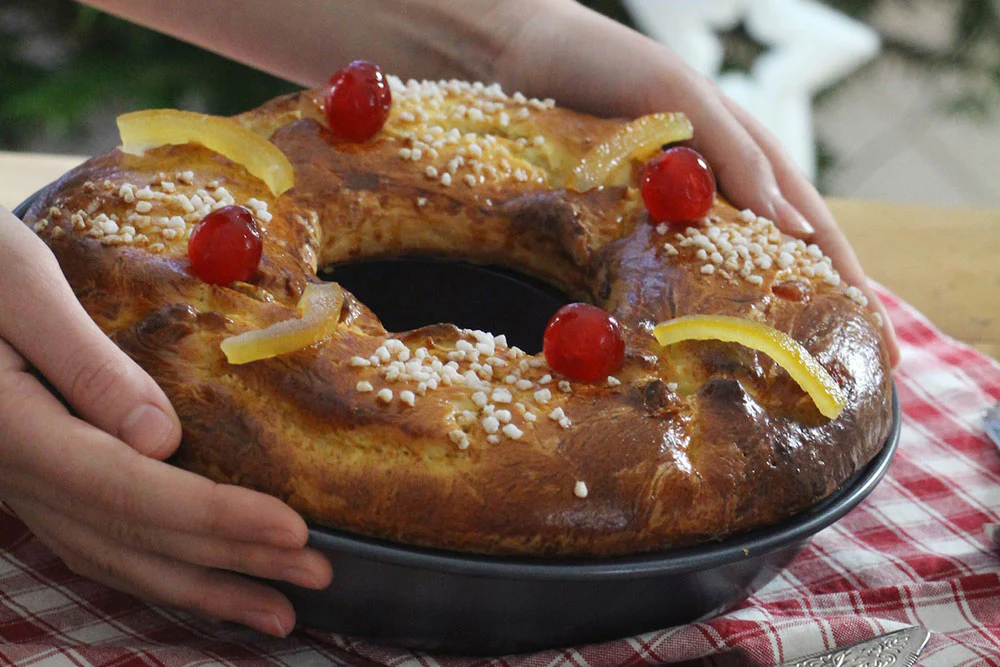
If you still wait for Epiphany with the same excitement as when you were little, today's recipe is going to delight you. This Roscón de Reyes is a brioche-style roscón, an approachable and easy-to-make dough, with just the right sweetness and filled with candied fruit. And of course, it includes the traditional fava bean, which has always brought so many laughs at home for young and old alike.
This recipe comes directly from France, courtesy of Emmanuelle, a French chef for the specialist De Buyer. In her version Emmanuelle decorates it with pearl sugar and candied fruit, but you can replace that with sliced or chopped almonds if you prefer. In any case, it will be a traditional and delicious roscón — decorate it however your family likes best.
A brief history of the roscón de Reyes and the hidden fava bean
The tradition of hiding the fava bean in the roscón is almost as old as the sweet itself. The roscón is said to have originated in the 2nd century B.C. as a round cake, with figs, dates and honey among its ingredients, and it was distributed to all the slaves as a gift for their work. It was the sweet used to celebrate the end of the hard fieldwork and the start of a period of light. These celebrations were known as the Saturnalia.
A century later, the fava bean was added as a symbol of prosperity and freedom, since the lucky person who found it in their slice of roscón was crowned the "king of kings" and was free during the Saturnalia.
Over the years the festivals and traditions changed, and the fava bean went from representing freedom to becoming the "unwanted" centerpiece of the roscón that everyone avoids. The prize no one wants in their slice, because whoever gets it has to pay for the roscón.
Be that as it may, whoever finds the fava bean in this Roscón de Reyes from the recipe I'm sharing will surely be happy to pay for it, because I assure you it's so tasty you'll lick your fingers!
I won't keep you waiting any longer — here is the roscón recipe, and happy Epiphany!

Ingredients
For the roscón
- 200 g milk
- 10 g dry baker's yeast or 20 g fresh yeast
- 100 g sugar
- 1 egg
- 500 g T45 flour or soft flour
- 8 g salt (2 dessert teaspoons)
- 3 tablespoons orange blossom water
- 120 g butter at room temperature (softened)
For the decoration
- 100 g mixed chopped candied fruit
- 1 fava bean
- 2 tablespoons pearl sugar
- Some candied orange peels and a few glacé cherries
- 1 egg yolk for glazing
Method
- Warm the milk slightly for 40 seconds. Pour it into the bowl and add the yeast. Mix until fully dissolved.
- Next, add the sugar and the egg. Mix well until combined.
- Put the flour and salt into your stand mixer.
- Start the stand mixer with the dough hook at medium speed and add the previous mixture little by little in a thin stream.
- While continuing to knead, add the orange blossom water.
- After 2–3 minutes, the dough should be smooth. Add the butter in pieces.
- Keep kneading for at least 5 more minutes, until you have a sticky but smooth dough (use a spatula to scrape the sides if necessary).
- Add the chopped candied fruit and the fava bean on top of the dough and process at low speed for a few moments so they incorporate well into the dough.
- Cover the bowl with a cloth and let the dough rest and rise in a warm, humid place.
- After about 2 hours, the dough should have doubled in volume. Deflate it (place your hands on the dough and press).
- Remove the dough from the bowl and shape it into a ball; make a hole in the center and stretch it until the dough forms a ring or hoop.
- Place it in the De Buyer nonstick ring pan greased with butter and let it ferment for about 1 hour.
- After one hour, preheat the oven to 180 degrees.
- Brush the brioche with the egg yolk. Sprinkle with the pearl sugar.
- Make deep transverse cuts in several places, using a scoring blade.
- Bake for about 25 minutes.
- Remove the brioche from the oven and arrange the strips of candied orange peel and the glacé cherries, and let cool on a rack.
Notes
- In addition to the fava bean, you can add a little king figurine and crown whoever gets it as the queen or king of the celebration.
- You can replace the glacé cherries with more candied orange or sprinkle sliced almonds or chopped hazelnuts instead.
- Serve each slice of roscón with a little whipped cream, melted chocolate or a few spoonfuls of custard. You'll see how delicious it is!



Comments
Claudia&Julia said:
Hola Arancha,
Por la cantidad de grasa que se usa esta receta, puedes usar harina común.
¡Saludos!
Arancha said:
¿No debería usarse harina de fuerza? Siempre se nos dice por los profesionales de la panadería que por la cantidad de grasa que llevan estas masas y para que leven bien, debemos usar harina de fuerza. Gracias por vuestra atención