
Sean angel wings, ears, little ears, beignets or carnival ears, among many other names, you are surely very familiar with or have heard of this fried sweet, crunchy and addictive, typical of this time of year and which owes its most popular name to a curious story.
The recipe is for a easy-to-make dough, although it requires a certain finesse or mastery—which you gain with practice!—so that it turns out smooth and takes whatever shape you want to give it. But before explaining how to make carnival ears, let's go over a bit of its history.
History of carnival ears
The ears are given this name because of their peculiar appearance, similar to that of pig ears. This curious shape has an explanation, which is related to Lent, period between Carnival and Holy Week, and the pig slaughter.
Carnival celebrations take place just before the Christian Lent. This week was traditionally a festive time marked by excess. Once the festivities were over, and for the next 40 days (until the start of Holy Week), people entered a period of abstaining from meat, which coincided with the pig slaughter.
Thus, taking portions of a dough with ingredients allowed and within reach of all the inhabitants, they were shaped into ears; some pig ears that could be eaten without sinning.
This dough, made with flour and eggs, and to which sugar is also added, it is flavored to the taste of each household in which it is prepared. Whether with rum, with anise or with a sweet wine, it's a simple, quick-to-make dough that requires a bit of resting, and once fried into an ear shape (or whatever it turns out to be), it's ideal for accompanying the after-meal conversation or brightening up the afternoon.
Now it's time to start practicing; so here's the recipe so you know how to make Carnival ears.

Ingredients
For the dough
- 250 g bread flour (T55 wheat flour)
- 4 M–L eggs, or 5 if they’re small (you need about 240 g of egg)
- 20 g of cream (35% fat)
- A splash of rum (or the liqueur or flavoring of your choice)
- 11 g of baking powder, "Royal" type
- 80 g of sugar
- Mild oil, for frying
- Confectioners' sugar, for decorating
Preparing Carnival ears in a traditional deep fryer
- In a bowl, mix the eggs, cream, and rum.
- Add the powdered sugar and continue mixing with a whisk.
- Add the flour and the yeast. Mix everything until the dough forms a ball.
- Cover with plastic wrap or with a silicone lid, and let it rest for at least one hour at room temperature.
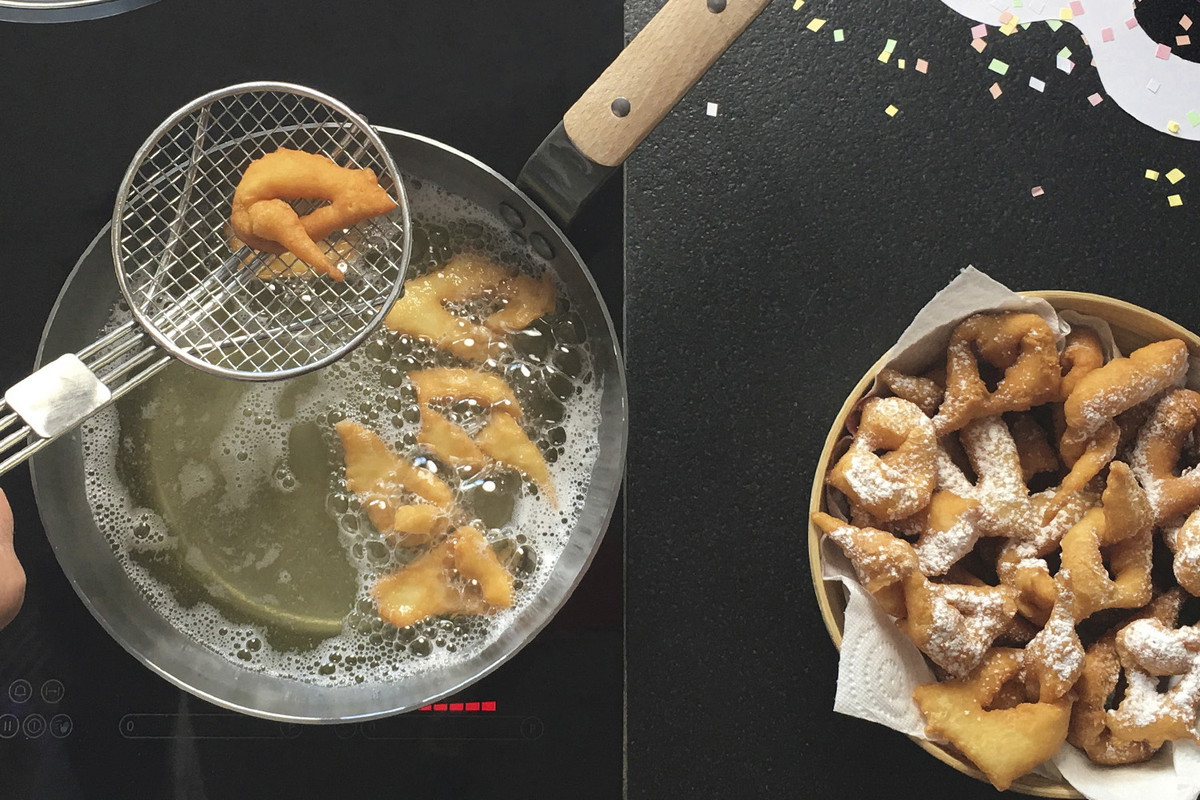
- After the resting time, start taking pieces of dough and shape the orejas. You can make small balls and roll them out very thinly with a rolling pin, or make thin strips about 3-4 mm thick and join the ends.
- Heat a good amount of mild oil in a saucepan or in a deep frying pan of iron.
- Fry the ears at 170 °C, turning them over halfway through cooking.
- As they are ready, remove them with a slotted spoon and place them on a cooling rack.
- Once cooled, dust with powdered sugar and serve them.
Enjoy your meal and a very happy Carnival!

Carnival Ears in an Air Fryer
Instead of using the fryer or traditional pan, you can also make them without oil in a oil-free air fryer. It's not the most traditional way to make them, but with this type of dough, the results in this kind of fryer are very interesting and suitable.
- Prepare the dough exactly as detailed above. After the resting time and once the orejas are shaped, place the orejas in the basket of your air fryer, brush them with oil and bake for about 6 minutes at 200 ºC. Remove them when they are golden brown.
- If you make the carnival ears flat (without the ear shape, just roll out the dough and make more cake-like carnival ears), they will cook faster in the air fryer, and in about 4-5 minutes they’ll be ready.
Notes
- It’s important to use a mild oil to fry the elephant ears (sunflower, for example). If we use a stronger oil, it will be the oil’s flavor that we notice when tasting them.
- You can shape them however you like, but the important thing is to make them as thin as possible, since that way they will turn out much crispier. It’s also common to see carnival ears stretched out, flat, cake-like, with only the corners lifted.
- The oil must be hot so that when you add the orejas, they fry well and come out crispy. It’s better to add them one at a time to keep the oil from cooling down (this can happen if you drop several in at once).
- It is important to leave let the dough rest, at least the indicated time, to allow the flour particles to hydrate.
- Flavor the dough however you like. The recipe calls for rum, but you can use anise or whatever liqueur you prefer—vanilla, cinnamon... Make it to your taste!
- As with anything, the secret is practice. So, to get ears in the shape you like best, I recommend making them many times. And tell me how it went!
- The most common thing is to sprinkle powdered sugar when serving, but you can also drizzle a little honey over them.
- You can eat them on their own, dipped in hot chocolate, with your favorite drink, or serve them with a shot of your preferred liqueur or sweet wine. What matters is that you enjoy them!


Comments
Claudia said:
Hola Carmen, gracias por tu aportanción! Ciertamente toma varios nombres, pero no las Ourellas do Entroido, y me animas a desubrir esa receta particular, investigaremos, gracias! :)
Claudia said:
Hola Ana María y Susana, gracias por preguntar! Hemos añadido el paso a paso con freidora de aire ahora en la receta, y lo veréis indicado en el texto, pero básicamente son unos 5 minutos a 200 ºC (pueden ser 4 minutos si estiras la masa, o unos 6 si formáis las orejas como tal y están algo más gruesas). En cualqueir caso , a la que veáis que están doraditas, las retiráis… y recordad pincelar las orejas con aceite para que queden crujientes y bien. ¡Gracias y a disfrutarlo!
Susana B said:
Excelente 😊 también estoy interesada en la versión para Air Fryer .. temperatura y tiempo.
Gracias y Feliz Carnaval 🥳
Carmen said:
Pueden ser hojuelas, orelletes, o beignets, pero esa receta no se corresponde con la receta de las Ourellas do Entroido gallego.
Carmen said:
Pueden ser hojuelas, orelletes, o beignets, pero esa receta no se corresponde con la receta de las Ourellas do Entroido gallego.
Ana María said:
Muchas gracias por la receta. Por favor, ¿Podrías decir temperatura y tiempo para freírlas en la freidora de aire?
Gracias!