
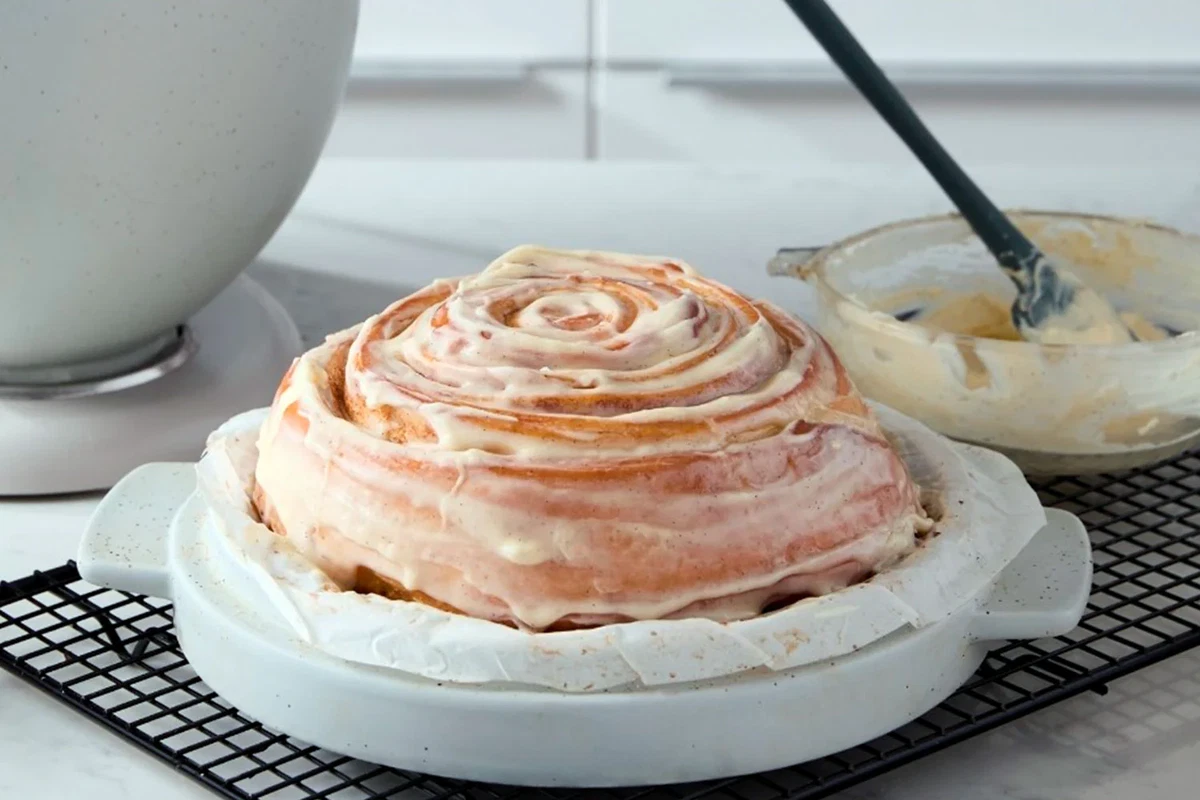
If you love cinnamon rolls with their delicious glaze and intense flavor, this Cinnamon roll bread will seem like a dream come true. One cinnamon roll, wrapped inside another roll that's wrapped in a third, and finally wrapped in a fourth and last one, forming a large cinnamon roll, perfectly baked, generously topped with a wonderful cream cheese and butter frosting and rounded off with the aroma and flavor of cinnamon. Could you ask for more? I don't think an answer is needed!
And if I also tell you that you can make it very easily, with almost no mess and using the same bowl to knead, to proof and to bake, I'm sure I've just convinced you to get your hands in the dough without wasting any more time, because an ally like the KitchenAid lidded bread bowl shouldn't be wasted. With it you can make your cinnamon roll bread from start to finish without having to change containers. And it's ideal for baking, because by simply turning it over you'll have a wonderful ceramic oven. Again I ask: could you ask for more? And again I say: I don't think an answer is needed!
Prepare the mixer, the bowl and all the ingredients, because with this wonderful Cinnamon roll bread recipe I'm bringing you today, you won't just enjoy it, you'll be a hit.

Ingredients
For the cinnamon roll bread dough:
- 125 ml warm milk
- 9 g active dry yeast (if using fresh yeast, you'll need 3 times more, that is 27 g)
- 15 g sugar + 50 g extra sugar
- 270 g all-purpose flour
- 1 large egg (room temperature)
- 1/2 teaspoon salt
- 60 g melted butter
- 60 g butter at room temperature
- 2 tablespoons warm heavy cream (minimum 35% fat)
For the filling:
- 100 g brown sugar
- 5 g ground cinnamon
For the glaze:
- 40 g butter at room temperature
- 60 g cream cheese (like Philadelphia)
- 1/2 teaspoon vanilla extract
- A pinch of salt
- 200 g icing sugar
- 15 ml cold milk (if needed
Method
- Fill the KitchenAid ceramic bread bowl with hot water and let it warm up a bit. This will help temper the bowl so the dough works better. When you feel it warmed, empty the water and dry it lightly.
- Pour the warm milk into the bowl along with the 15 g of sugar and add the yeast. Stir gently to combine and let rest for about 5 minutes (you can use a handheld whisk to stir).
- Place the bowl on your KitchenAid stand mixer and add to the previous mixture the extra 50 g of sugar, the flour, the egg, the 60 g melted butter and the salt. Attach the dough hook and knead at speed 4 for about 5-6 minutes, or until the dough is homogeneous and sticks to the sides of the bowl as it turns.
- Remove the bowl from the base of your mixer, turn the dough out onto the countertop and shape it into a ball. Lightly grease the inside of the bowl, place the dough ball inside and put on the baking lid. Let the dough rest for about half an hour, preferably inside the oven or in a warm place.
- While the dough is proofing, you can prepare the cinnamon roll filling and glaze.
- The filling is very simple: just mix the brown sugar with the cinnamon and set aside.
- Now prepare the glaze:
- Beat the 40 g of butter at room temperature with the cream cheese until well combined and smooth.
- Add the vanilla extract and the salt.
- Sift the icing sugar and add it to the cream, beating until incorporated. If you see the mixture is too thick, you can add a little milk to lighten it. It's ready! Set the mixture aside.
- Beat the 40 g of butter at room temperature with the cream cheese until well combined and smooth.
- After 30 minutes, lightly dust the work surface (just enough so it won't stick, but don't overdo it, because if you add too much flour the dough will slip and you won't be able to roll it properly). Place the dough on the counter and with a rolling pin roll it into a rectangle about 50 x 24 cm.
- Now spread the 60 g of butter at room temperature over the rectangle. Do it gently, using a pastry spatula, a silicone spatula or a rounded-tip knife.
- Sprinkle the sugar and cinnamon mixture over the butter, spreading it as evenly as possible.
- Cut the dough lengthwise into 4 strips more or less the same width (about 6 cm wide) and roll one of the strips tightly to form a compact roll.
- When you have it, place the rolled strip on top of one of the plain strips so the ends align (top and bottom), and roll the two strips together to form a new roll.
- Now place this thicker roll on another strip and roll the same way, as shown in the video. Do it once more, placing the roll on the fourth strip and rolling again. You will obtain a large dough roll.
- Cut a circle of parchment paper about 5 cm larger than the diameter of the roll and place it on the lid of the bowl.
- Make a small angled tuck at the end of the outer layer of dough so it tucks underneath the roll. This will prevent it from unrolling while proofing and during baking.
- Place the roll on the lid over the paper and cover the lid with the bowl. Let it proof a second time for another half hour.
- Preheat the oven to 200 °C.
- After the time has passed, remove the bowl and pour the two tablespoons of warm heavy cream over the surface of the dough roll. Pour carefully and slowly, trying to get it into the folds and not let it run down the sides.
- Cover the dough again with the ceramic container, ensuring the parchment paper stays completely inside, as it will help retain any filling that may melt during baking.
- Place the dough in the oven and bake for 35 minutes. Put the KitchenAid lidded bread bowl on the middle rack, but not touching the top of the oven. If necessary, move the rack slightly lower.
- After 35 minutes, uncover the dough and let it bake uncovered for a couple of minutes or until you see it has browned a bit.
- Remove the cinnamon roll bread from the oven and let cool for 10 minutes before adding the glaze. Enjoy!



Comments
Claudia&Julia said:
Hola Pilar,
La levadura seca o la fresca que usamos en la receta es, tal como indicamos, levadura de panadería. No se trata del tipo “Royal”, que es un impulsor químico. En cualquiera de los dos formatos (seca o fresca) la puedes encontrar en cualquier supermercado.
¡Un saludo!
Pilar said:
Qué es la levadura suca y la fresca?? Es la Royal?? Gracias
Claudia&Julia said:
Hola Helena,
Hemos revisado el vídeo y podemos verlo sin problema. ¿Es posible que pueda ser problema de tu dispositivo? Te dejamos el enlace a continuación, por si pudieras verlo desde allí:
https://www.youtube.com/watch?v=C1hiG5k9KS8&t=2s
¡Un saludo!
Claudia&Julia
Claudia&Julia said:
Hola Laly,
En este caso se añade fundida para que se integre antes, pero ciertamente es mejor pomada o a temperatura ambiente.
¡Un saludo!
Claudia&Julia
Claudia&Julia said:
Hola Lucía,
Es un error, que ya hemos corregido. La cantidad correcta son 9 g de levadura seca de panadería y si usas levadura fresca, necesitarás 3 veces más, es decir 27 g.
¡Un saludo!
Claudia&Julia
Lucía said:
Hola, Esto no es al revés? 9 g de levadura seca de panadería (si usas levadura fresca, necesitarás 3 g)
laly said:
Hola, no entiendo porqué añadís mantequilla fundida, se desnaturaliza. ¿no sería mejor pomada? gracias
Helena said:
hola, no veo el vídeo…