
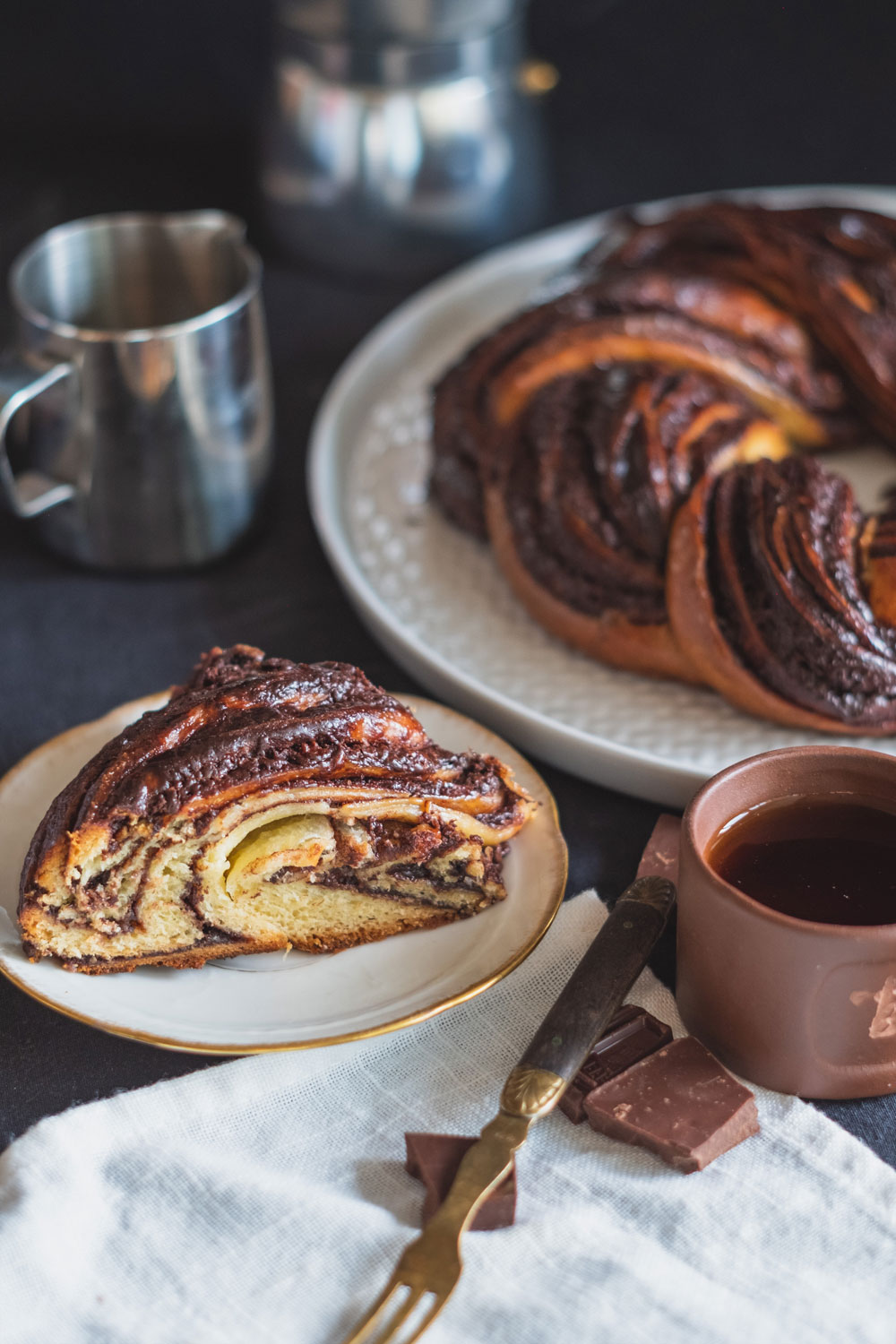
It is Easter tradition to make the Babka or Baba recipe, a fluffy braided rectangular or crown-shaped loaf made from a sweet fermented dough so delicious we enjoy it all year round. You’ve probably heard the word "Babka" recently or seen a "chocolate babka", because babkas are trendy and with good reason!
In the complete babka recipe we bring today, we tell you how to make a Chocolate Babka that is delicious and traditional, with detailed step-by-step instructions so you can make it confidently and resolving all doubts. It will turn out great!
You can already think about whether you want it rectangular or crown-shaped; in any case success is guaranteed.
What is a babka
The babka, bobka or baba is a braided, fluffy, fermented bun (it requires some kneading and baker's yeast), and it is a sweet dough originating from Eastern Europe.
It is traditional to prepare it at Easter, and it comes from eastern countries (it is very typical in Poland, Russia, Ukraine...), filled with chocolate or cinnamon.
The name babka means "grandmother" in several Slavic languages: the folds of the bun resemble those of a skirt.

Ingredients
Ingredients for the babka:
- 310 gramos de harina de trigo de todo uso (y 2 cucharadas más)
- 35 gr de azúcar (unas 2 cucharadas)
- 5 gr de levadura seca de panadero (o 15 gr de levadura fresca)
- 1¼ cdta de sal (unos 3,5 gr)
- 60 ml de agua (más 1 cucharada aparte)
- 60 gramos de mantequilla sin sal (¼ de taza)
- 60 ml de leche entera
- 1 cdta de extracto de vainilla
- 2 huevos XL, a temperatura ambiente
- Relleno de chocolate (la receta a continuación)
- 50 gr de chocolate de repostería (de 65-70% cacao mínimo), troceado
- Jarabe de azúcar simple (la receta a continuación)
Ingredients for the chocolate filling:
- 65 gr de chocolate negro 70% cacao
- 45 gr de mantequilla din sal (unas 3 cucharadas)
- 30 gr de azúcar glas
- 3 cdas (unos 15 gramos) de cacao en polvo
- ½ cucharadita (1,5 gramos) de sal
Ingredients for the syrup* (simple sugar syrup):
- 35 gr de azúcar (unas 3 cucharadas)
- 30 ml de agua (2 cucharadas)
*With this amount you get 3 tablespoons of syrup. You can double the quantities if you want to drizzle more syrup, or add half a tablespoon more water if you want it a bit more liquid.
Preparation
Step by step to make the babka:
Preparing the chocolate babka dough:
- In a bowl, mix 125 gr of the flour, the sugar, the yeast and the salt. Set aside. Note: if you have a KitchenAid stand mixer, make this flour mixture in the mixer bowl.
- Put a small saucepan over low or medium heat and heat the water, butter, milk and vanilla, stirring with a spatula while it warms, until it reaches 50 ºC. Let it cool a few degrees for a few minutes and add that butter mixture to the reserved bowl with the flour (or to the KitchenAid bowl if you have one).
- Use the paddle attachment to mix at medium-low speed until you get a homogeneous mixture.
- Add 1 of the eggs and beat until incorporated.
- With the mixer on low speed (or while stirring by hand), gradually add the rest of the flour (the 185 gr remaining), beating at speed 4-6, until incorporated, stopping to scrape the sides occasionally.
- Once you have a homogeneous dough, switch to the dough hook. Note: the dough hook is the attachment used for kneading; if doing it without a mixer it's time to take the dough out of the bowl and place it on a floured surface to start working it.
- Knead at speed 4 for a good while, until a soft and slightly sticky dough forms (5 to 7 minutes), stopping every few minutes to scrape the bowl and the hook. If the dough is very sticky, add the remaining 2 tablespoons of flour (first one, and if after integrating and kneading it still needs it add the second, about 8-10 grams each time).
- Once the dough is ready, pour it onto a lightly floured surface and using your hands shape it into a ball.
- Lightly grease a large bowl with oil and place the dough inside. Cover with a cotton cloth and leave it in a warm, draft-free place until it doubles in size, about 45 minutes.
- Once risen, transfer the dough to a very lightly floured surface (I like to use the Nordic Ware tray for this because it is very large and I don’t dirty the countertop), and press and stretch the dough to get a rectangle of about 20 cm x 15 cm. Place a piece of plastic wrap previously greased with oil loosely over the dough, not pressing it. Leave it at least an hour in a cool place (you can leave it in the fridge overnight, to finish and bake in the morning).
Filling and Shaping the chocolate babka:
- When you are ready to prepare the babka, remove the tray from the refrigerator and let it come to room temperature for 15 minutes.
- Meanwhile, prepare the tray or pan where you will bake the babka: grease the surface of the pan with butter or simply apply a layer of baking spray.
- NOTE: You must decide whether you want to make a ring-shaped babka or a rectangular one:
- If making a ring-shaped babka, you can use a perforated tray (like the Le Creuset Pizza pan, or a De Buyer perforated tray) or, as in our case today, the base of the Le Creuset bread oven.
- If you want to make a rectangular babka (a chocolate braid), you will need to prepare a rectangular pan of about 30 x 12 cm. You can use the Le Creuset pan or the Emile Henry ceramic pan

Le Creuset bread oven and Emile Henry ceramic pan
- Prepare the chocolate filling (recipe below).
- Preheat the oven to 180 ºC.
- On the same tray or floured surface where you have the dough, roll the dough into a rectangle In a lightly floured surface, roll the dough into a rectangle of 30 x 25 cm (and 5 or 6 mm high).
- With an offset spatula, spread the chocolate filling over the dough, leaving a half-centimeter border on the two short sides and one long side (that is, you only need to bring the chocolate all the way to one of the long sides).
- Scatter the chopped chocolate over the entire surface.
- Now, you must roll the dough. It should be done along the long side, rolling toward the other long side, obtaining a long thick cylinder. To ensure it doesn't unroll, pinch the dough with your fingers, joining the final edge with the bottom dough (sealing the dough and preventing the cylinder from opening).
- Place the seam you closed facing down but not centered, rather to one side. Now, with the help of a sharp knife or a bench scraper, cut the roll lengthwise down the middle but leave the end joined (thus obtaining two long strips joined by the dough at the top).
- Twist the halves so the cut side faces up (so the layers of dough and chocolate are visible on top). Now, cross them forming an "X", and cross again (in short, braid the two strips of dough you have, keeping the cut layers facing up).
- Your babka is now shaped! Now:
- If you make a rectangular babka: Place it in the rectangular pan you prepared, making sure to keep the cut sides facing up and the ends tucked in, so it looks neat. Cover and let it rise at room temperature (ideally about 24 °C) for about 30 minutes to 1 hour (the babka should grow).
- If you make a ring-shaped babka: Place the braid you formed on the prepared tray, forming a circle, and join the ends, interlacing and pinching the point where the ends meet. Let the dough relax again, covering the babka with oiled plastic wrap, for half an hour to an hour.
- In a small bowl, mix the reserved egg and a tablespoon of water (15 ml), and brush the babka with a pastry brush.
- Place it in the oven for about 45- 50 minutes, until it is golden and shows an internal temperature of 90 ºC. If you notice it’s cooking too quickly on top, cover it with aluminum foil when using a rectangular mold or baking sheet, or put on the casserole lid if you’re making it in the bread casserole (in fact, you can bake the babka covered from the start in the casserole; it will rise more gradually).
We cover with the simple sugar syrup:
- In a small ceramic bowl, mix the 35 gr of sugar and the 2 tablespoons of water. Heat in the microwave or on high heat in a small saucepan, in 15-second intervals. Stir at each pause, and repeat until the sugar is completely dissolved. Let it cool until it is practically warm before applying to the babka.
- When the babka is done, remove it from the oven and brush it immediately with the syrup you prepared.
- Let the pan or tray cool for about 10 minutes, unmold and place it on a cooling rack until completely cool.

Preparing the chocolate filling:
- In the microwave: place the butter and the chopped or chopped chocolate in a bowl and heat in the microwave for one minute. Remove and mix well; the melted butter will help finish melting the chocolate, or if needed return to the microwave for another 10 or 20 seconds. When completely melted and still very hot, add the confectioners' sugar, cocoa and salt until you get a smooth texture. Let it cool at room temperature.
- Bain-marie: In a bain-marie saucepan, add the chopped chocolate and butter and melt until you obtain a homogeneous, smooth and glossy mixture. Add the sugar, cocoa and salt and keep stirring until everything is integrated. Remove from the heat and let it cool to room temperature before using.
Notes on preparing the babka:
- I use the oven to let doughs rise. You just have to leave the oven at about 50 degrees for 5-8 minutes and then turn it off. Then put the bowl with the dough inside, covered with the damp cotton cloth (with the cloth over the bowl, not touching the dough). It's a good trick to keep the dough in a warm place and rise quickly.
- As you can see, what will determine the recipe's time is the dough rising time. The colder the place, the longer it will take to rise.
- This babka is also delicious with hazelnuts. You just have to add crushed hazelnuts spread over the dough surface when you spread the chocolate (at step 18, in addition to the chocolate you can also add the hazelnuts).
- Cinnamon babka is also traditional. You can simply add cinnamon in the center or add cinnamon and hazelnuts, or a hint of cinnamon to your chocolate babka.
Served with a coffee or a cup of hot chocolate, I assure you this babka is the best for breakfasts and snacks. I hope you enjoy it a lot (many times).

Note: If you want to make a chocolate braid with enriched dough, I invite you to see this one we have on the blog.


Comments
Claudia&Julia said:
Hola Cristina,
Realmente, es una excelente opción para el día del chocolate. Lo sentimos, pero esa fuente no la tenemos actualmente en nuestro catálogo. Por si pudieran ser de tu interés, te dejamos enlaces a otras fuentes redondas de cerámica o porcelana:
https://claudiaandjulia.com/products/fuente-para-servir-de-porcelana-arezzo-la-porcellana-bianca?variant=57301971861829
https://claudiaandjulia.com/products/plato-de-gres-sappihire-dutch-rose?variant=46363716780357
https://claudiaandjulia.com/products/plato-ceramico-para-hornear-y-servir-madeleine-emile-henry?variant=57255496384837
¡Saludos!
Cristina Crespo said:
Gracias por la receta. Se ve espectacular para hacerla el día internacional del chocolate.
Me gustaría saber de qué marca es la fuente texturizada en la que se presenta.
Muchas gracias
Claudia&Julia said:
Hola Fernanda,
Las cantidades indicadas son las correctas; no obstante, puedes poner menos gramos de sal si lo prefieres, para que sea más a tu gusto :)
¡Un saludo!
Fernanda said:
Es demasiada sal para el relleno.
Desde que vi las cantidades se me hizo un exceso, pero decidí confiar en el proceso… resulta que no, terrible. Yo creo que debe ser máximo ¼ cta, y se me sigue haciendo mucho para esa cantidad (ej. para el betún de un pastel doble de 8 pulgadas uso solamente ⅛ cta y si acaso aguanta ¼ cta rasa).
Claudia&Julia said:
Hola Daniella,
Lamentamos el malentendido y que pudiera perjudicar el resultado final. Comentarte que la temperatura a la que se indica que se ha de precalentar el horno (180ºC) es la temperatura a la que se hornea durante 45-50 minutos, hasta que esté dorado y, cuando se compruebe la temperatura interior del babka, esta sea de 90 °C (puedes comprobarla introduciendo la sonda del termómetro de cocina).
Te animamos que pruebes de nuevo la receta, el resultado vale mucho la pena :)
¡Un saludo!
Daniella said:
Hice la receta, todo bien hasta la hora del horneado, coloca que son 90 grados por 50 minutos y eso no es suficiente. Todo el tiempo que tardé en que elevara la masa se dañó por ese error de los grados. Corroboré con otra receta en línea y decía 190. Pésimo que escriban y no lean de nuevo
Anca Mihaela Tabaranu said:
Hola! También es un dulce tradicional en Rumanía y se llama ‘cozonac’. Yo el otro día he hecho el pan vienés de vuestra página, me ha salido espectacular. Lo hemos comido como un pan quemado, de hecho he pensado que es la misma receta. Estoy pensando hacerlo otra vez y ponerle el relleno típico de cozonac – babka: cacao, azúcar, nueces, canela. Y creo que saldrá divino. Gracias por vuestras recetas.
Claudia said:
Feliz de que te guste, Isabel. Sí te animas a hacerla, verás qué riquísimo resulta! Un abrazo
Isabel said:
Maravillosa receta,mil gracias!!!!!!