

Back to the cold, back to the oven! I find it a wonderful ally in the kitchen, because it lets me stop worrying about the stove and the result is always fantastic. And this onion tart is good proof of that — you'll see why in a moment!
This delicious tart has a crunchy pastry base and a filling of caramelized onions with eggs and milk. In the pure style of a quiche, the tart combines all the ingredients perfectly, resulting in a delicious and versatile dish to enjoy as an appetizer, starter, or main course, and that you can serve hot or at room temperature whether at home or on a picnic.

The main star of the tart is the onion. It should be cooked slowly in butter, letting time do its work and turn it into an ingredient with a completely different flavor and aroma. The onions become soft and sweet, creating a wonderfully caramelized flavor. When everything is baked together (pastry, onion, and the rest of the ingredients), the miracle happens without doing anything else and the result is a dish where the creamy filling contrasts wonderfully with the crunchy texture of the pastry.
Just imagining it makes my mouth water! I'm leaving the recipe so you can prepare this delight.
Ingredients
For the caramelized onions
- 500 g of onions
- 50 g of butter
- Salt and ground pepper
For the pastry
- 250 g of wheat flour
- 125 g of unsalted butter
- 7 g of salt
- 7 g of sugar
- 10 g of egg yolks
- 30 g of whole eggs
- 60 g of milk
For the filling
- 250 g of whole milk
- 250 g of heavy cream
- 40 g of egg yolks (or 2)
- 180 g of whole eggs (or 3)
- Salt and ground pepper
Preparation
For the pastry
- Put the flour and butter in the bowl of the KitchenAid mixer and mix well with the paddle attachment at low speed.
- Dissolve the salt and sugar in the milk and add them to the mixture.
- Next add the whole egg and the egg yolk and mix until incorporated and the dough looks smooth.
- Roll out the dough with a rolling pin between 2 sheets of baking paper until it is 3 mm thick. Let the dough rest in the refrigerator for 30 minutes.
For the caramelized onions
- Peel and finely slice the onions with a knife or with a kitchen mandoline.
- Sauté the onions with the butter over low heat, covered, for 20 minutes without letting them brown.
- When done, let cool and set aside.
For the filling
- Put all the ingredients indicated above for the filling into the bowl of the hand blender (or a countertop blender).
- Add salt and pepper to taste.
- Blend until homogeneous, without moving the blender too much to avoid incorporating air.
Line the pan
- Prepare a removable pan on the countertop, or place the perforated baking tray with baking film, and a tall round ring in the center. Remove the dough from the refrigerator.
- If you want a tart with a rustic, imperfect finish, you can lay the dough as is in a removable pan: simply place it on the base and press the sides so they cling to the pan walls. You can cut off the excess dough or fold it inward.
- If you want a more uniform, perfect finish (as we did), place the rolled-out dough on the perforated tray, and cut two strips about 5 cm wide. With the same round ring, cut the dough into a disk that will go on the base, 20 cm in diameter.
- With the ring in the center of the baking tray, place some strips of baking paper on the sides (you can slightly wet the ring so it adheres).
- Then, place the strips of dough inside the ring, pressing to adhere them to its sides.
- Then place the dough you cut into a circular shape in the center of the ring, in contact with the tray. Press lightly to attach the ends of the dough to the sides you placed previously.

Filling the tart
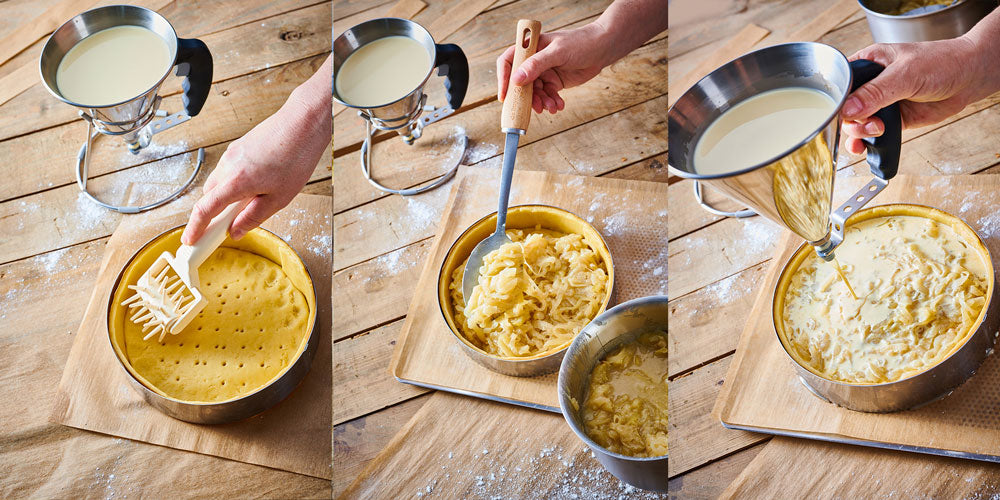
- Prick a few holes in the base of the tart with a fork.
- Place the caramelized onions in the center of the dough, in the pan. Spread them to fill the entire interior.
- Add the filling mixture you have pureed previously (the measuring funnel offers great possibilities).
Baking the tart:
- Bake in a preheated oven at 220 °C for 20 minutes on a middle/lower rack of the oven.
- After that time, lower the temperature to 170 °C and bake for 30 more minutes.
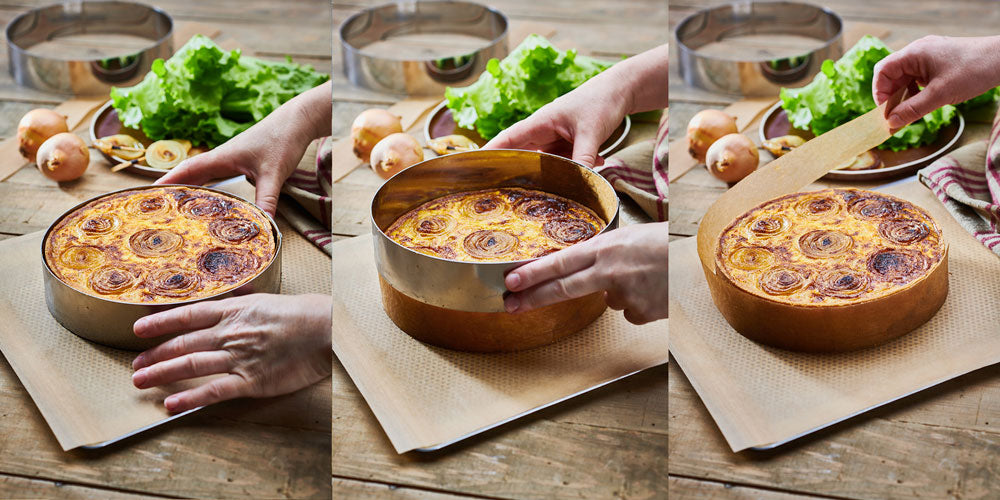
- Remove the tray from the oven and place on a cooling rack. When it has lost heat and feels warm to the touch, remove the ring (or the removable pan if used).
Notes
- The onion tart lends itself to endless variations. Don't hesitate to add the ingredients you like to give it different flavors. Play with cheese, fresh herbs, spices, chopped ham, a bit of sobrasada or crumbled blood sausage... you decide!
- You can bake the tart in a high-sided round pan or also make it in a ring by placing a bit of baking paper on the base.
- You can also make it in small rings and present individual or single-serving tarts. Besides being very cute, you'll reduce the oven cooking time.
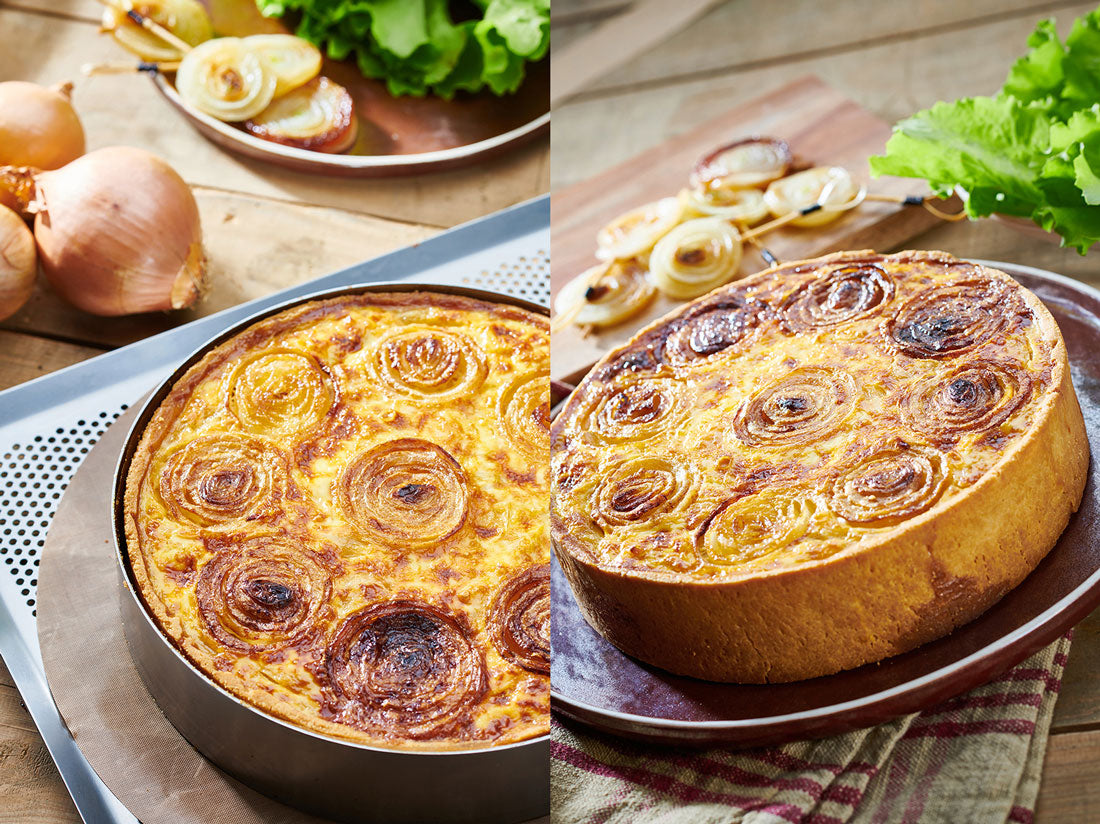
- Serve the tart warm or hot — it's good both ways! Paired with a fresh salad it's a perfect dish.


Comments
Claudia&Julia said:
Hola Eugenia,
Hemos revisado la receta y la cantidad de huevos es la correcta. Esperamos que te guste el resultado ;)
¡Un saludo!
Eugenia said:
Y la cantidad de huevos es la correcta?
Gracias
Claudia&Julia said:
Hola Juana,
Muchas gracias por tu aportación, es muy interesante. En realidad, la receta no lleva 500 g de mantequilla, sino 50 g. Era un error que ya hemos corregido.
Saludos y felices fiestas :)
Claudia&Julia said:
Hola Isi,
Había un error en la cantidad de mantequilla indicada en la receta; son 50 g y no 500 g, por lo que no es necesario escurrirla. En caso de que fueran 500 g realmente lo ideal es escurrirla.
Muchas gracias por tu comentario y felices fiestas :)
¡Un saludo!
Claudia&Julia said:
Hola Carlos María,
Tienes razón, 500 g de mantequilla es una barbaridad. Por suerte, la receta no los lleva; son 50 g. Ha sido un error de transcripción que ya hemos corregido.
Muchas gracias por avisarnos y felices fiestas :)
¡Un saludo!
Juana said:
Yo sustituyo a menudo la mantequilla por aceite, el resultado suele ser excelente si ajustas las cantidades. Por ejemplo ayer hice un bizcocho relleno para cumpleaños y sustituí la mantequilla, normalmente 300 g/ para 300 g harina/ 300 g azúcar por 50 gramos de aceite de oliva virgen, y para suavizar el sabor del aceite añadí una cucharada de extracto de almendras y otra de canela en polvo. Quedó excelente. Si seguimos esta proporción (he probado varias veces) para 500 gramos de mantequilla se podrían usar 85 gramos de aceite. Será cosa de probar.
Isi said:
Las cebollas se escurren cuando se sacan de la mantequilla, al menos yo, lo haría
Carlos María said:
Buenas tardes
La receta tiene una pinta espectacular pero….. ¡500 gramos de mantequilla!!!!! ¿acabaremos en urgencias con las arterias obstruidas?
Gracias