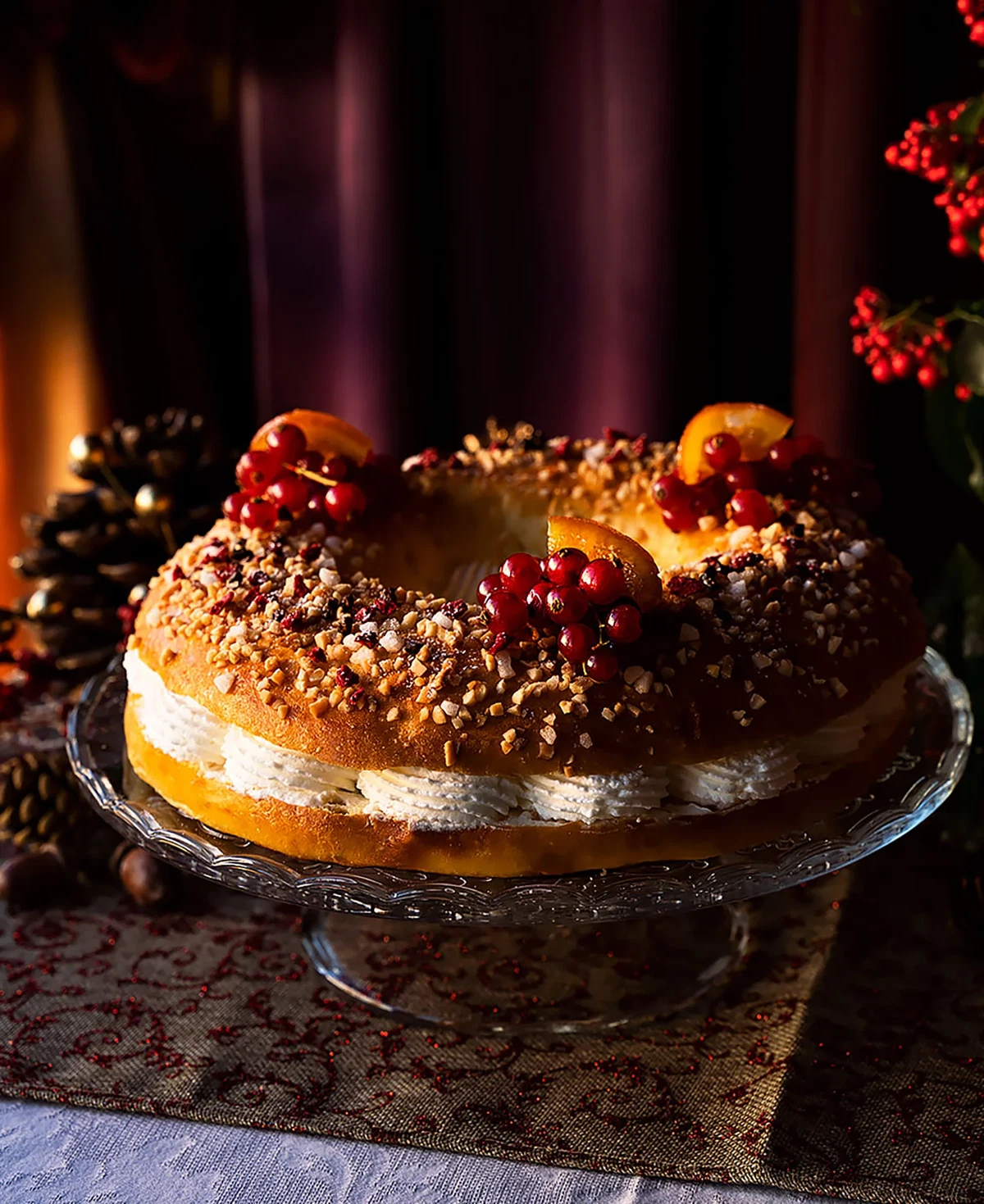
At Christmas we can enjoy a wide variety of sweets; in fact, it could be considered the sweetest time of the year for that very reason. But if there is a star sweet at this time of year it is, indisputably, our beloved Roscón de Reyes.
A fragrant sweet bread of which we can find countless recipes and variations to make it, although they all have several things in common: orange blossom water, citrus zest and its peculiar decoration with almond, pearl sugar and/or candied fruit.
It is true that nowadays there are very different and daring roscones, inspired by many other preparations. But for those who prefer classic and traditional tastes, today we can enjoy the original recipe, so to speak.
Origin of the roscón de Reyes
This type of sweet bread dates back to Roman times and, it seems, was present in the "Roman Saturnalia." These were important Roman festivities also known as the "Feast of the Slaves." During this celebration, slaves received extra rations, time off and other benefits.
The name of this celebration comes from honoring Saturn, god of agriculture, and it was also a tribute to the victory of a triumphant general. They were celebrated from December 17-23 to mark the end of the year's dark period, decorating houses with plants and candles, and gifting clay figurines. From December 25 the arrival of the sun was celebrated.
Probably, the Saturnalia were the festivals marking the end of field work, celebrated after the completion of winter sowing, giving time to rest from daily toil. Later the Church aligned those dates with the birth of Jesus of Nazareth in order to put an end to the old celebrations.
For these festivities rings made of dates, figs and honey were prepared and distributed equally among slaves and commoners. In the 3rd century, the custom arose of inserting a dried bean and the lucky one who found it was named “King of Kings” for a short period of time.
The recipe we will see how to prepare today is based on the traditional way of making it, even with its majestic whipped cream filling (which is not mandatory, of course). To break a little from the classic and usual aesthetic, when decorating I decided to use some fruits like currants, which will provide a slight acidic and fresh touch, and caramelized freeze-dried raspberry.
The freshness and acidity typical of these fruits combine very well with the sweet and fruity flavor of the roscón. Additionally, they allow us to give it an elegant and eye-catching decoration that helps break a little from the usual look.

Ingredients (for one large roscón or two medium)
For the preferment
- 150 g strong wheat flour (W=300)
- 100 g whole milk at room temperature
- 3 g dry yeast or 9 g fresh yeast
For the dough
- 550 g strong wheat flour (W=300)
- 140 g whole milk at room temperature
- 3 g dry yeast or 9 g fresh yeast
- 2 large eggs (110 g)
- Zest of two oranges and one lemon
- 130 g unsalted butter at room temperature
- 35 g orange blossom essence (not concentrated; if so, use less)
- 15 g aged rum
- 1 vanilla pod (the seeds)
- 200 g sugar
- 10 g salt
To decorate
- 1 beaten egg
- Chopped or sliced almonds
- Pearl sugar
- Candied orange
- Fresh currants
- Caramelized freeze-dried raspberry (optional)
- Caramelized cacao nibs (optional)
- Icing sugar for dusting
For filling (quantity for 1 medium roscón)
- 600 g heavy cream for whipping
- 120 g sugar
- ½ vanilla pod (optional)
Preparation
Prepare the preferment
- In a bowl add the milk at room temperature together with the yeast and the flour.
- Mix well with a spoon until homogeneous. Once the ingredients are more or less combined, move to a clean work surface and knead until you obtain a finished dough that is more or less smooth and uniform. It is not necessary to knead for a long time.
- Form a ball, place it in a bowl, cover with cling film and let rise until it doubles in size. This will take around 2-3 hours at about 21ºC.
Prepare the roscón de Reyes dough
- Once the preferment is ready and fermented, proceed to prepare the dough for the roscón.
- Wash the lemon and oranges well with water. Dry with kitchen paper and, with the help of a grater, zest without reaching the white part (this would give a slight bitter taste). Set aside.
- In a KitchenAid bowl add the flour together with the chopped preferment, the yeast, the milk, the eggs, the orange blossom and the liqueur. Mix with the hook until you achieve a more or less homogeneous dough.
- Add the sugar in 3 batches. Add the first portion while kneading and wait for it to incorporate completely. Repeat this same process with the rest of the sugar.
- Add the salt together with the zests and the vanilla seeds, knead again to distribute evenly throughout.
- Once the gluten has developed (remember to check it with the windowpane test*), add the butter. Do this little by little, waiting for it to integrate completely into the dough before adding the next portion. We must be patient.
- Once the butter has fully integrated, you will obtain a smooth, supple and shiny dough.
- Grease a container with oil and place the previously rounded dough inside. Cover with its lid or with plastic film and let rise for 4-5 hours at about 21º-22ºC.
- The fermentation time is indicative; always remember that it should double in volume.
- If you want to split the process into 2 days to make it easier, once the dough has increased by ⅓ of its volume, store it in the refrigerator until the next day.
*NOTE: To do this take a portion of dough after a short rest once kneading is finished, or by stretching a bit of it, and slide between the fingertips. If you can see a thin veil, the gluten is ready. If the dough breaks or tears irregularly, you will need to knead a little more to finish developing the gluten. If, when stretching the dough, a tear forms in the veil creating a perfect circle, this also indicates that the gluten is well developed.
Divide and pre-shape the roscón
- If you decide to retard the dough in the fridge, bring the dough to room temperature 2 hours before proceeding to pre-shape and shape the roscones.
- If making two roscones, turn the dough onto a work surface lightly dusted with flour and divide into two equal pieces. If making only one roscón, pre-shape without dividing the dough.
- Turn the dough out onto a work surface lightly dusted with flour and degas very gently. Divide the dough into two equal pieces and pre-shape. To pre-shape dough, take the ends of the piece and bring them to the center. Turn the piece over and round into a ball.
- Cover with cling film and let rest for 20 minutes.
Form the roscones
- Prepare two perforated baking trays and line with silpat, baking mat or parchment paper.
- Lightly grease your hands with oil and shape the roscón.
- Insert your fingers into the center of the piece to create a hole. Lift the dough into the air and twist to enlarge it. Be careful when handling it and try to maintain the same thickness throughout the piece.
- Leave a wide hole in the center, since after proofing and baking it will shrink considerably.
- Insert the surprise wrapped in film (if you choose to do so) through the underside of the roscón and seal with dough. Do the same with the bean.
- Cover with cling film and let rise for 5-6 hours at 21º-22ºC, it should double in size or even a little more.
 De Buyer baking mat
Bake the roscón de Reyes
- Preheat the oven to 180ºC with top and bottom heat.
- Beat the egg and brush the surface of the roscón very gently with a T&G pastry brush.
- Sprinkle the surface with chopped almond and pearl sugar.
- Place in the oven on the central rack and bake for 14-15 minutes if dividing the dough into two roscones or 23-24 minutes if baking a single large piece.
- To check it is done, insert a digital thermometer into the roscón; it should read 96º-97ºC.
- Remove from the oven, place on a rack and let cool completely.
 T&G pastry brush and De Buyer baking mat
Whip the cream to fill the roscón de Reyes
- The cream should be chilled for at least 24 hours.
- The bowl where you whip the cream must be cold.
- Pour the cream into the cold bowl along with the vanilla seeds.
- Start whipping with the whisk at speed 1.
- Increase the speed gradually but never reach the maximum. The ideal is a medium-high speed.
- When it begins to thicken, add the sugar. Do this little by little while the whisk continues whipping until you obtain a very firm cream. Be careful not to overwhip it or you'll make butter (if this happens, there is no fix).
- Transfer the whipped cream into the De Buyer cream whipper fitted with a star nozzle and fill the roscón.
- Turn the wheel of the whipper, located just at the base of the handle you press, so it allows a longer dispensing.
Fill and finish decorating
- Using a serrated knife, cut the roscón in half lengthwise.
- Pipe the whipped cream with the De Buyer whipper across the roscón surface. You will need to refill the whipper twice because the amount of cream exceeds its capacity.
- Place the other half of the roscón on top of the cream.
- Decorate the surface with fresh currants, candied orange quarters, freeze-dried raspberry and caramelized cacao nibs and, finally, dust very lightly with icing sugar.
- Serve.

***** NOTES *****
- It is important to keep in mind that not all flours behave the same way. If using a flour with greater or lesser strength, the formula will change. If you use a flour with strength W=200, you will need to adjust the amount of liquids for a good result. Reduce them slightly. If using a stronger flour, you may need to increase that amount a bit.
- Wholemeal flours behave differently, both when handling the dough, ingredient amounts, kneading and fermentation. Also, the final result will not be as tender and fluffy as if made with white flour.
- Each gram of dry yeast equals 3 grams of fresh yeast.
- You must knead well to develop the gluten and achieve a good structure in the crumb.
- It is very important to respect all resting and proofing times to obtain a good result.
- If when shaping the roscón the dough contracts trying to return to its initial state, it is because the dough is tight. Cover with cling film and let rest 5-10 minutes before shaping the roscón again.
- Respecting fermentation times is very important to achieve a good final result, as well as good aroma, flavor and fluffiness. If our roscones split during baking, it is because they lacked final proofing time.
- Decoration is completely optional; you can decorate it however you like.
- The De Buyer whipper allows us to pipe the cream very cleanly while controlling the pressure well. This ensures that the dispensed amount is always the same. Also, we don't waste any whipped cream thanks to the piston that descends each time we press. In my case I used a star nozzle, but you can use another model from the many available.
- If you don't have pearl sugar, you can moisten some sugar with orange blossom water and place it on top just before baking the piece.
- The roscón keeps in perfect condition for 3 days wrapped in cling film. If filled, it can be refrigerated for 3-4 days well wrapped in film to prevent the cold from drying the crumb.

We hope you have a wonderful and magical Epiphany night! Don't forget to leave Their Majesties from the East a good plate with cookies or sweets and milk, although they will surely spoil you even more if you leave them some pieces of Roscón de Reyes made by you.