

Today Miriam, author of The Winter Guest, nos brings a recipe to make delicious croquettes at home. I encourage you to make them; with its tricks and tips, they will undoubtedly turn out perfect.
Croquettes are a classic that adults and kids alike enjoy, and these chicken and ham croquettes are no exception; it's rare to find a specimen that doesn't like them, though it takes all sorts…
How are they a dish a bit laborious there aren't that many people left willing to sweat buckets preparing the dough and shaping croquettes one by one. Those of us who still dare to take them on are highly sought-after, ahem.
That's why any little help in the croquette-making process is welcome. This is where a croquette maker like the Millecroquettes, that speeds up forming or molding by being able to shape the dough into three long cylinders with a single lever stroke: it cuts shaping time to a third. Or almost. Plus, you get uniform, well-formed croquettes, of course.
Croquettes are the leftover dish par excellence, they take a wide variety of add-ins. In cooler times than this, I use the chicken or hen from the stew to add to the croquettes. In this case I also added cooked ham to give it an extra touch of flavor. The combination is fantastic and the kids love it.
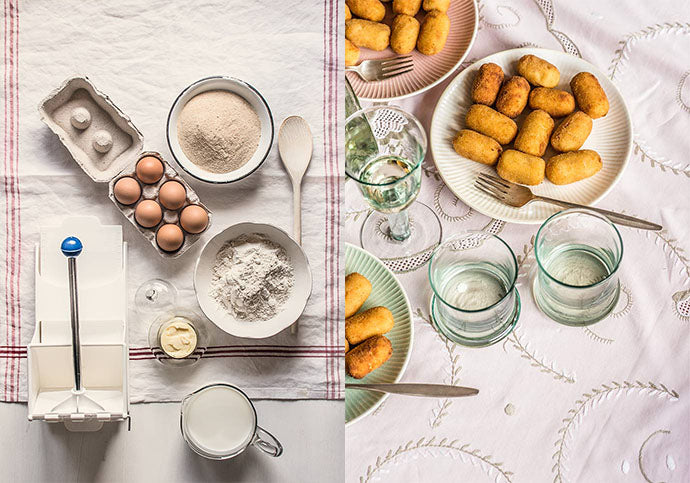
Millecroquettes croquette maker, Textured plate by Tokyo Design and Mediterránea glasses
Ingredients
- 1,1 liters of whole milk
- 2 tbsp. butter
- 2 tbsp. of olive oil
- 120gr of all-purpose flour
- A touch of nutmeg
- 150gr of cooked chicken (can be leftovers from a roast, a stew, etc.)
- 100 g of cooked ham
- Salt to taste
- Breadcrumbs and beaten egg for breading
- Plenty of olive oil for frying
Production
- In a large frying pan, we melt the butter and add the oil.
- When the butter begins to bubble, add the flour and stir well with a wooden spoon until you get a sandy mixture.
- We toast this mixture for 3-4 minutes to remove the raw taste from the flour and add half of the milk.
- Stir well, breaking up all the lumps. As soon as it starts to come together and thicken, keep adding more milk while continuously stirring, until you’ve added it all.
- If we have any lumps left, we put in a immersion blender and whisk the mixture a little.
- We season with nutmeg.
- We continue cooking this thick béchamel so it continues to thicken. The exact point of thickness isn’t easy to nail when you’re starting out in the science of croquettes, in theory A croquette mixture at the right consistency should start to come away from the side of the pan.
- When the dough is almost ready, finely chop the chicken and ham and add them, distributing evenly.
- Add salt and taste for seasoning, since the ham also contributes some salt. Adjust if necessary, turn off the heat, and pour the mixture into a shallow dish so it cools faster. To keep a hard skin from forming, cover it with plastic wrap or brush it with butter. Let it cool completely and, if you have time, it’s best to then leave it in the fridge overnight so it sets well.
- To form the croquettes, we put in the Millecroquettes half of the dough we’ve prepared and we place the tray with wheels under the machine, with the end almost under the tubes. I prefer to sprinkle this tray with breadcrumbs so nothing sticks. We can also grease it with oil.
- We lower the lid with the machine’s lever, applying some force to push out the dough cylinders. The dough itself moves the tray forward until it covers the entire length. We cut the cylinders flush with the machine’s tubes, place them on a dish filled with breadcrumbs, and proceed to cut them into portions of whatever size we like. We can also cut the dough on the tray itself using the evenly spaced marks on it.
- We proceed in the same way with the remaining half of the mixture. In two batches, we have all the croquettes shaped.
- Coat well in breadcrumbs, then in beaten egg, and finally again in breadcrumbs. Place the well-coated croquettes on a tray.
- To fry them, we heat plenty of oil, enough to cover them, in a small frying pan or stainless steel saucepan, up to about 176°-179°. Yes, I measure the temperature with a thermometer at all times, because an appropriate frying temperature helps prevent the croquettes from bursting.
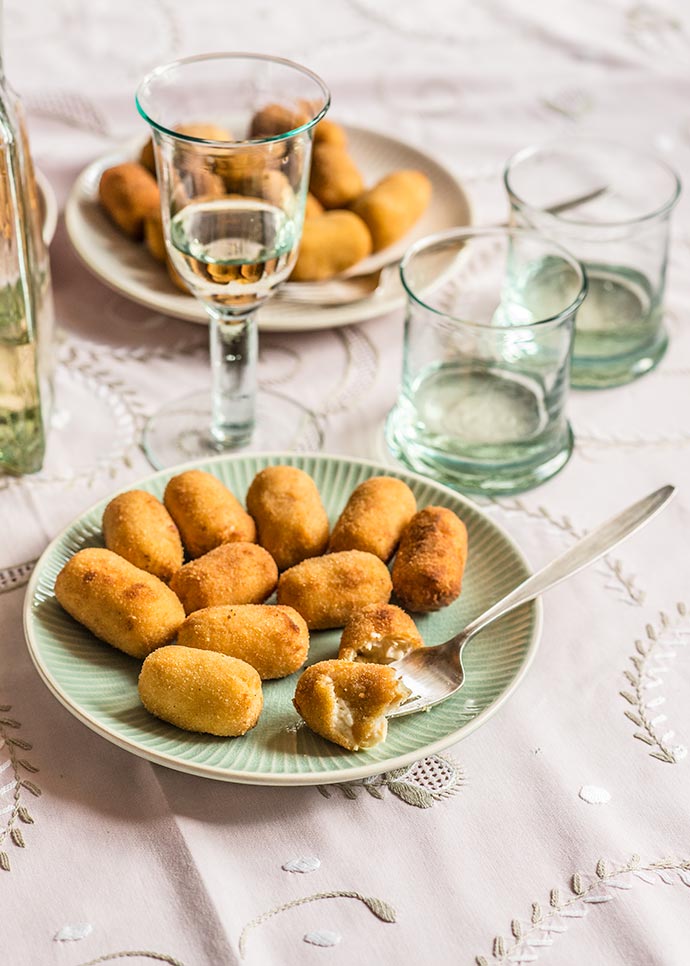
Glasses and Mediterránea glasses and Tokyo Design Studio Textured Plate
Tips for perfect homemade croquettes
Aside from shape and bread with care the croquettes, the following points should be taken into account:
- Better to fry in a good olive oil and without exceeding 180° because otherwise it starts to burn.
- Never put the croquettes before the oil has reached its operating temperature. Yes, I'm a geek about the kitchen thermometers, but once you get used to controlling the temperatures there's no guesswork: you always play it safe.
- I like very fine breadcrumbs. With a good blender at home, you can make breadcrumbs to your liking.
-
So the croquettes don't explode is fundamental:
- Make a dough that's firm enough, but won't break a tooth. I know, this isn't trivial; it takes practice.
- A proper frying oil temperature, as I mentioned before.
- To make sure I I let the croquettes dry a little on a cooling rack after shaping them. Having the breading a bit firm helps keep the filling inside. No, it doesn’t turn out coarse because I make it with fine breadcrumbs, as I said before.
You’ve run out of excuses for not making croquettes. With this item you have everything you need and these chicken and ham croquettes you're going to love them.


Comments
Lucía said:
Hola!! Me has animado a hacerlas porque tienen pinta de salir cespectaculares.Tengo una duda.. No sé si arriesgarme y hacer la bechamel con la thermomix. No quedarán igual claro…Saludoss!!
Luis said:
Hola. También me habían dado un consejo , que una vez pasado por el pan rallado dejarlas unos 30 minutos en la nevera antes de freír. No se si es correcto
Gracias
Saludos
Isabel said:
Me encantan. Y me salen muy bien. Hace tiempo que os compré el croquetero y cierto es que ayuda mucho. Y no se desperdicia nada de masa