

Miriam, author of The Winter Guest, today presents a delicious recipe to make a coca de San Juan or Bolla larpeira at home. In addition, they prepare it an one of my favorite baking dishes, the Le Creuset cast iron dish, although you can use a ceramic platter or nonstick without any major problem.
If you’re not Galician or don’t visit Galicia often, the name bolla larpeira might not ring a bell, but it’s a very popular Galician sweet: a light brioche-style dough flavored with anise and lemon, with distinctive bands of pastry cream that form a lattice. Luscious.
Larpeira in Galician means “sweet tooth” because it really is, and it’s not hard to make with my friend’s recipe Pam, from the blog Uno de dos, a true Galician. As with all leavened doughs, you need a bit of patience and care, but with the amount of yeast I indicate, which is relatively high, the rises are quick. If you want it to have even more flavor, use half the yeast; slow rises always allow more complex, deeper flavors to develop in fermented doughs.
Don't be put off by the ingredient list. You do need to make a homemade pastry cream, but it's not hard. Because contrary to what the naysayers say, pastry cream won't split—the starch in cornstarch prevents it. There's a nugget of wisdom for you. And it's all about reading the recipe very carefully before you start and planning ahead. You’ve got this.
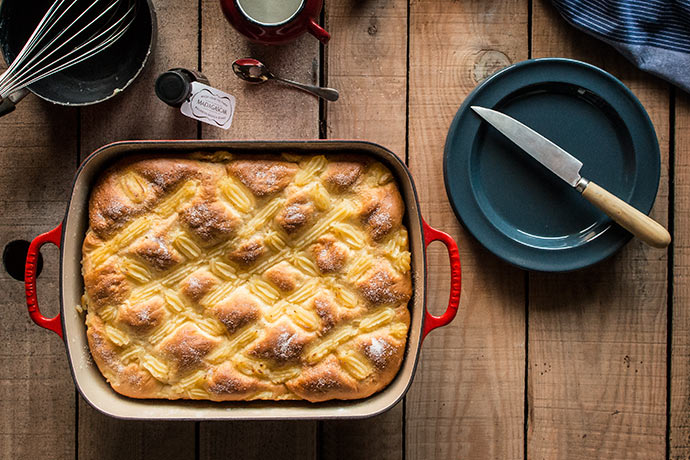
Le Creuset cast iron baking dish, Madagascar vanilla extract, ceramic plate Emile Henry and Pallarès iron knife
Ingredients
For the preferment:
- 100 g bread flour
- 100 g of milk
- 5 g of freeze-dried baker's yeast (15 g of fresh yeast)
For the pastry cream:
- 250 g of whole milk
- 90 g of sugar
- 1 medium egg
- 20 g cornstarch
- 1 tsp vanilla extract
For the final dough:
- The preferment you will have prepared
- 2 eggs
- 35 g of sweet anise
- 25 g of milk
- 60 g of sugar
- the zest of a lemon
- 325 g of bread flour
- 60 g of softened butter
For the anise syrup:
- 50 g of sugar
- 50 g of water
- 50 g of sweet anise
Preparation
Preparation of the preferment:
We mix the three ingredients, cover, and let it ferment until it puffs up.
Pastry cream preparation:
In the meantime, prepare the custard. Put the cold milk in a saucepan and add the cornstarch. Whisk lightly until it dissolves.
We add the rest of the ingredients: the egg, the sugar, and the vanilla. Put the saucepan on the heat and warm gently, stirring constantly, until it thickens. Let it bubble a couple of times and remove from the heat. Cover with plastic wrap so a skin doesn't form and let it cool completely.
Final dough preparation:
When the preferment is ready, place it in a bowl with all the dough ingredients except the butter, and knead until the dough comes together well. Then add the butter in a couple of batches, kneading well each time until it’s incorporated.
We keep kneading until we get a smooth, elastic dough. Shape it into a ball, place it in a greased bowl, cover, and let it double in size.
When you have folded the dough, place it on a lightly floured countertop and press it with your hand to deflate it. Roll it out into a round, oval, or whatever shape you like best, and place it in a baking dish, like this one from Le Creuset.
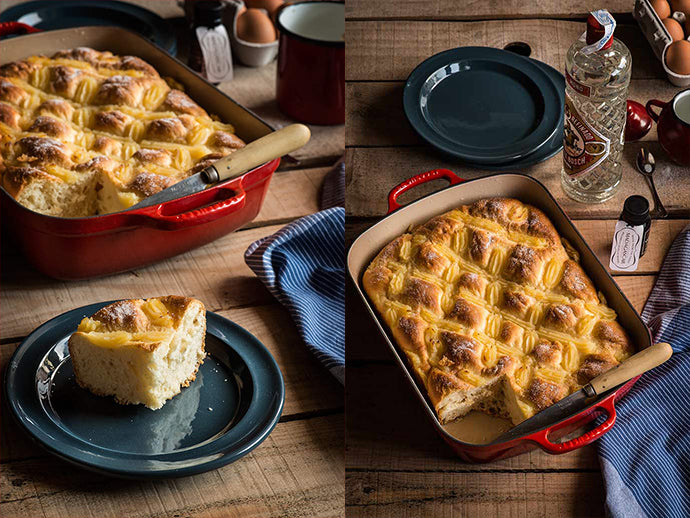
Le Creuset iron baking dish, Emile Henry ceramic plate and Madagascar vanilla extract
Using a knife, make diagonal cuts in the surface of the dough and place strips of pastry cream over them, which we will have previously introduced into a piping bag with a small tip. We cover the dish and let the dough ferment again. We can also sprinkle it with some sugar.
Anise syrup:
We prepare the anise syrup so it’s hot when the bolla larpeira comes out of the oven.
We put in a saucepan the anise, sugar, and water, and boil for a couple of minutes. Set aside.
When the dough is almost ready, preheat the oven to 180°. Once it has risen, put it in the baking dish in the oven and bake the bolla larpeira for about 25 minutes, until it is golden on top.
We take out the larpeira and we paint it with a kitchen brush immediately with the hot anise syrup. We unmold carefully and let it cool on a grid. And enjoy.


Comments
Carmen said:
Pintaza!! El anís es uno de mis sabores menos estimados… Alguna idea para sustituir este licor para que el resultado sea tan maravilloso?
Miriam said:
Hola Elena, No indicamos tiempos porque el periodo de fermentación puede variar muchísimo en función del estado de la levadura y de la temperatura en la cocina. En cualquier caso será como mínimo una hora. Saludos!
Claudia said:
Deliciosísima, MAría! A por ella! :) Ya nos contarás, saludos!
María said:
Que delicia!! Esta “bolla” larpeira,aunque es un poco laboriosa, cosa que a mi me encanta , el resultado tiene que ser muy gratificante, en breve la harè , muchas gracias x compartir.
elena said:
Magnifica receta!!
Cuanto rato mas o menos se deja fermentar una vez tiene la crema puesta?
Un abrazo
Claudia said:
Olé también por tus palabras, Teresa, muchas gracias!
Claudia said:
Ojalá llegue el día, Lidia! Muchas gracias, ya nos contarás qué tal resulta esta receta en tus manos gallego-argentinas ;)
Teresa Amat Solanes said:
Postre de peso y sabroso,
de tierra pura delicia,
un OLÉ muy clamoroso
para el y toda Galicia.
Lidia Lagares Sanchez said:
me parece riquisima.La hare en cuanto pueda.
Soy argentina,pero todos mis ancestros son gallegos y tambien tengo la misma nacionalidad.
Quiza si se abre la importacion pueda comprarles algo de las muchas cosas utiles y bonitas que teneis.Un abrazo.Felices Pascuas de Navidad y un prospero AÑO NUEVO