
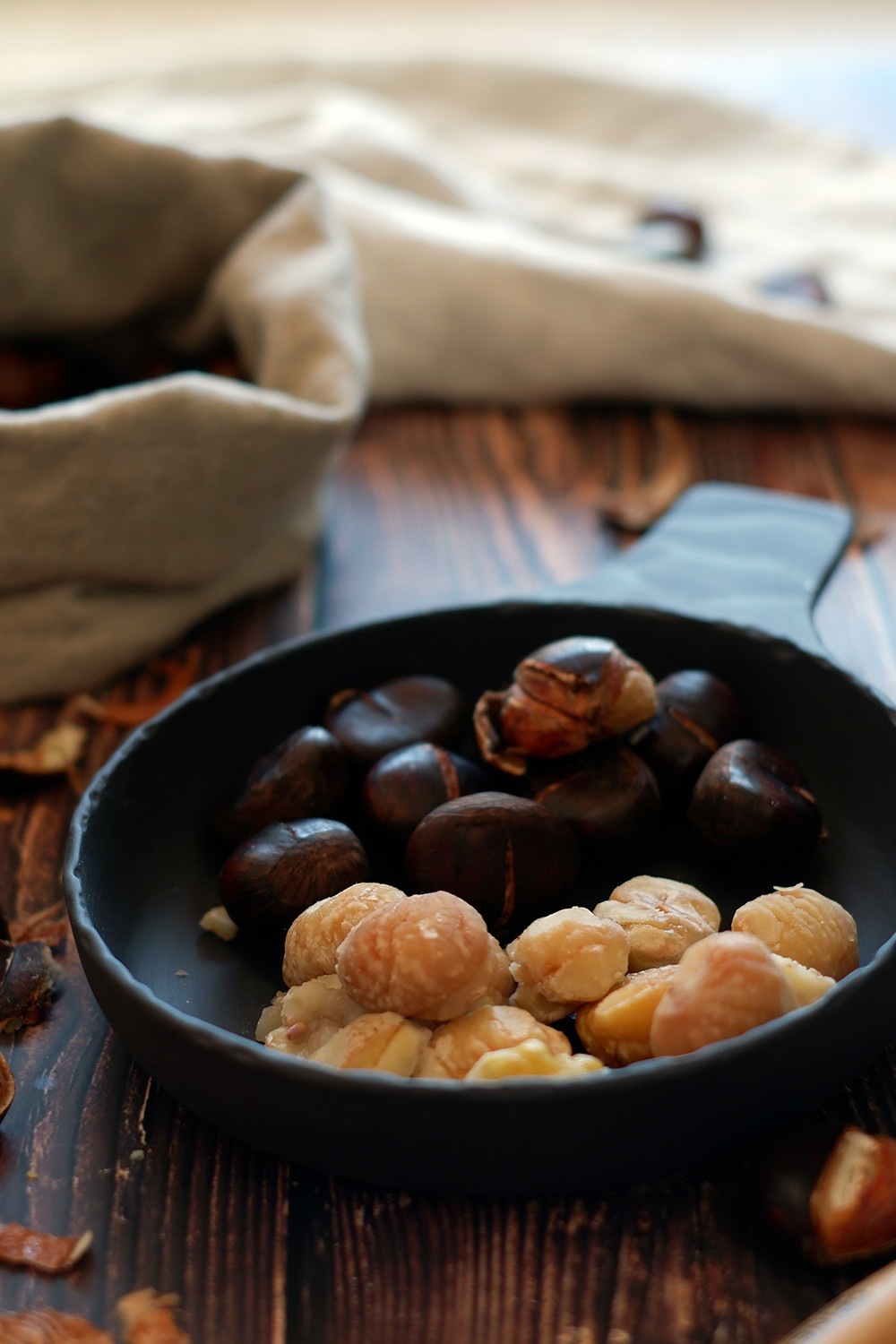
Boiling chestnuts, not roasting them, is one of the easiest things you can do if you decide to cook chestnuts and the result is delicious. I fondly remember how at home, when I was little, at Sunday autumn dessert time they would bring two trays to the table: one with fire-roasted chestnuts, and the other with boiled chestnuts. The truth is it was hard to decide which were tastier. They always disappeared!
You can prepare boiled chestnuts by simply using a saucepan or a small pot, since they take up little space and the water will start to boil in no time. Or you can make them even faster in the pressure cooker. It is without doubt an excellent option to save even more time.
Boiling chestnuts has very few secrets, since it is a simple and quick cooking method. But I leave you an easy step-by-step and some tips and ideas so they turn out just right. Delicious!
If you haven't boiled chestnuts you should. I think you'll be surprised by the result: they become tender and flavorful, with their characteristic chestnut taste. If you cook them well, which takes very little effort, they are super quick to peel and are a great way to enjoy autumn and recharge your energy.

Ingredients
- Chestnuts (quantity according to each person's choice)
- One tablespoon of salt
- Anise (optional, although it is a very popular addition)
- One bay leaf (optional)
Preparation (in a conventional pot and in a pressure cooker)
- Clean the chestnuts by running them under water in a colander.
- Make a deep cut in them*. There's no need to make a cross, a simple transverse cut will do, but you must cut the chestnut's skin so the water can penetrate.
- If you cook the chestnuts the traditional way: Put water in a saucepan or a medium-sized pot, enough to more than adequately cover the chestnuts you want to boil. Heat the water and, when it's hot, add a tablespoon of salt and half a teaspoon of anise (also, if you like, the bay leaf). Add the chestnuts and let them cook for 35–40 minutes over low heat (just enough to keep a simmer once it has started to boil). After that time remove from the heat and strain the water.

Notes
- Choose the chestnuts well: ideally they should be firm and a glossy brown.
- Make sure they are all of similar size, to ensure even cooking.
- *Undoubtedly, for making those cuts in the chestnuts, there is no better knife than the special for garlic and chestnuts from Opinel - its curved, sharp tip and the shape of the short blade allow you to hold the chestnut in such a way that you can make those cuts with great skill.
- Cooking time will vary by a few minutes depending on whether the chestnuts are larger or smaller.
- When peeling chestnuts it is important to remove both the outer shell and the inner skin layer, which is bitter.
- Once cooked and peeled, try them also coated in a sugar glaze... Or they will be a guaranteed success if you serve them at coffee time covered in fondant chocolate! A bite of chestnut and chocolate is an ideal accompaniment to close any family gathering.



Comments
Claudia&Julia said:
Hola Montse,
¡Muchas gracias! Tenemos en el blog la receta del capón relleno con puré de castañas; allí puedes encontrar lo que buscas. Para que puedas verla, te dejamos el enlace a continuación:
https://claudiaandjulia.com/blogs/general/capon-relleno-y-pure-de-castanas
¡Esperamos que te guste!
Montse said:
Hola ! Todo tasty ,por favor podrías indicarme cómo hacer una crema de castañas para acompañar pato o pollo,,mil gracias
Montse
Claudia&Julia said:
Gracias a ti, Henar y, ¡un saludo!
Claudia&Julia said:
Hola Juan José,
Muchas gracias por compartir tu historia :)
¡Un saludo!
Claudia&Julia said:
Hola Manuel,
Muchas gracias por compartir; dan muchas ganas de probarlo, porque parece muy aromático ;)
¡Un saludo!
Manuel said:
Holi, gracias por compartir.
Yo las cocí con una raíz de cúrcuma, un poco de jengibre, cáscara de limón, 3 cucharadas de miel y media cuch. Sal.
Quedó sencillamente especial, sabor sofisticado, no paraa todos los paladares.
Con vino rojo tipo merlot…
Saludos
JUAN JOSE MARTIN FRECHILLA said:
tengo 82 años, soy venezolano nacido en Donostia, cocino desde 1972, cuando me casé y, como me gusta comer bien, recién casado con tres años de postgrado europeo por delante Université Catholique de Louvain (Belgique) y Paris I Sorbonne (France) tomé el mando de la cocina en un reparto, muy avanzadamente feminista en tiempos de “La mujer eunuco” de Germaine Greer Ahora viudo vivo en Barcelona y, frente a un régimen de estaciones, sigo cocinando, sigo las estaciones, invento, con el apoyo de los tres años de postgrado en cocina francesa y belga.
Tenia camagrocs y castañas; conseguí una receta que me gustó las castañas que hice al horno la salsa bien con roquerfort como base- pero no me gustó la textura de las castañas asadas. Como era la primera vez que me enfrento al corte y al asado, me di cuenta que todo esta ligado a lo dulce; y busque una forma de cocerlas, para que la receta funcionase. Lo he con seguido y he querido compartir todo este tinglado caribeño/català. Utilice el acompañante camagrocs, castañas y roquefort, para un muslo de pato al hormo -matriz de Martin Berasategui, que elabora una salsa/crema de aceitunas para cubrir patatas como acompañante que es un desastre, como en muchas ocasiones lo es su cocina. Perdió los origenes, cosa que ni Arzak ni Subijana han hecho. Juan Jose Martin Frechilla, venezolano nacido en Donostia en 1942.
Henar Hidalgo Riol said:
Cuando las castañas se asan hay que hacerlas un corte porque de lo contrario explotan. Cuando las castañas se cuecen todo es tan rápido y sencillo como echarlas a cocer enteras, sin corte.
Saludos y muchas gracias.
Teresa said:
Hola!! El anís es en especia o licor? Gracias.
Cestadefruta.es said:
Que ricas por favor, con anís están súper buenas
Claudia said:
Hola Montse,
Los 7-8 minutos son a contar a partir de que los anillos de presión ya han subido. Siendo así, recuerda siempre haber bajado el fuego cuando los anillos han subido -cuando la presión en la olla ya es alta, solo debes MANTENER esa presión, y para ello es conveniente abajar el fuego, simplemente para que se mantengan allí, pero nunca con el fuego al máximo cuando la presión ya ha alcanzado su punto óptimo.
Cualquier duda, escríbenos a tienda@claudiaandjulia.com. Gracias!
montse said:
les castanyes fetes amb olla a pressió, no tinc clar si els 7-8 minuts són sense abaixar el foc o és a màxima potència.
Claudia said:
Qué alegría Mireia, me alegro mucho!! La verdad es que sí están ricas, mucho, un vicio para toda la family! Saludos, Claudia
Mireia said:
¡Pero qué ricas! No las había probado nunca así, y la verdad es que estoy como dices tú, ya no sé si las prefiero asadas o cocidas! Muchas gracias por la receta :)