

How many of you have heard about potato milk? It's a plant-based drink totally new, an alternative to cow's milk, a milk lactose-free and gluten-free with great benefits, both nutritionally for the body and for the environment: it is the most eco-friendly plant milk available, in fact the winner of the innovation award. If this is the first time you're reading about it, you may have reacted like I did... I was astonished! In this post I hope you find answers to all the questions about potato milk and the recipe to make it.
The first thing I thought was, Can you make milk from potatoes? What does it taste like? What is its texture like? Can I use it the same way as other types of milk? There are many questions that may arise, as well as doubts about whether we'll like it.
It's totally normal since potato is not naturally a sweet ingredient, and we usually associate it with other types of preparations that have nothing to do with a consumption like the one we propose today. But I assure you that with the right combination, it is a rather pleasant milk to drink.
Although we may think potato is only used for cooking, it is an ingredient used, due to its high starch content, to make vodka through a fermentation process.
 Glass jar with cork lid Inspired by Revol and America' 20s glass from Bormioli Rocco
What is potato milk?
Potato milk is a milk or plant-based drink made from potatoes. Its texture and consistency are milky, you can notice the starch, and it has a mild, almost tasteless flavor.
The creation of this new variety of "milk" comes from a Swedish food researcher and a professor at Lund University.
Legally, plant milks cannot be called "milk" as such except for almond milk.
Both found a way to turn the humble potato into a plant-based drink. The Swedish company DUG (winner of a 2021 World Food Innovation Award in the Best Allergy-Friendly Product category for their creation) currently sells potato milk in some countries, although it has not yet been marketed in Spain.
It is a blend of water, potatoes, rapeseed oil, pea protein, chicory fiber, maltodextrin (sugar) and some other ingredients such as an emulsifier, vitamin D and an acidity regulator.
The company claims the final result is quite similar to cow's milk in terms of texture and flavor; additionally the nutritional benefits of the potato are added; fiber, vitamin C, magnesium and potassium.
I'll make a brief parenthesis here to note something: I don't know what this company's potato milk is like, but after my tests (several) I have never found similarity between the texture and taste of cow's milk and potato milk. In my humble opinion, they can't be compared because they are totally different.
The brand offers 3 options for consumers; original, barista (with higher fat content to help it froth better) and unsweetened.
So, what makes potato milk special?
Among other things, its sustainability. It is much greater than that of other plant milks such as almond milk (requires large amounts of water to grow), soy (its cultivation causes soil devastation, deforestation, river and aquifer pollution, elimination of family farming, loss of biodiversity...) or oat.
Regular consumption of potato milk, unlike other varieties of plant milk, promises to reduce the carbon footprint (its cultivation produces much less CO₂ than other plants), reduce water consumption (56 times lower than almond milk) and require less land to be cultivated.
Additionally, potato milk, not being a dairy product, is suitable for those who are lactose intolerant or for people who suffer from poor digestion.
Benefits of potato milk.
Among all the ingredients that can be used to make a "plant milk", it's not surprising that potato was chosen to be part of the plant-based milks.
After all, potatoes have many health benefits which I list below.
- Vitamin C: When we talk about this vitamin, it's common to associate it with oranges and citrus. But an important source of vitamin C in the British diet for much of the 20th century came from potatoes. In general terms, about 150 g of potato provides around 15% of our daily vitamin C. Vitamin C supports immune function, contains antioxidants and plays an essential role in the formation of connective tissue.
- Vitamin B6: Helps the body's enzymes function properly, allowing them to break down proteins, a key process for proper nerve function. A small potato contains about a quarter of the recommended daily intake of B6 for an adult.
- Potassium: Regulates electrical signaling in muscles and nerves.
- Choline: This is a compound that binds to fat to form phospholipids, the building blocks of cell membranes, as well as the neurotransmitter acetylcholine (which helps us contract muscles, dilate blood vessels and slow heart rate). Potatoes contain the second highest levels of choline, after protein-rich foods like meat and soy.
- Resistant starch: Cooking and cooling potatoes before eating allows resistant starch to form. This healthy starch helps our body in various ways, even acting as a prebiotic. Cooling cooked starches causes them to collapse. This makes them harder to digest, but the bacteria in our colon ferment them producing compounds called short-chain fatty acids. These fatty acids feed our intestines and keep them healthy. This type of fatty acids can also positively alter our metabolism, helping reduce fat and blood sugar levels.
- They don't contain gluten: Potatoes, by nature, do not contain gluten, so it's a great option for people with celiac disease or who need to avoid gluten.
- Lactose-free drink: It's an option suitable for people with gluten and lactose intolerance.
- It's a good alternative for those with allergies or intolerances to soy, almond, oat or other plant milk bases.

Glass jar with cork lid Inspired by Revol and America' 20s glass from Bormioli Rocco
Considerations to keep in mind when consuming potato milk.
Potato is an ingredient that has a low protein content. It's true that when we consume other types of plant milks like almond, rice, oat... we are consuming a plant milk whose main ingredient, in origin, is rich in protein. But when it is processed to make the milk, only a small percentage (around 10%) of that ingredient becomes part of the milk. This makes it a plant milk with a lower protein index.
Potato naturally contains very little protein, and when turned into plant milk, its presence is reduced to almost match other plant milks. But it is still lower than the other options.
Potato milk, if we make it at home, contains no sugars. If we buy it ready-made, it has less sugar than other plant milks. But it's true that to make it more appealing to the palate, it's necessary to sweeten it a little. There are many options to do this instead of using refined sugar.
It has a low fat content, so if we don't use an ingredient that adds fat, the result will be very similar to water. Commercial potato milk contains refined oils to provide creaminess and make it more appealing. We can use nuts for this same purpose or even coconut oil if you prefer.
We cannot expect to taste a milk that reminds us of cow's milk, soy, almond, coconut... Because it's nothing like them. Flavor, texture and smell are very particular.
That said, if we don't season potato milk, we'll find a plant drink that tastes like potato. But by adding some ingredients we'll flavor it so that it's very appealing, without losing the essence of the drink we're making.
The final result is a drink with a milky texture, a sweet aroma and a slight reminder of a soft roll. But of course, we used vanilla and dates... It's normal.
To drink it, in my humble opinion, it's best enjoyed as prepared and very chilled. Although it can also be consumed hot. I haven't tried mixing it with coffee or another drink of that kind, but I can't quite see the combination. I suppose it's just a matter of trying.
On the other hand, I do see it as a variety of plant milk perfect for making doughs; I think it would work very well in breads, or even fruit smoothies.
The recipe to make potato milk
Ingredients for approximately 1 L
- 275 g potato*, peeled
- 800 g water (700 g cold water + 100 g cooking water)
- 35 g ground almond
- 2 Medjool dates, approximately 80 g
- 1 teaspoon natural vanilla extract
- 2 g salt
* In the notes section I detail the varieties we can use
Preparation
Cook the potatoes
- Wash and peel the potatoes. Cut into slices about 2 cm thick.
- Place in the WMF pressure cooker, in the small 3 l. pot, and fill with water to the 1/2 mark.
- Close the cooker, turn the handle ring to cooking 1 and put on the heat. Once the first green ring appears, cook for 6 minutes.
- Remove from heat, release the steam, gently shake the pot and remove the lid.
- Remove the potatoes with a slotted spoon and reserve the cooking water.

WMF pressure cooker, Emile Henry salt jar and Pallarès kitchen knife
Blend the potatoes
- Place the cooked potatoes in a food processor along with half of the water.
- Process on high speed until achieving a very smooth and silky consistency.
- Add the rest of the water and process again at medium-high speed for 2-3 minutes. You should obtain a very smooth, lump-free mixture.
Add the rest of the ingredients and process again.
- Add the ground almond along with the chopped dates, the vanilla and the salt.
- Process again for 3 minutes until the ingredients are fully integrated.
- At this point you can taste the potato milk and adjust any elements if you wish. You can even add a little more water if you consider it appropriate.
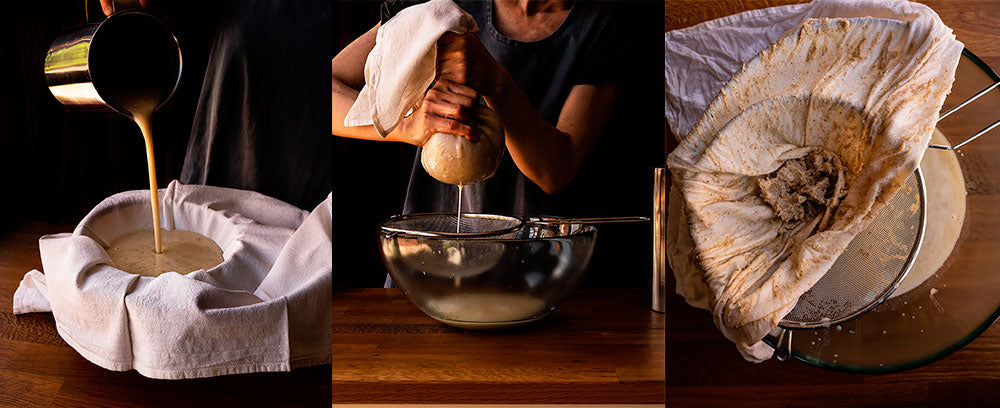
Pass the mixture through a cheesecloth.
- Over a large bowl, place a strainer and over it a cheesecloth.
- Pour the mixture onto the cloth. Gather the ends, roll up and begin to press.
- This step will be a bit laborious; you'll need to do it patiently since the mixture passes through the cloth with some difficulty. From time to time, you'll need to release air to help it pass better. This step will help remove almond pulp and small pieces of date skin.
- Pour through a strainer into a glass bottle, like this beautiful one from Revol.
- Serve or refrigerate.
Gefu squeezing and pressing mesh and Nynet Mediterránea glass bowl
Notes:
- Ideally, use Spunta potatoes (I used this variety for the final result), Kennebec or Russet. You can make it with other varieties, but I have tried these three types and the result is quite good.
- It's very important that the potato is cooked and no raw parts remain. But it's also important not to overcook it so it retains all its properties.
- Ground almond can be replaced by another ground nut if you wish, like hazelnuts for example.
- If you are nut intolerant, omit this ingredient entirely. In that case, to add a fatty element, you can use coconut oil or another type of vegetable oil with a very mild flavor.
- Potato milk by itself is quite bland. For that reason We will add sweet and savory notes to enhance the Set. Salt is an indispensable element to enhance flavors; I advise you not to omit it.
- To sweeten you can use any ingredient you want; in my case I used dates, but you can use agave syrup, honey, maple syrup or the type of sweetener you prefer. The amount of this ingredient is entirely up to you.
- Vanilla gives a wonderful aroma to potato milk, make sure it's natural and not artificial.
- The final amount of water depends on your tastes. In my case with 800 g of water, I consider it has a good texture and consistency, but you can make it more fluid or thicker. I advise adding the water little by little so you can taste and adjust the desired consistency to your liking.
- It can be stored in the refrigerator for 3-4 days.
- This type of milk cannot be frozen, like the potato. The consistency changes and it's not pleasant.
I can't wait to know what you think and that you get encouraged to prepare this potato milk to tell me what you thought. Although it's true that it's not what our palate might expect if we compare it to cow's milk, it is a pleasant drink to consume and will bring many benefits to our body.
So we want to hear about your experiences!

Sources: The Conversation, The Conversation, Dr. Axe, Uppers


Comments
Eva {Bake-Street} said:
Hola, Yolanda :)
Claro, porque si la elaboramos en casa, este ingrediente, es totalmente facultativo. Puedes optar por utilizarlo o no, sin embargo cuando la compramos envasada, no tenemos esa opción. En mi caso he usado dátiles porque me gustan, pero como os comento en el apartado notas, pueden usarse estos u otro tipo de endulzante (siempre que así lo desees, no es obligatorio). Considero que mejora mucho el sabor final, pero esto queda a vuestros gustos.
En las notas os detallo esto:
Para endulzar podemos usar el ingrediente que deseemos, en mi caso he usado dátiles, pero podemos utilizar sirope de Ágave, miel, sirope de Arce o el tipo de endulzante que vosotros consideréis. La cantidad de este ingrediente es totalmente a vuestra elección.
Gracias por tu comentario, un abrazo!
Yolanda said:
Hola, no entiendo muy bien que afirmes que si se hace en casa esta leche no tiene azúcar si en la receta se usan dátiles que tienen un alto contenido en azúcares ( unos 63 gramos por cada 100)
Eva {Bake-Street} said:
¡Buenos días, Milagros!
No sabes cuanto me alegra saber que te ha gustado y vas a animarte a probarla! Ya nos contarás qué tal! :D
Respecto a tu pregunta, es cierto que en este caso sí deseché la pasta de almendras y patata (de esta cantidad había prácticamente nada). Se me ocurre que puedas darle el mismo uso que se le da al excedente de almendra molida cuando hacemos leche de almendras (puedes encontrar la receta en el blog de Claudia https://www.claudiaandjulia.com/blogs/general/como-hacer-leche-de-almendras).
Podrías secarla en el horno y destinarla para galletas, bases friables de tartas… Tal vez incluso en una masa de bizcocho. Espero haberte ayudado, un abrazo!
milagros said:
Me encanta el post y sobre todo probar cosas funcionan.Acabaré haciendo porque es una manera perfecta de introducir mas alimentos vegetarianos y de paso equilibrar el bolsillo. Y ya puestos, ya que yo reciclo todo, que hacemos con el bagazo de patata+frutos secos, alguna idea porfis? para hacer el combo perfecto-besos
Eva {Bake-Street} said:
Buenas tardes, Elena :)
Antes de nada, muchas gracias por tu comentario y tu tiempo. Tal y como detalla Claudia, sí se especifica en el post el error que cometemos (todos nosotros) al denominarla “leche de patata”. Si lees el post, cuando llegas al apartado – ¿Qué es la leche de patata? – , encontrarás esta cita:
La leche de patata es una leche o bebida vegetal elaborada a base de patatas…
Legalmente, las leches vegetales no pueden denominarse “leche” como tal a excepción de la leche de almendras.
Y, ¿Por qué puede denominarse como leche a diferencia de las otras bebidas vegetales?
El Codex Alimentarius, define leche como “la secreción mamaria normal de animales lecheros obtenida mediante uno o más ordeños sin ningún tipo de adición o extracción, destinada al consumo en forma de leche líquida o a elaboración ulterior”.
En base a esta definición, es incorrecto hablar de leches vegetales (soja, arroz, avena), por lo que deben nombrarse bebidas vegetales. Pero, dentro de éstas, la procedente de las almendras sí que puede denominarse leche de almendra, debido a su uso tradicional.
No es correcto denominarlo de ese modo, pero es como el público lo conoce y, lo más importante, se le ha dado a conocer. Por lo tanto, es de este modo como la buscaran.
Aquí puedes leer más sobre este tema: https://www.cato.org/blog/yes-virginia-almond-milk-can-be-called-milk
Si en el post se ha denominado de esa forma, es porque se busca por esa terminología en los buscadores. Esta hecho para facilitar que la receta se encuentre. Pero, dentro del propio post (cuando lo lees) puedes ver que se detalla la explicación de que se trata de una bebida vegetal y aclarar que denominarlo así sería un error.
Gracias de nuevo, un abrazo!
Claudia said:
Hola Elena, tienes toda la razón y de hecho en el post así lo indicamos, de que en realidad no la debemos llamar leche… Pero a la vez nos vemos algo obligados porque nos ha venido heredado así y es lo que la gente comprende (si la llamamos agua de patata la gente se confundirá respecto al agua resultante de hervir la patata, que no es la idea). Gracias por tu aportación y comprensión… Tal vez llamarla Bebida Vegetal de Patata será lo más adecuado. Saludos!
elena said: