

If you're looking for a soft, delicate cake that leaves a delicious taste in your mouth, the recipe Rosa brings us (Pemberley Cup&Cakes) you'll love it. This is not just a peach tart; it's filled with a truly delicious and delicate almond cream. The peaches, for their part, have a touch of wine and cinnamon that gives the tart a special touch. Their explanations will guide you step by step, because anyone can make it!
Although it's more than tempting to give the oven a vacation as soon as summer sets in, I find it even more tempting to prepare and enjoy a good homemade dessert made with top-quality ingredients and an unbeatable combination of flavors and textures, as is the case with this luscious peach tart.

Glass vase with Mediterranean rope, Le Creuset ceramic teapot, Le Creuset ceramic tumblers, Kusmi Tea tea tin and Pallarès bread knife
Just after discovering the Conservas Serrano peaches which I have used to make this recipe—macerated in Rioja wine and cinnamon and with a light syrup—I instantly knew that all my baking instincts would start figuring out how to shape the next summer dessert. And for any season of the year, since being a top-quality preserved fruit, we no longer have to wait for its season to arrive to enjoy it.
So, once the matter of the fruit was resolved, they wanted to add to it without hesitation a delicious almond cream, my favorite version of frangipane, smooth and incredibly easy to make. And as the finishing touch, the matter was settled with a sablée dough base (or sweet shortcrust pastry) to further delight everyone with its irresistible texture, crisp and melt-in-the-mouth at the same time. I admit, I may not be the most impartial person in the world right now when it comes to this recipe, but the truth is that I’ve always been fascinated by this kind of fruit tart, whether the fruit is fresh or canned, and at home it was a real hit.
And to counteract the effects of its necessary time in the oven, I can’t think of a better remedy than to serve this peach tart with a generous scoop of ice cream; the contrast is simply spectacular.
Ingredients (for 8-10 servings)
All ingredients must be at room temperature, unless otherwise indicated
For sablée dough (sweet shortcrust pastry):
- 200 g plain wheat flour (+ extra flour for kneading)
- 55 g powdered sugar
- ¼ teaspoon of salt
- 125 g unsalted butter, very cold (even frozen), cut into small cubes (+ extra butter for greasing)
- 1 egg yolk (L)
For the frangipane (or almond cream):
- 90 g of unsalted butter
- 90 g of white sugar
- 1 egg (L)
- 15 ml (1 tablespoon) of orange juice
- 90 g ground raw almonds
- 35 g of cake flour
- ¼ teaspoon of salt
For the fruit filling:
- 6 halves of peach in wine with cinnamon in syrup (350 g approx.) (Alternatively, you can opt to use peach in syrup)
- 40 g (2 tablespoons) of apricot jam or peach for brushing
- 5 ml (1 teaspoon) of peach syrup
Production
For the sablé dough:
1. We sift the flour together with the powdered sugar and the salt in a large bowl and mix well with some rods until all the ingredients are well combined.
2. Next, add the butter very cold and cut into small cubes, and work it with your fingertips until it is more or less incorporated into the dry ingredient mixture from the previous step. It’s important to avoid overworking it to introduce as little heat as possible; otherwise, the butter would soften and the gluten in the flour would develop and the dough would end up acquiring an elastic texture instead of a flaky texture, as is the goal. We should end up with a texture like irregular floury crumbs.
3. Now add the egg yolk, lightly beaten, and fold it in just until combined, the same way we did in step 2.
4. Next, we press the mixture together with our hands (at first it may seem like it won’t come together, but once it’s in contact with our hands everything will combine without a problem and start to take shape) and shape the dough into a ball, wrap it in plastic wrap and refrigerate for at least 1 hour.
5. After this time, we take the dough out of the refrigerator and, if it is too hard, let it come to room temperature for about 5-10 minutes.
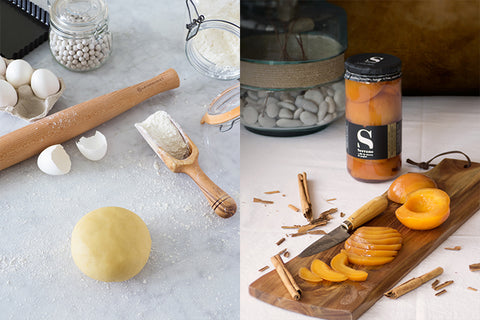
Le Creuset rolling pin, Bérard flour spoon, MasterClass Baguette Board and Peach in Serrano Wine
6. Meanwhile, Grease the inside of a non-stick rectangular pan with a removable base of 36 x 10 x 2,5 cm (like this one from De Buyer) with a bit of melted butter and the help of a pastry brush.
7. Next, we roll out the dough with a rolling pin, lightly floured, on a work surface, also floured, shaping it into a rectangle about 5 cm larger than the base of our pan and a little more than 0,5 cm thick (about ¾ cm is fine), always rolling from the center outward. To roll it out more easily, we can place it between two sheets of parchment paper or plastic wrap.
8. Once extended, we carefully transfer it to the mold so that it doesn't break on us. Since it’s quite a crumbly dough, to make it easier to handle, we fold half of the dough over the rolling pin (like on a clothesline), place the fold over the center of the pan, unfold to cover both halves, and press it in so it fits perfectly to the interior shape of the pan. The advantage of this dough is that it is very pliable and any possible cracks can be easily repaired with your fingers, and you can even gather it back together and roll it out again as many times as necessary, as long as it hasn’t softened too much, in which case we would refrigerate it for as long as needed so it can be worked without difficulty.
9. Next, we run the roller over the edge of the mold to trim the excess dough and achieve perfect edges.
10. Next, since these types of tarts require a partial blind bake, we need to prepare it properly before it goes into the oven. Although there are other methods, I usually use the traditional one, which consists of pricking the base of the dough repeatedly with a fork, covering it with plastic wrap, and chilling for about 15–20 minutes until the dough firms up slightly.
11. While we wait for it to chill, preheat the oven (electric, no fan) to 190ºC, with top and bottom heat.
12. Once the base of our tart has been chilled, we take the pan out of the refrigerator, remove the plastic wrap, completely line the inside with parchment paper (it’s better to crumple it and stretch it beforehand so it adapts better to the shape of the inside of the pan) and we fill with ceramic beads for baking to prevent the dough from rising during baking.

de Buyer rectangular mold, Kitchen Craft ceramic balls and Bérard flour scoop
13. Next, place the pan on the oven tray and bake on the middle rack for about 20-25 minutes, until the dough turns a nice golden color.
14. Remove from the oven, place the pan on a rack and, taking great care not to burn yourself, remove the parchment paper and the ceramic pie weights. Turn off the oven and let the crust cool completely in the pan before filling.
Frangipane (or almond cream) preparation:
1. Once the base of our tart has cooled, we will start preparing the filling. In a medium bowl, we combine the ground almonds, the flour, and the salt with a few rods until you get a homogeneous mixture. Set aside.
2. In the bowl of our electric dough mixer, fitted with the paddle attachment (or in a large bowl using a spatula or wooden spoon), beat the butter vigorously for 1-2 minutes until smooth and creamy.
3. Next, we add the white sugar and we continue mixing with the same intensity for about 3-4 more minutes until it reaches a smooth, fluffy consistency and is visibly paler.
4. Next, add the egg and mix, now gently, until well incorporated.
5. Add the orange juice now and mix just until you have a uniform mixture.
6. Finally, add the mixture of ground almonds, flour, and salt that we had set aside (point 1) and mix just enough to combine.
Preparation for assembling and baking the cake:
1. Preheat the oven again (electric and without fan) to 180ºC with top and bottom heat.
2. We cut the peaches into slices about 0,5 cm thick and set aside inside a strainer over a large bowl to collect the excess liquids.
3. Once cool, We fill the sablée pastry base of our tart with almond cream or frangipane up to ¾ of its capacity and we smooth the surface with the help of a small spatula or the back of a spoon.
4. Next, we place the peach slices over the almond cream following the design that appeals to us most, overlapping them slightly so the frangipane doesn’t seep between them and make them sink.
5. Finally, we place our cake on the oven tray and we bake on the middle rack for about 40-45 minutes until the filling has set and the surface is lightly golden.
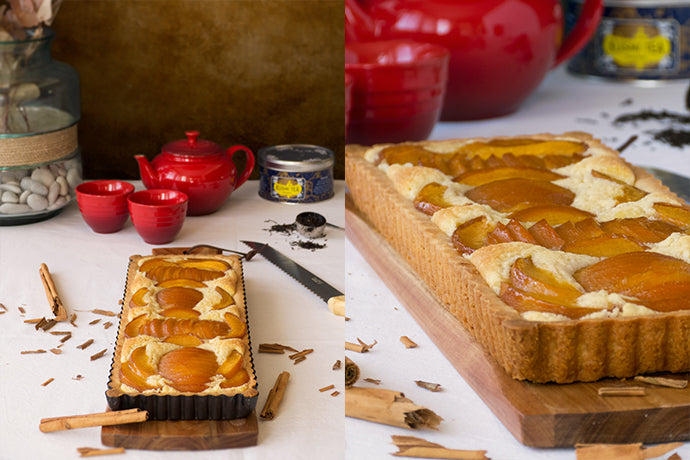
de Buyer rectangular mold, jGlass arrón with Mediterranean rope, Le Creuset ceramic teapot, Le Creuset ceramic tumblers, Kusmi Tea tea tin and Pallarès bread knife
6. Remove from the oven and let cool in the pan on a rack for about 20 minutes before unmolding (the fruit may be partially covered by the almond cream, which usually rises a little during baking, but after a few minutes out of the oven it will go down).
7. Meanwhile, we lightly heat the peach or apricot jam along with 1 teaspoon of peach syrup, just enough until it becomes semi-liquid.
8. Once the frangipane has relaxed, with the help of a pastry brush, Brush the surface of the fruit gently with the jam lukewarm (if the jam has small bits of fruit, it's best to pass it through a sieve before spreading it over the fruit), being careful not to go over the frangipane.
9. Finally, remove from the mold (there’s no need to take off the base of the pan; this will prevent it from breaking) and serve while still warm or at room temperature.
Store refrigerated and well covered for 3-4 days. It’s advisable to remove it from the refrigerator about 15-20 minutes before serving.
Notes
- Likewise, We can make this cake with almost any fruit (pears, apples, strawberries, berries…) and, in particular, with stone fruit (apricots, nectarines, plums, etc.), both canned and fresh.
- In the same way, we can choose to use a conventional round mold for this type of cake (about 23-25 cm Ø max. for these quantities) or even make it in the form of individual tartlets.
- The ceramic balls for baking are really practical and make the task much easier in this type of recipe, so I think they’re a very interesting utensil if we’re going to use them fairly often. Otherwise, some kind of alternative weight is usually used, typically dried legumes (chickpeas, beans, lentils, or even rice).
I hope you’ll be inspired to try it and discover which is your favorite version; it will be hard to find the words... Best regards and have a great week,
Pink


Comments
Claudia said:
Ya veo Mº Carmen que has venido directo a la receta :) Un saludo bonita, a disfrutar de la tarta si te animas a prepararla!
Tarde de hadas said:
Qué buena pinta tiene !!!!! En esta época apetecen mucho las tartas con frutas