

Is there anything in the world more comforting than a soup? There might be, but nothing will make you feel better than enjoying a good hot bowl of this preparation. I love soups and creams, of all kinds and consistencies. The last one I made is this vegetable minestrone soup, with a variation or two to suit my tastes.
It is not the original, traditional recipe, but it does keep the base used to make it. Although, in reality, it is not a preparation that requires a strict recipe.
I assure you that, although at first it may not catch your attention, this is a soup you will make more than once.
The great thing about this soup is that if we have some components prepared, we'll have it ready in just 5 minutes! And how is that possible? By using the WMF Perfect Premium pot. As easy as adding everything inside, placing it over heat and letting it cook while we set the table and prepare the rest.
The word minestrone, which means thick vegetable soup, has been attested in English since 1871. It comes from the Italian minestrone, the augmentative form of minestra, "soup", or more precisely, "what is served", from minestrare, "to serve".
What is Minestrone soup?
Minestrone soup is a variety of thick Italian soup made with vegetables and often accompanied by pasta, rice or legumes. Often several of these are combined.
The most commonly used ingredients are beans, onion, garlic, celery, carrot, broth and tomato.
There is no established recipe for making minestrone, since it can be made with any seasonal vegetables or whatever we have available at the time. It can contain meat, just vegetables, or a mix of both.
The author Angelo Pellegrini stated that the base of minestrone is bean broth and that borlotti beans (also called Roman beans) "are the beans that should be used for authentic, genuine minestrone".
In my case, I did not use that variety but small red kidney beans. But, if you wish and want, you can use that type of bean.

Origin of Minestrone soup.
Some of the earliest origins of minestrone soup predate the expansion of the Latin tribes of Rome, which became the Roman Kingdom (later the Republic and Empire). At that time the local diet was "vegetarian by necessity" and consisted mainly of vegetables such as onions, lentils, cabbage, garlic, fava beans, mushrooms, carrots, asparagus and turnips.
During this time, the main dish of a meal was the pulte, a kind of simple porridge made with spelt flour scalded in salted water, to which any available or seasonal vegetables were added.
When Rome conquered Italy and monopolized trade and road networks, it flooded the capital and began to change its diet by merging with the diet of Italy. This led to meat being added more frequently, even to make broths for soups.
Spelt flour was removed from soups, as the Greeks introduced bread into the Roman diet. Pulte became food for the poor.
Marcus Apicius, ancient cookbook De Re Coquinaria.
In it he describes polus, a version of Roman datable soup from 30 AD made with farro, chickpeas, fava beans, onion, garlic, lard and vegetables.
As eating habits and ingredients in Italy changed, so did minestrone soup.Apicius updated the pultes and pulticulae with “fancy garnishes” such as boiled brains and wine.
By the mid-16th century, the soup recipe changed again when two new ingredients became available, tomatoes and potatoes that arrived from America, becoming staples.
The tradition of not losing rural roots is something that remains today. Minestrone is known in Italy as a style of cooking called "cucina povera" - "poor kitchen". These are dishes with rustic, rural roots, as opposed to "cucina nobile" a style of aristocratic and noble cooking.
Among all the ingredients you will find one that may seem particular: achiote.
Achiote is a natural coloring, also called annatto, onoto or bijol. It is obtained from a small tree whose fruit is oval and fleshy with seeds that give rise to this spice. In some countries it is used as a substitute for saffron to season and color dishes.
The flavor of achiote, if used in large amounts, can be earthy and spicy. The amount to add to the recipe can be adjusted to your taste.
Recipe adapted from Alpha Foodie

Ingredients (for 6 servings)
- 1.5 liters of vegetable or chicken broth, preferably homemade
- 340 g of passata, preferably homemade
- 3-4 tablespoons of olive oil
- 300 g of zucchini, washed and cut into pieces
- 130 g of sweet onion, finely chopped
- 20 g of fresh garlic, finely minced
- 200 g of celery, about 3 stalks, cut into pieces
- 225 g of green beans, Bobby variety, washed and cut into rather large pieces
- 280 g of carrot, washed, peeled and sliced
- 115 g of red Italian pepper, washed and chopped
- 125 g of red beans, cooked
- 60 g of fresh spinach, washed
- 1 dried chile de árbol
- generous ½ tablespoon of dried oregano
- ½ teaspoon of achiote, adjustable to taste
- salt and freshly ground black pepper
- 270 g of small dried pasta, in my case I used orecchiette
- Shavings of Parmesan cheese
- Fresh basil leaves
Preparation
We prepare the sofrito:
- In the sauté pan from De Buyer or directly on the bottom of the pressure cooker, add the olive oil and place over medium heat. Once it reaches temperature, add the onion together with the garlic.
- Sauté for 10 minutes, until it becomes semi-transparent. The heat should not be high to avoid browning the ingredients.
- Add the chile, crushed by hand (remember to remove the stem) along with the oregano and achiote. Stir and cook over medium heat for 2 minutes.
- Add the Bobby green beans together with the carrots and celery. Cook for 7-8 minutes over medium heat stirring occasionally. The vegetables should become slightly softer but still retain firmness.
- Remove from the heat.

We prepare the soup
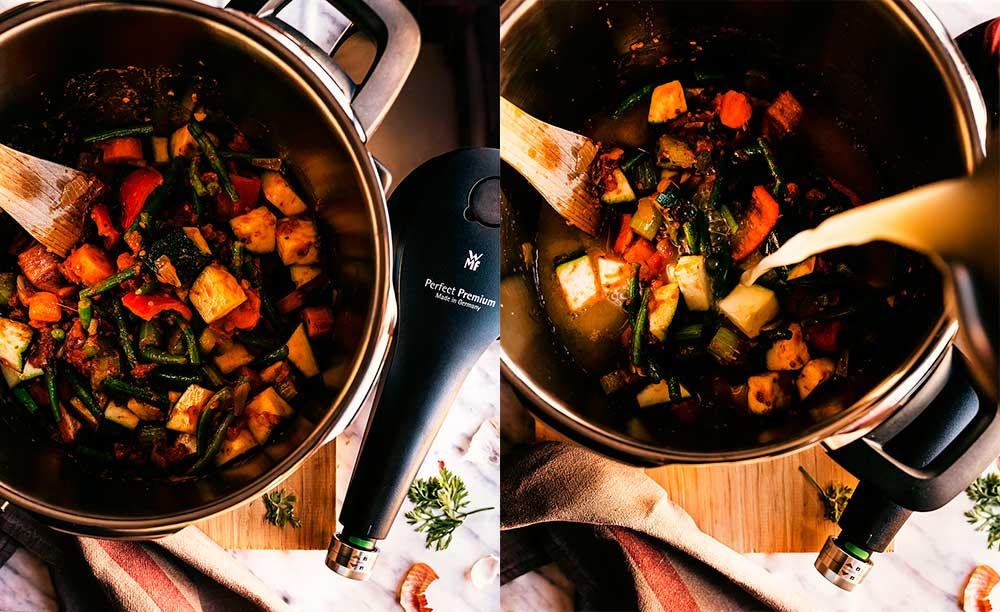
- In the WMF Perfect Premium pressure cooker add all the sofrito together with the tomato paste, zucchini and red pepper. Mix well with a wooden spoon or spatula.
- Add the broth.
- Close the lid of the pot, turn the lid knob to position 1 (recommended for delicate ingredients, such as vegetables) and place over high heat.
- Once the cooking ring rises to the first green ring, set the timer and leave for 5 minutes. It is important to monitor during cooking that the green ring does not rise or fall; it should remain in that position.
- Once the cooking time is finished, turn off the heat and remove the pot from the heat source.
- Release the steam and open the lid.
- Add the spinach and mix; they will immediately become soft.
- Add freshly ground black pepper, mix and taste. If necessary, adjust salt and pepper.
We serve
- When serving the soup we can add the pasta and beans to the pot, mix and serve from there or place in each bowl or Revol soup tureen the amount of pasta and beans per person and then ladle the vegetable soup over them. I leave it to your choice.
- Once the soup is served, accompany with Parmesan shavings and some fresh basil leaves.
- Serve immediately.
- If you wish, you can accompany with garlic bread, croutons or even slices of toasted bread with butter and flaky salt.
NOTES:
- I advise you to use homemade broth, whether vegetable or chicken. The flavor will be much better. Likewise, the passata, if homemade, will taste better. The latter can also be flavored with basil if you wish.
- I recommend sautéing the vegetables before proceeding to make the soup, this way we will greatly enhance the flavors and aromas, as well as the textures.
- The vegetables can be varied if you don't like any of them or can incorporate others you prefer.
- As aromatic herbs you can use, in addition to oregano, marjoram or thyme.
- In my case, after 4 minutes of cooking, I turn off the heat and let it finish the last minute without the heat source on. The pot retains heat very well and we can finish the cooking without direct heat, which also saves a bit of electricity (if you use ceramic or induction). If cooking with gas, you can carry out the same step if you wish.
- You must use a small-sized pasta variety. Any you like or have at home will work.
- I cook the pasta separately because I like it to be al dente. That way I can control the exact cooking point I want. The pasta variety I used, being made from durum wheat, requires a longer cooking time than conventional pasta. It needs 15 minutes.
- Achiote, if you don't have it, can be replaced with concentrated tomato paste, even sweet paprika or smoked paprika. The flavor is not the same at all, but you will add color to the soup.
- If we serve the pasta and beans in each bowl or tureen, this will allow us to refrigerate or freeze any leftover soup more satisfactorily. Especially because of the pasta since if we reheat it, it can become soft and unpleasant in texture.
- The soup can be frozen for up to 3 months.

You have surely prepared this minestrone soup more than once... Well, not exactly, but something similar.
So I encourage you to make this version that, I assure you, will make you fall in love with it. Not only because it's incredible, but because it takes so little time to prepare and enjoy.


Comments
Claudia&Julia said:
Hola Lucry,
Seguro que estaba deliciosa y, como comentas, muy completa :)
Nos alegra que te haya gustado.
¡Un saludo y gracias por comentar!
Claudia&Julia
Lucry said:
Deliciosa receta, me gustado muchísimo, la hice con sopa de huesos, queda fuerte el sabor, pero me gusta. Es un platillo muy completo.
Claudia said:
Hola José Ramón, ¡muy felices de leer tus comentarios! Verás que Eva nunca falla en sus recetas y sale super sabrosa esa sopa. Y en cuanto a la olla, sin duda que sí, es una pieza estupenda.
Gracias y muy feliz emana, Claudia
Jose Ramon said:
¡Me encanta! He hecho esta sopa sin tantas especias pero me has enamorado con tu propuesta. La haré, tengo esa olla rápida y va de fábula.