

How can something as simple as a good piece of bread with chocolate be so delicious? Surely many of you will remember having it often as a childhood snack. Today Miriam, from El Invitado de Invierno, invites us to do it again, but with some delicious homemade Vienna rolls. Will you resist the temptation?
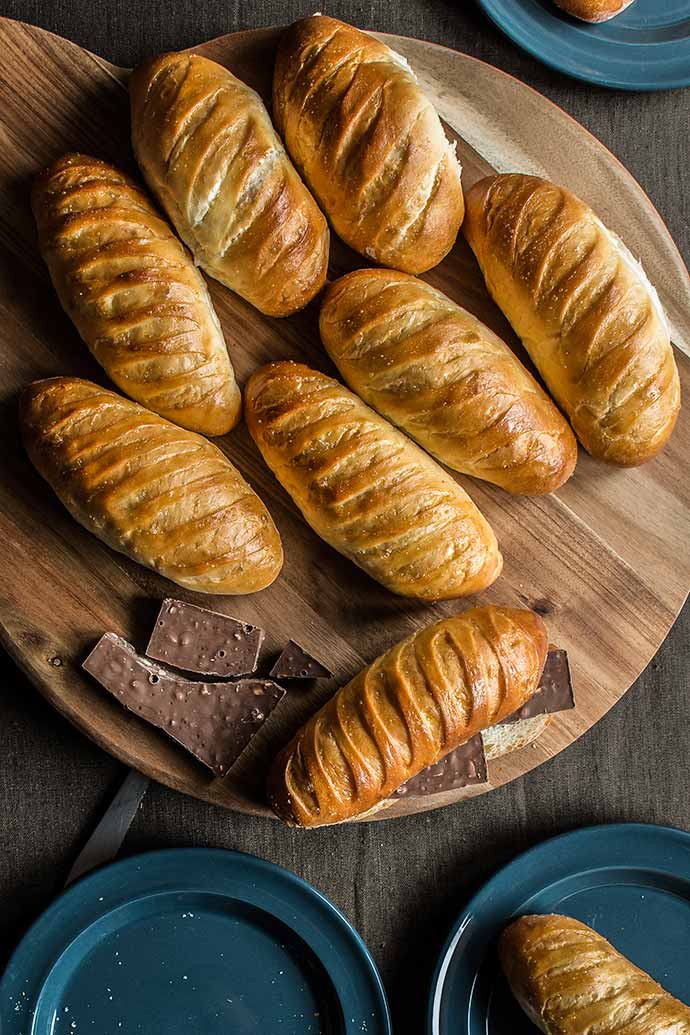
MasterClass round acacia wood board and Set of Emile Henry ceramic dessert plates
I've been making bread at home for years because nothing compares. And when we talk about replacing industrial pastries with homemade buns or breads, we're not only talking about flavor but also health. That's why I highly recommend these perfect Vienna rolls for children's sandwiches.
These fantastic Vienna rolls are the typical soft enriched bun made with eggs, sugar and butter, with just the right sweetness that kids love. And why not say it, adults do too.
In short, if we fill them with a few squares of good chocolate they suspiciously resemble those entities whose name I will not mention, but that start with bolly and end with cao. Only much tastier and without disgusting fats.
Ingredients
600gr strong flour
300gr milk
5gr dry baker's yeast (15 g fresh yeast)
12gr salt
50gr sugar
2 medium eggs
70gr softened butter (not melted)
Preparation
We take 100gr of the flour and 100gr of the milk and put them in a bowl. We add the yeast, mix, cover and let it ferment until puffed and bubbly.
We then add to this preferment the rest of the flour and milk, the salt, the sugar and the eggs. We knead for a couple of minutes, by hand or with a stand mixer.
Next we add the butter, kneading until it is well incorporated. We continue kneading until the dough is smooth and elastic. We shape it into a ball, place it in a greased container, cover and let it double in size.
When the dough has fermented we press it down on the countertop to remove the gas. We divide the dough into 10 equal portions (it's better to weigh them); with these quantities you get rolls of about 110 g, perfect for a good sandwich. We shape the rolls into an elongated form and place them on two baking sheets lined with parchment paper (or directly on a nonstick baking tray), five buns on each. With a sharp knife we make the characteristic cuts seen in the photos.
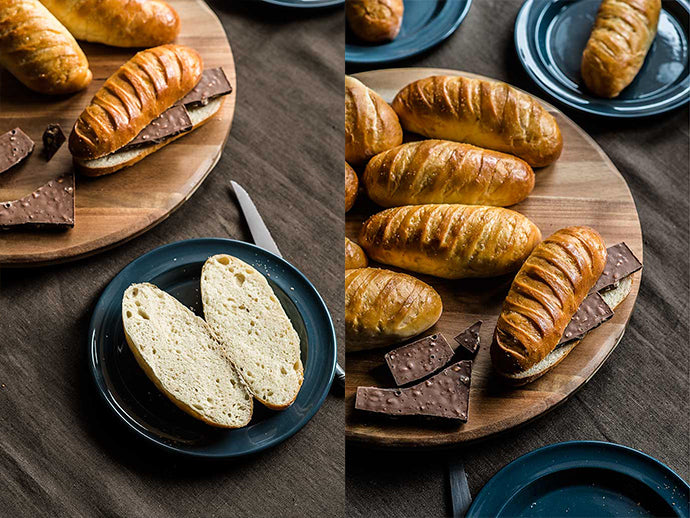
We cover the rolls with plastic and let them proof; they don't need to double in volume. When they are ready to go into the oven we brush them with beaten egg, making sure the egg gets into the cuts. If we like them especially golden we will brush them with egg twice, about 10 minutes apart.
We put the trays in the oven (it's better to bake the trays one at a time) and bake the Vienna rolls for about 15 minutes in an oven preheated to 190°. It's important that the oven has reached the indicated temperature when baking the breads (an oven thermometer can be useful).
When they are done and golden we remove them to cool on a rack over the same parchment paper. And enjoy.


Comments
Leticia said:
Hola, voy a probar pero me surge la duda de si la cantidad de leche indicada (=300) es en gr o en ml.
Quedo atenta!
Gracias
Rosa said:
Probaré, si quitais el huevo ya no es lo mismo. No me gustan los videos, prefiero una buena explicación como soleis dar. Saludos a tod@s
Rosa said:
Hola. Quisiera saber en qué posición pones la bandeja en el horno, en medio o abajo del todo.
Un saludo
Pepa said:
Me parece muy buenas las recetas,pero me gustaría que hicierais videos.En otros bloc asi lo hacen y sabes como usar el robot:es muy practico
Pepa said:
Me parece muy buenas las recetas,pero me gustaría que hicierais videos.En otros bloc asi lo hacen y sabes como usar el robot:es muy practico
Alicia Barrera said:
Hola! Me he animado a preparar estos panecillos. Aunque a mí no me han quedado tan vistosos. La masa me quedo muy pegajosa y por más que me engrasaba las manos era imposible darle una forma bonita. Gracias!!! Me encanto!
Alicia Barrera said:
Hola! Me he animado a preparar estos panecillos. Aunque a mí no me han quedado tan vistosos. La masa me quedo muy pegajosa y por más que me engrasaba las manos era imposible darle una forma bonita. Gracias!!! Me encanto!
Miriam said:
Hola, Gemma, a priori se podrían sustituir, pero no puedo decirte exactamente en qué cantidad porque no tengo la experiencia, porque al tener más grasa los huevos que la leche intuyo que no es tan fácil como sustituir el mismo volumen. Los panes solo con leche y no con huevo no quedan tan tiernos ni jugosos ni se doran tanto.
Gemma Talló said:
Hola!
Se pueden sustituir los huevos por leche?
Gracias!
Claudia said:
Deliciosos, Carmen, tienes que probar! Saludos!
Claudia said:
¡Pero qué ilusión, José! Muchas gracias, me alegro mucho de que hayas probado la receta, y aún más de que el resultado haya sido tan satisfactorio! Muchas gracias y un saludo, Claudia
José said:
Vista la receta esta mañana, horneados a la 6 de la tarde. He hecho piezas de 60 gr, poco más de 18. Están en su punto de dulzor… ni pan ni medianoche. Muy ricos, y el amasado a mano tipo Bertinet, sin dificultad. Leva bien las dos veces. Horneados todos a la vez en dos bandejas, con ventilador 175 grados, 20 minutos.
Gracias
Carmen said:
Tienen que estar muy buenos. Pero se podría eliminar el huevo