

At Claudia&Julia we love perforated molds because we find them a stroke of genius in its simplicity. Who doesn't like a crust—the crispier, the better? Long live the crunchiness.
But you may be wondering:
- Where is the mystery in a perforated mold?
- Are they really worth it?
- Who are we?
- Where do we come from and where are we going?
In this article we are going to try to answer these and other questions metaphysical about perforated molds, which we know keep you up at night.
The mystery of the perforated molds
The advantage and how it works differently from non-perforated molds are pure physics: if the base or wall surrounding the food is perforated, there will be many points where the hot air from the oven has direct contact with the food, which removes moisture more effectively and makes the dough in question turns out crispier. Because that's what happens when moisture is removed: the crunchiness.
The perforated molds we have in the store and recommend to you in this article are from the brand Kitchen Craft, specifically of its Master Class range, a collection of utensils of excellent quality and very well thought out. So much so that they offer a 10-year warranty, which not all brands dare to do.
Kitchen Craft perforated pastry and bakery molds are designed for the high temperatures of ovens; they don't warp, they keep their non-stick coating in perfect condition without releasing toxic substances and, above all, they last and can handle the baking and cooking pace we want to put them through. A fine pair we are. We just have to treat them with care and not use metal utensils inside.
We have three different molds from the Master Class range:
- Rectangular mold
- Wavy baguette mold
- Quiche pan

The perforated mold for baguettes
The need for a crispy crust is especially critical in the case of bread. ?Can you imagine a baguette without a crispy crust? Couldn't we call it baguette, because much of its appeal lies precisely in that: that it's all crispy crust.
The perforated tray for baguettes not only does it give them a perfect shape but it also guarantees a crispy crust if we create the most suitable conditions in the oven, such as intense heat and a bit of moisture.
Do not confuse the perforated mold for baguettes with the oven for baguettes by Emile Henry. The latter, besides giving the loaves a good shape, makes it possible to create optimal humidity and heat concentration thanks to the reduced space, whereas the Kitchen Craft pan is just that (no more, no less), an excellent pan to make baking easier and give a nice shape, but it’s our oven that provides the optimal conditions.

The perforated mold for quiches
The shortcrust pastry that forms the base of a quiche It should be as crispy as possible. Although it always tends to absorb some moisture from the filling, the shape and the temperature at which it is baked have a significant impact on the final result.
¿What do you prefer to be called? your diners?
- Option 1 - "This one's good quiche".
- Option 2 - Make them shout: "I want more!"
The difference between good and exceptional lies in using the right utensil, like this one perforated and removable pan expressly designed for quiches in particular, but it works for all kinds of cakes, sweets too, with a shortcrust or sablé-type base.
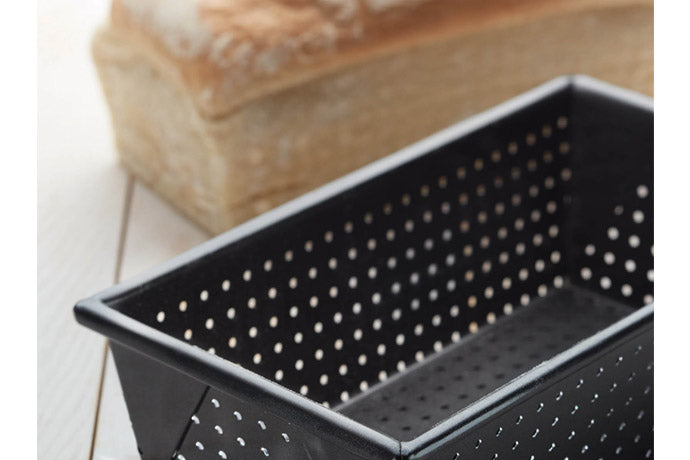
The rectangular perforated mold
This mold works for both sliced bread such as for meat and poultry terrines, as well as for what North Americans call quick breads or quick breads, very dense cakes, that won't seep through the openings.
Although we may think that sandwich bread, by definition, has a soft crust, those of us who bake at home know that A sandwich loaf can be delicious with a nice crispy crust. We recommend you try it.
The Kitchen Craft rectangular perforated pan works wonderfully with terrines wrapped in shortcrust pastry (for example, like this pork terrine); prevents the dough from becoming excessively moist.
Conclusion
We hope that with this review of the perforated molds we have answered the questions you were asking yourselves. And if you want to know more about them, don't hesitate to ask us; that's what the comments section is for. Come in and make yourselves at home at Claudia&Julia's.


Comments
Maria Luz Hernánez said:
Si utilizo el molde perforado de quiche, para hacer una tarta con masa quebrada, he de cubrir el molde con papel de horno?
Quiero vanesa. Costa said:
Quiero. saber. Si los. Aros. Perforados. Sirven para. Hornear merengue
Lilian said:
Buenas tardes, quisiera saber donde puedo comprar los moldes
Puri soriano said:
Necesito molde de 36 sin agujeros
Pablo Antonio said:
Un cordial saludo, desearía saber como varia , la temperatura y el tiempo de horneado entre un molde normal sin perforaciones y un molde con perforaciones. También la ubicación del molde dentro del horno.
Miguel Molina Calfunao said:
Hola, necesito datos para poder realizar compra de moldes.
Te dejo mi número.
9-41250977
Pancho said:
Hola, me compre el molde perforado para quiches de 25,5, es excelente pero me temo que hay que controlar el tiempo de cocción pues si utilizas los tiempos por recetas, se pueden pasar. No he encontrado ninguna sugerencia en la web respecto a los tiempos de cocción, si hay que reducir un porcentaje de lo que las recetas establecen. Si sabéis o tenéis información os agradezco.
Rebeca said:
Hola, acabo de comprar uno de estos moldes para quiche. ¿Ya no hay que perforar la masa con un tenedor o es mejor seguir haciéndolo?