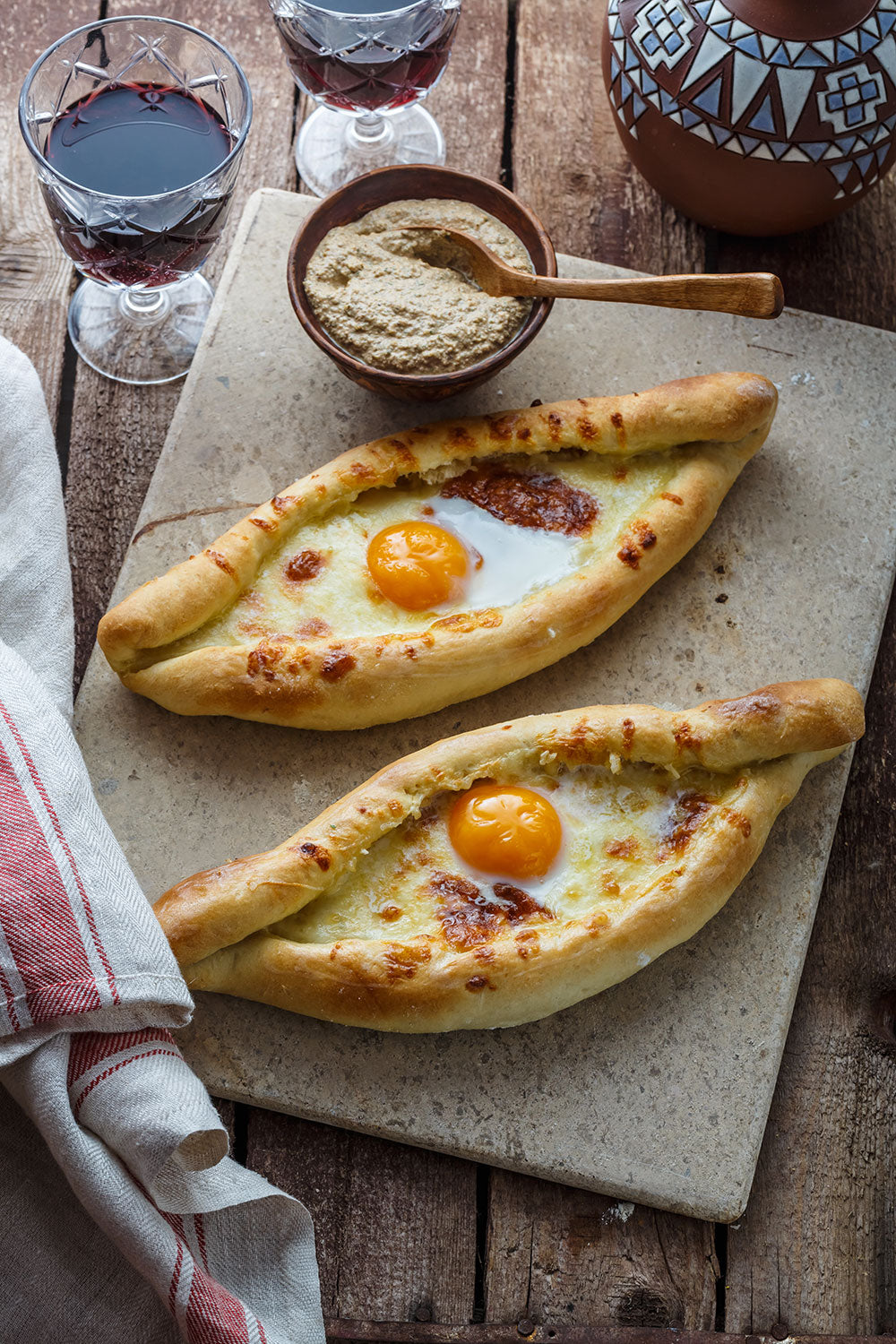
You have to discover how delicious the Adjarian Khachapuri: today I'm bringing an authentic culinary journey to Georgia, where this recipe for boat-shaped bread with cheese and egg comes from, which has captivated the hearts and palates of those who try it.
Imagine a golden and fluffy bread`, with an oblong shape that evokes the waves of the Black Sea`, filled with a blend of cheeses that melt in a delicious symphony of flavors. But that's not all—just before it comes out of the oven, an egg is placed in its center, partially cooking and adding a unique texture and flavor to every bite.
Adjarian Khachapuri is more than just a piece of bread and cheese. It’s a symbol of Georgia’s rich culture, where food is an expression of love and hospitality. Every bite of this creation will transport you to the picturesque cobblestone streets of Tbilisi, Georgia’s capital, or to the natural beauty of the Adjara region, where the sea and mountains blend in harmony. If you’re enthusiastic about trying new flavors, international cuisine, making bread creations, and you love cheese, you’ll adore this recipe.
It’s a recipe with humble origins that, over time, has become a culinary icon—Adjarian Khachapuri has a story to tell. Do you dare to try them?

Which cheeses to use for this recipe
The original Adjarian Khachapuri recipe is made with traditional Georgian cheeses, Imeretian and Sulguni, which contribute to the dish’s unique flavor and texture.
-
Imeretian Cheese: Imeretian cheese comes from the Imereti region in Georgia. It is a semi-soft cheese with a creamy texture and mild flavor. It is made mainly from cow's milk and is known for its versatility in cooking. It can be used in both hot and cold dishes, and is a common component in various traditional Georgian dishes.
-
Sulguni Cheese: Sulguni cheese is another traditional Georgian cheese, originally from the Samegrelo region. It is a cheese with a springy, moist texture, similar to mozzarella. It has a slightly tangy flavor and a distinctive aroma. Sulguni cheese is widely used in Georgian cuisine to make khachapuri and other traditional dishes, as its ability to melt makes it an ideal cheese for fillings and gratins.
If you are in Spain and want to make Adjarian Khachapuri, but you can't find Imeretian and sulguni cheeses, you can opt for substitutes that have similar characteristics in terms of flavor and meltability. Here are some options that could work:
-
Mozzarella: Mozzarella is a cheese that is easy to find in Spain and is known for its ability to melt and create stretchy strands. You can use mozzarella in combination with other cheeses to recreate the texture and flavor of Georgian cheeses.
-
Mild sheep's cheese: Mild sheep’s cheeses, such as young sheep’s cheese, can add a rich, mild flavor to the dish. If possible, look for cheeses that melt well to achieve the right texture.
-
Feta cheese: Although feta cheese has a different flavor from Imeretian and sulguni, its crumbly texture and saltiness can add an interesting touch to the recipe. You can combine it with other cheeses to balance the flavors.
-
Cream cheese: Creamy spreadable cheeses, such as cream cheese, can be an option if you're looking for a smooth, easy-to-work-with texture. You can mix them with other cheeses to achieve a blend that melts well.
In our recipe, what we will do is:
- Replace the cheese Imeretian for a Manchego sheep's milk cheese with a smooth texture and lightly aged.
- Replace the cheese Sulguni for mozzarella.
Let's get to the recipe!
Ingredients (for 2 units)
For the dough:
- 200 g of all-purpose wheat flour
- 100 ml of warm milk
- 50 ml (about 4 tbsp approx.) of water, depending on the flour
- 4 g (1 teaspoon) of fresh yeast
- 4 g (1 teaspoon) of salt
- 8 ml (2 teaspoons) of oil, for greasing
For the filling:
- 200 g Manchego sheep’s cheese (if unavailable, substitute with Imeruli cheese, original to the recipe’s region)
- 100 g mozzarella cheese (or, if available, sulguni cheese)
- milk or cream, a few tablespoons as needed
- 2 eggs
When serving:
- Butter, a couple of tablespoons or cubes to place on top when serving.
Preparation
- Prepare the dough: in a glass, dissolve the yeast in the milk, and add it along with the flour and the 50 ml of water to the KitchenAid bowl. Start mixing with the dough hook attachment, and when the ingredients are incorporated, add the salt. Knead well for about 5 minutes, let rest for about 10 minutes, and knead for another 5 minutes. If needed, you can add a couple more tablespoons of water, and knead for another round with its corresponding rest.
- Remove from the bowl, flour your hands, and fold the dough over itself four times. Place the dough in a bowl greased with oil, cover with a damp cloth, and let the dough rest for 8 hours at room temperature or 24 hours in the refrigerator.
- After the resting time, degas the dough, divide it into two parts, shape each into a ball, and place each one in an oiled bowl, covered with a cloth, or you can leave them on the surface where you shaped them, covered with oiled plastic wrap. Let them rest for another 90 minutes.
- Preheat the oven to 220 ºC.
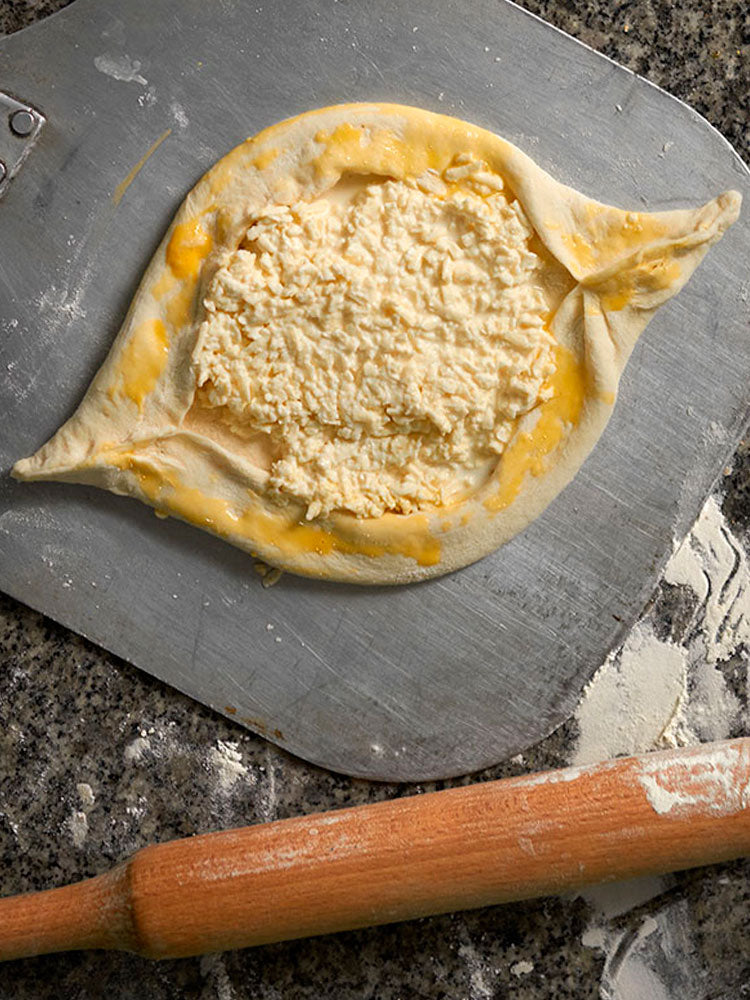
- Meanwhile, prepare the filling: grate the cheeses in a bowl and add a few tablespoons of milk until you see that the consistency is somewhat loose (don’t overdo the milk—add it a spoonful at a time; it shouldn’t be liquid -see photo).
- Remove the plastic wrap from the doughs and shape each ball into an oval (simply using your hands). Once they are oval, fold the long edges over so they have a rim (creating a border), and join them at the narrow ends to obtain a "boat" shape.
- Line a perforated baking sheet with parchment paper or a silicone mat, and transfer the "boats" onto it.
- Add the cheese mixture you prepared inside the boats. Brush the edges with beaten egg.
- Place the tray in the oven and bake for 10-12 minutes (depending on the oven, cooking may take up to 15 minutes.
- After 8 or 9 minutes from when you put the khachapuri in the oven, open the oven and place an egg in the center of each one. Bake until the dough is done and the egg white is set.
- Serve hot, with a teaspoon of butter on top.
Notes:
- There’s an alternative way to shape Adjarian Khachapuri: when you have the dough in an oval shape, first place some well-melting cheese (like mozzarella) along the entire outer edge of the dough, so that when you fold the dough to form the boat, the whole rim is filled with cheese, and finally fill the center of the boat with the cheese filling.
- If you like, you can sprinkle a little oregano on top. It’s not traditional, but it also gives it a great flavor.
- You can give the boat a rounder shape or a longer one; either way, they look super stylish and beautiful.