

Baking bread is always one of the best options we can choose when we want to disconnect and relax a bit. But, if we also want to enhance our more creative side, we can carry out a different shaping like this Pelota Bread.
I remember the first time I saw it; it was in a course I took with Josep Pascual. I have very fond memories of that weekend, and I was lucky enough to meet wonderful people with whom I still keep in touch today. Bread brings people together a lot.
Surely many of you know Josep Pascual; I remember he became known for his very creative breads. He always used shaping techniques different from what we usually saw on social media (at that time there wasn’t as much information as there is now) and decorated the breads with stencils that were somewhat particular. The result of his creations was very eye-catching.
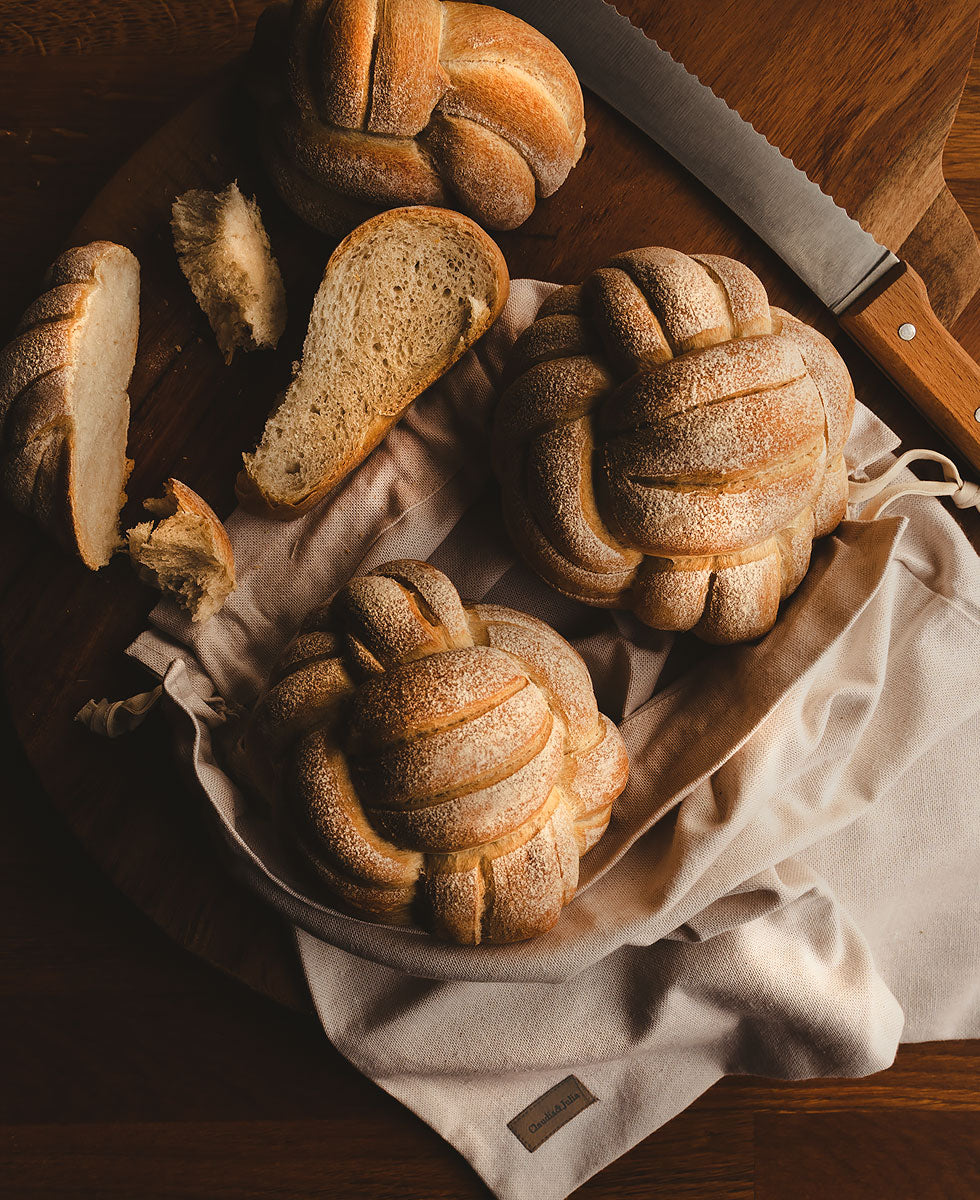
Among all the techniques we learned to do with him, in a bakery in Talaván (Cáceres), one of them was this bread. To be honest, the first time I made it it didn’t turn out very well… Forming the dough strands and braiding/shaping the bread afterward was somewhat complicated at that time. But I really enjoyed the experience and the company.
The recipe I used is not Josep Pascual’s; it is a bread dough that works very well for this type of shaping and with which you will get a wonderful bread for sandwiches, slicing, or whatever you prefer.
Furthermore, I detail the whole process step by step so you can make it at home with very good results. And so you don’t get lost during the process, I link a video where you can see how to do it more visually so there is no room for error.
Ingredients (for 3 breads of 265 g/piece)
- 500 g flour T45 or strong flour W=280, approximately
- 290-300 g water
- 18 g olive oil
- 6 g fresh yeast or 2 g dry yeast
- 9 g salt
Preparation
Prepare the dough for the pelota bread:
- In the bowl of the KitchenAid add the flour together with the water and the yeast.
- Knead at medium speed until you obtain a homogeneous dough.
- Add the salt and knead again until homogenized.
- Once you have a medium-developed gluten, add the oil. Ideally do it in two parts; wait for the dough to absorb the first before integrating the next. This step makes the kneading/integration of the fatty ingredients easier.
- The complete kneading process can take around 20-30 minutos to properly develop the gluten and obtain an elastic, soft, and very well-developed dough. The dough, always after a rest, should pass the windowpane test. To do this, take a portion of dough and slide it between the tips of your fingers. If you can achieve a thin dough veil without it cracking or, if it does, forming a perfect circle, then your dough will be ready.
- NOTE: If you make rests during the kneading process, the dough must always be covered to prevent it from drying out.
Do the first fermentation/bulk fermentation:
- Round the dough, lightly grease a bowl/tupper with oil and place the dough inside.
- Cover with plastic wrap or its own lid and let rise until it increases by ⅓ of its volume. In my case it was 2 hours at 22,5ºC.
- Place in the refrigerator until the next day.
Temper the dough before working it:
- Take the dough out of the refrigerator and temper for 1 hour. The dough will have grown more than 4 times its size.
- With the help of a bench scraper, divide the dough into 3 pieces of approximately 265 g.
- Each piece, is divided into 6 parts of 44 g each. You need 6 dough strands to form each pelota bread.
- Don’t worry if there are scraps of dough; place them in each corresponding piece trying to give a rectangular shape.
- Cover with plastic wrap and let rest for 5 minutes.
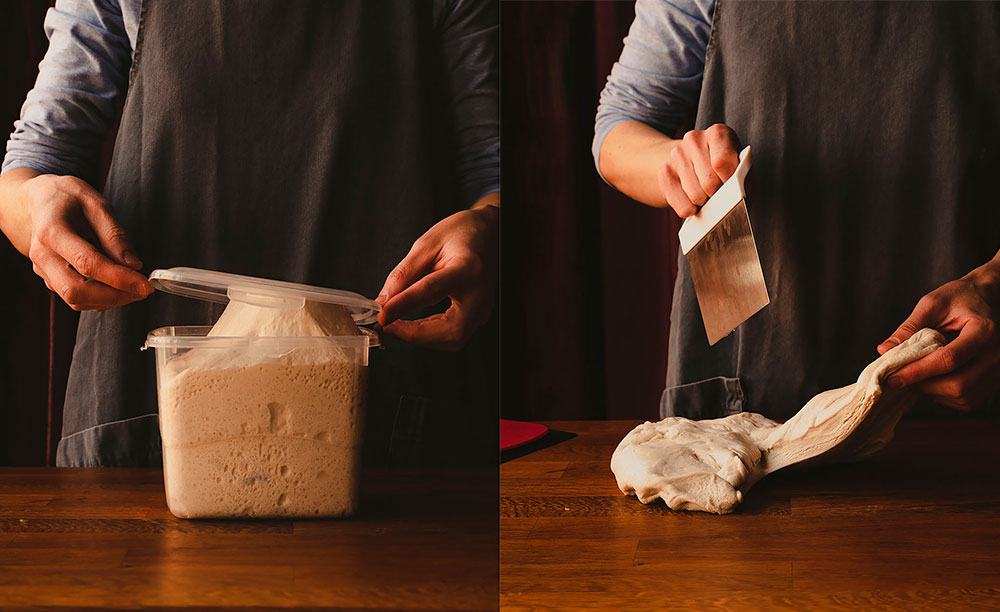
Form the dough strands:
- With the help of a rolling pin, slightly stretch each piece trying to give it a rectangular shape.
- Roll the dough from the widest side to form a strand.
- Place your hands on the piece and slide, at the same time, applying a little pressure to lengthen the dough strand.
- Repeat the same process with the remaining pieces.
- Cover the dough with plastic wrap whenever you have handled it to prevent it from drying out and making it difficult to work with.
- Let rest for 10-12 minutes to encourage the gluten to relax and allow us to stretch the dough well.
- After the rest time, stretch each strand again in the same way as before. Place both hands on the dough and slide, rolling the piece and moving each hand toward an end to give length. We need each dough strand to measure about 40-42 cm.
- If you notice the dough is still tight or tends to shrink back to its original shape, let it rest a little longer to allow the gluten to fully relax.
Form the pelota bread:
- To form each pelota bread, you need 6 dough strands of 40-42 cm in length.
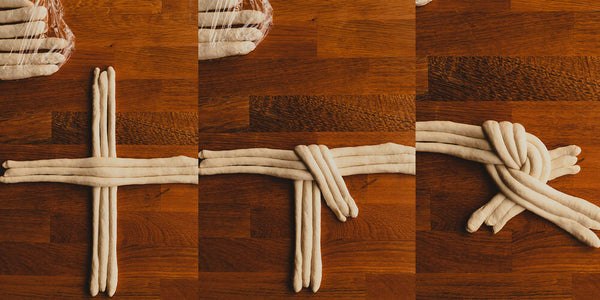
- Place 3 strands, side by side, of dough in a vertical position.
- On top of these, place the other 3 dough strands in a horizontal position forming a cross.
- Take the part formed by three strands from the top of the cross and bring them down, placing them over the right side of the cross.
- Fold the right side of the cross over the portion of dough we just brought down.
- Overlap the bottom part of the cross, bringing it to the right side, over the last part we lowered. The purpose is to braid the dough.
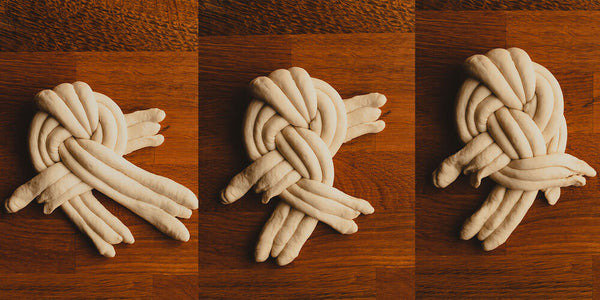
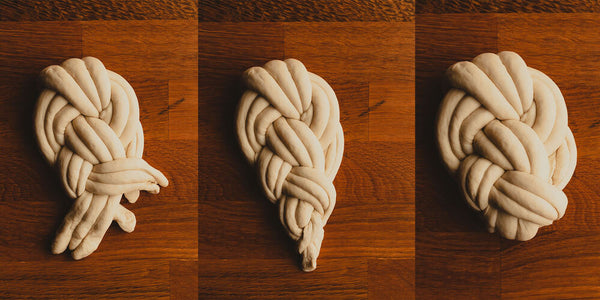

15. Cover with plastic wrap and let rise until they have more than doubled their volume. In my case they were 2 hours at 22,5ºC.
16. NOTE: In this video you can see Josep Pascual forming this bread.
Baking - Option 1) Bake the pelota bread on a baking tray:
- Preheat the oven to 210ºC with top and bottom heat.
- Dust the breads lightly with flour on the surface.
- Place at mid-height and bake with steam for 10 minutes.
- Remove the steam, reduce to 190ºC and bake for 20 more minutes.
- Finally, bake for 5 minutes with fan at 190ºC.
- Remove from the oven and let cool completely on a rack.
- We serve.
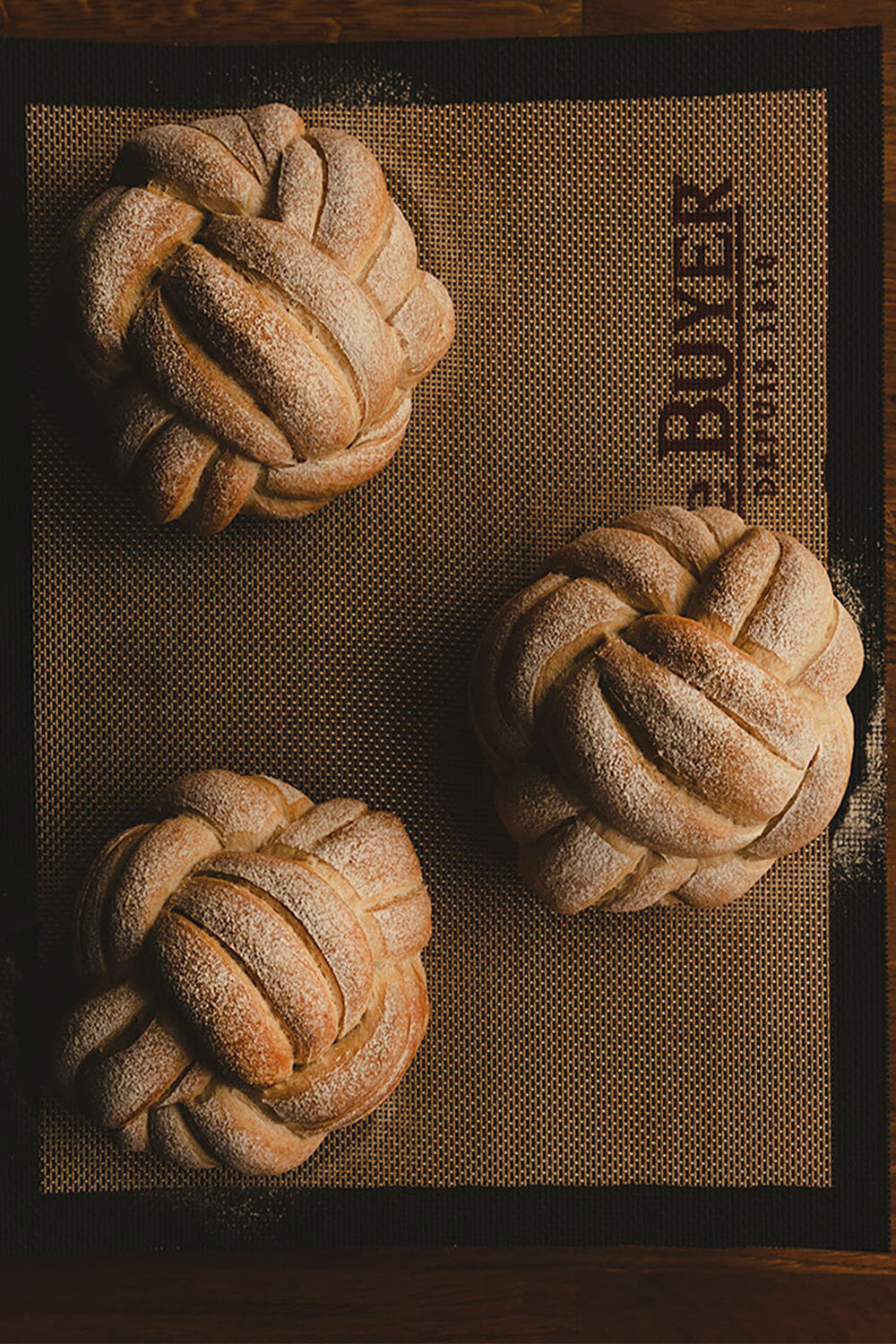
Baking - Option 2) Bake the pelota bread in the bread casserole oven:
- If we use the Le Creuset bread casserole oven, we can fit a single 265 g bread or make a larger bread with all the dough, making better use of the baking time.
- Preheat the oven to 210ºC with top and bottom heat. Place the Le Creuset casserole (base and lid) inside at the same time you turn on the oven to preheat. To be able to bake bread in it, it must be very hot.
- We will place it on the rack and in the lowest part of the oven, the last slot. Ideally preheat 20-30 minutes before putting the breads in.
- To bake a 265 g loaf: Open the casserole oven; using oven gloves, remove the casserole lid and set it on a wooden board.
- Place the pelota bread in the Le Creuset casserole, with baking paper or Teflon on the base; put the lid on, place it inside the oven, and close the door.
- Leave 10 minutes at 210ºC.
- After these first 10 minutes, open the oven door, remove the casserole lid using oven gloves, and set it on a wooden board.
- Finish the baking. Lower the temperature to 190ºC and finish baking without the lid for 20 minutes.
- After this time, set to 190ºC with fan and leave 5 more minutes. This helps dry the bread and improve the crust.
- Once you finish baking, remove and let cool completely on a rack before cutting it open.
- If you prepare a bread with the entire amount of dough listed in the ingredients, you should bake 20 minutes with lid at 210ºC, 25 minutes without lid at 190ºC and 5 minutes with fan at 190ºC.
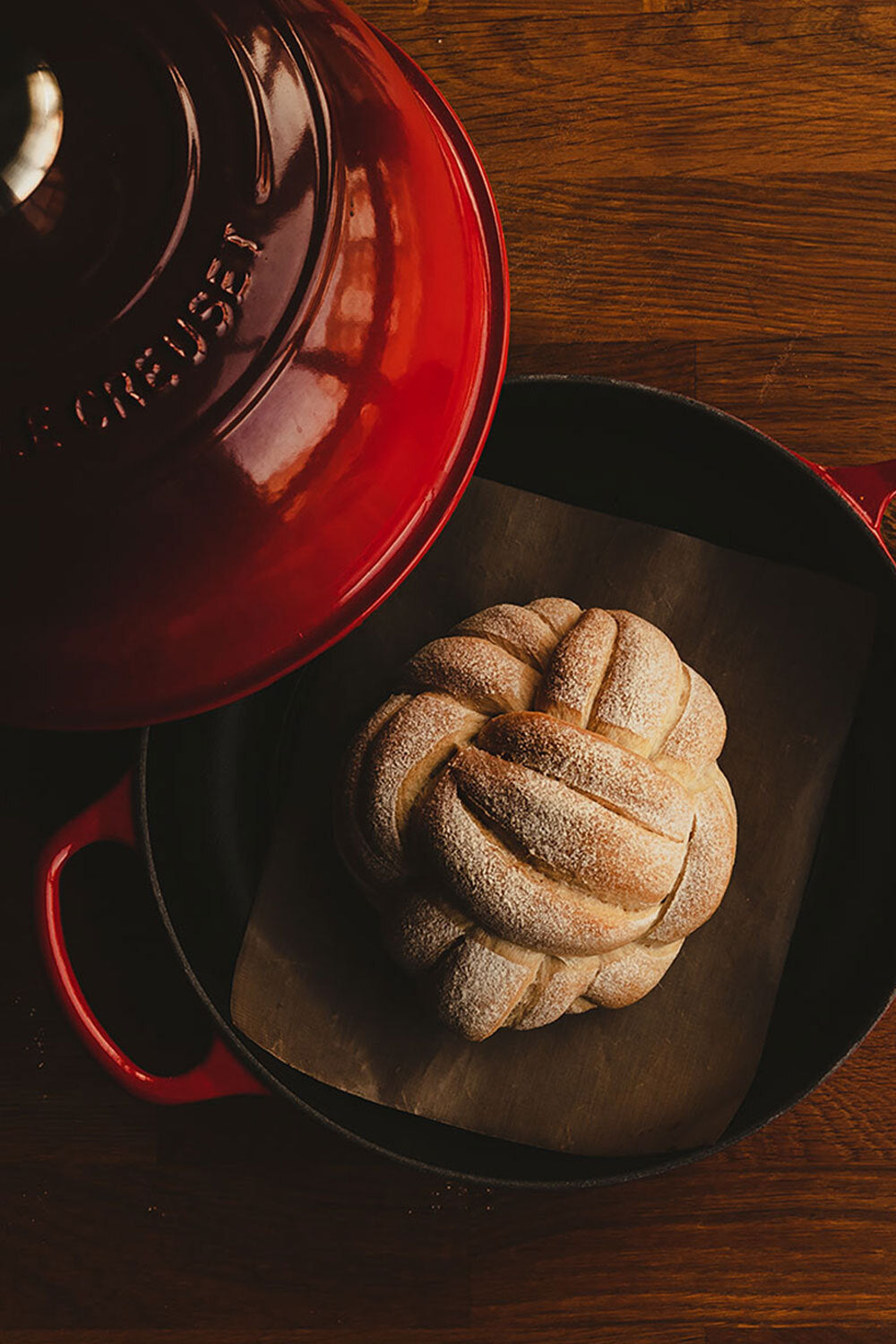
Notes
- Flour T45 is equivalent to a medium-strong wheat flour, with a W=280; the characteristic of this flour is that it has very good elasticity/extensibility.
- Can I carry out the whole process straight through without retarding in the fridge? Yes, you can. Following the same steps I detail, only avoiding the step of retarding it in the refrigerator. Splitting the process into 2 days not only makes it more manageable but also encourages the development of very pleasant aromas and flavors due to a slow fermentation process.
- If you want to do it with sourdough, it can be done without problems. Ideally add a maximum of 20-30% sourdough relative to the final weight of the flour used. Remember to subtract the amount of flour and water from the final dough that you incorporate in the sourdough.
- To know if our bread has finished its baking time, you can check it by pricking with a digital thermometer and checking its internal temperature. It should be around 90ºC.
- The bread can be baked whether on a baking tray, in a casserole, or on a steel griddle. It is important that there is steam during the first minutes of baking to promote its expansion.
- We can store this bread in a linen bread bag for a maximum of 24-48 hours.
I’m sure you’re going to really enjoy making this at home, this Pelota Bread. Not to mention the wave of excitement your friends and family will give you when they see it. They’ll surely be amazed! And we can’t wait to see the results of those wonderful breads.


