

We start the week with very good news! Since many of you are eager to learn how to make bread at home, Eva, author of Bake-Street, has agreed to participate in our blog to encourage you to embark on this delicious journey into the world of baking: she brings a basic recipe for making baguettes at home. I encourage you to read it, follow the tips she gives us and enjoy a delicious homemade bread!
Making bread at home is one of the most rewarding and satisfying things I know. Not only is it a process that relaxes us, but it also allows us to enjoy artisan, freshly baked bread every day.
At the beginning of this wonderful adventure in your homes, I recommend you start with yeasted breads or simple preferments like poolish or sponge. Once you feel comfortable with these types of breads, you can move on to sourdough.
Let's see how to make traditional baguettes, the simplest in terms of process and ingredient use.
The baguette is a bread that everyone likes, with a very thin, crunchy crust, a very distinctive flavor and aroma, and a very soft and airy crumb. If we add that we can enjoy them in about 5 hours maximum, I think there's little more to say… it's definitely worth it, and a lot!
You will notice that the recipe I leave you below uses a small amount of yeast; do not increase it to finish the process sooner. A bread made with little yeast stays fresher longer than one with a lot of yeast, besides making it healthier and tastier.
The shaping process may not be perfect on your first try, but remember that baking is practice and the more loaves you make, the better they will turn out.
To bake the baguettes I used the Emile Henry ceramic oven; it is very similar to a Dutch Oven. In it we can create a perfect environment to obtain baguettes with a soft, airy crumb and a very thin, crunchy crust.
Because it is made of ceramic, during the oven preheating it allows the Emile Henry oven to reach high temperatures — this step is essential to achieve great oven spring and volume for the bread, along with a very thin, crunchy crust. Also, baking it in a closed container promotes steam formation, together with a prior spray on the bread, which will help us obtain greater volume and opening of the cuts.
If you make the recipe with this oven, I recommend following the steps I give in the recipe. It is very important that the Emile Henry oven be preheated beforehand to ensure proper baking of the baguettes and to achieve good oven spring and a thin, crunchy crust.
This ceramic oven has another peculiarity: when it gets very hot it slightly changes color, going from red to a very dark garnet. That way we can tell, when we let it cool, whether it is still hot.
The result is baguettes with extraordinary flavor and texture — you'll tell me! Now let's go through the process.

In the photo, ceramic oven for baguettes by Emile Henry
Ingredients (for 3 baguettes)
300 g bread flour with strength W=180-190
50 g cake/pastry flour
245 g water
0.8 - 1 g dry yeast or 2.4 - 3 g fresh yeast
6.3 g sea salt
1.7 g toasted malt
Preparation
We prepare the dough for our baguettes:
In a large bowl add the two types of flour and mix with a silicone spatula. Add the water and mix until both ingredients are completely combined; there should be no dry flour left.
To mix it we can do it manually or in a mixer using the hook; always mix at the lowest speed for a maximum of 2 minutes.
Cover the dough with a cotton cloth and let autolyse for 60 minutes.
This step allows the flour protein to hydrate, making subsequent kneading easier, and helps us obtain greater volume in our breads.
After this rest time add the yeast. I recommend using dry baker's yeast; it integrates much better into the dough and is easier to dissolve. Knead well, performing the French knead, making sure to fully incorporate it. Then add the salt and proceed to knead again until completely integrated.
How do you perform the French knead?
Place the hands like paddles, with the fingers together; this way we avoid leaving gaps where the dough can slip through. Take part of the dough from one end as if you were going to take a sandwich, and with the thumbs lightly resting on it, lift the dough up and drop it onto the work surface, folding it forward and releasing the end you held. Repeat this process several times.
The kneading between adding the yeast and the salt should not be extensive — just enough to distribute them in the dough so they don't scatter across the work surface. For this bread we should not knead thoroughly; we should perform a short knead.
Once both ingredients are integrated into the dough, perform 3-4 additional folds using the French knead and place the dough in an airtight container or a bowl previously greased with olive oil. Cover with its lid or plastic wrap to prevent a crust from forming, and let perform a bulk fermentation for 3 hours.
During these 3 hours you will need to fold the dough during the first hour every 20 minutes. For the next 2 hours let the dough rise without touching it at around 27-28ºC maximum.
How do you perform a fold?
After the first 20 minutes, uncover your bowl and wet your hands with cold water; this way you can handle the dough without it sticking excessively.
With the folds we will form a sort of square with our dough. Imagine the container is square — it's easier to visualize — take one end of the dough, lift it slightly up and fold it over the dough. Turn the container 180º, take the other end of the dough and fold it over itself.
Turn the container 90º, take the end of the dough and fold it, letting the dough fall onto itself. Finally, turn the container 180º, take the last end of the dough and fold it over itself.
Cover and let rest another 20 minutes.
Once the bulk fermentation time, the first fermentation, has passed, we will need to pre-shape our baguettes.
Pre-shape and shape the baguettes:
Flour the work surface; not too lightly but not excessively either! There may be flour residue between the dough folds, and turn out the dough.
Divide into three equal portions; they will be around 200 g each, and pre-shape. For this take each piece — they will be like small rectangles — and fold the right end over the dough and then the left end. Do not apply too much tension to the pieces because they would degas too much and you would ruin the work done so far.
Cover the pieces with a cotton cloth and let rest for 15-20 minutes.

After this time, proceed to shape our baguettes.
Prepare a linen couche or, if not available, a large linen or cotton cloth; flour it generously. Set aside.
To shape the baguettes it is very important that, before anything else, you consider the length the Emile Henry oven allows for our baguettes; otherwise they would stick out and we couldn't bake them properly.
Take one of the pieces, leaving the rest covered, and place it in front of you. The dough will be more or less rectangular and the longest side will be horizontal to you.
You must “roll” the dough three times to form the whole baguette. The right hand will guide and the left hand will seal the dough as you roll it.
Place the right thumb at the top left end of the dough piece; with the rest of the fingers help lift the dough to roll it onto itself.
Keep in mind that this step must be done 3 times, so visually estimate how much you need to roll.
The left hand will seal; use the index and middle finger to help seal the dough being rolled to aid shaping and apply tension. Do this step until you have rolled the entire piece for the first time.
Once you have completed this first part repeat the process for a second turn and finally a third. At the end you will obtain a cylinder of dough with the seam of the last joint facing you.
Gently slide a bench scraper under the base of the baguette to separate the dough from the work surface in case it has stuck.
Now you will need to give some length to the baguette; remember not to exceed the length allowed by the oven.
Place both hands on the dough cylinder and, with gentle rocking movements, slide each hand toward the ends. Do not insist too much on this step; you could degas the dough and harm the shaping.
Take the baguette and place it on the couche. Repeat this step with the other two pieces.
When placing the baguettes on the linen you should create little gaps by lifting the couche between baguette and baguette. Sprinkle a little flour over the surface, cover and let rise for about 60-75 minutes.
If you do not have a peel to transfer the baguettes from the couche to the oven you can do the following. Place a strip of parchment paper on the couche and place the baguette on it, so that once it has risen it will allow you to move it to the oven without handling it with your hands, since you risk damaging it.
We should not let the baguettes rise in the baguette oven, as specified in the manual, because we need to preheat it well before using it to obtain good results after baking.
When there are 45 minutes left to bake the baguettes, preheat the Emile Henry oven: place the ceramic oven, base and lid, on the rack and on the lowest position, preheat to 250ºC.
After the proofing time prepare our baguettes for baking:
Once we have preheated the oven and are going to put the baguettes in, ideally transport them on strips of baking paper or parchment. It will be very convenient to move them without burning ourselves. If you have a peel, you can transport them on it and slide them into the Emile oven. In that case I recommend to lightly grease with olive oil and sprinkle flour over the oven cavities before heating it, always! (as you use the oven, the cavities will stop sticking to the bars).
Uncover the baguettes and proceed to make the cuts before transferring them to the oven. Use a blade or lame slightly moistened.
This step must be done just before baking; you cannot score the baguettes and leave them like that for a few minutes before putting them in the oven.
The cuts should not be angled; they are practically straight and you should make 3 to 4 cuts on the baguette. Make the first cut roughly in the center of the baguette with a quick, confident movement; do not hesitate or recut over a cut.
The next should be made about a third of the way from the first; you could say they more or less overlap in height.
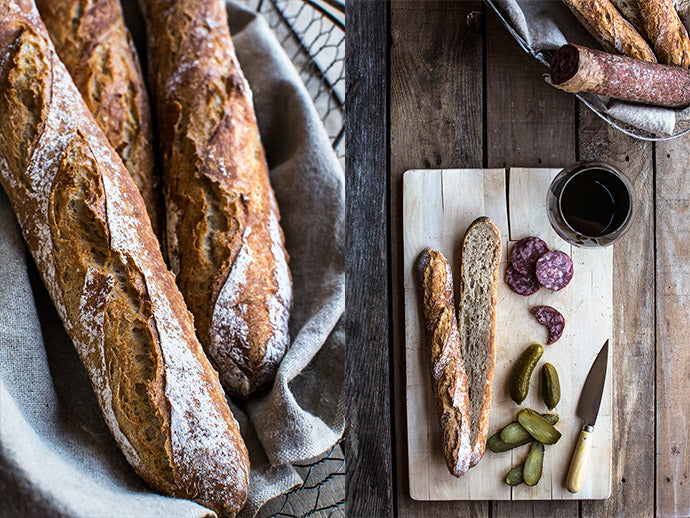
In the photo, breads presented in the Kitchen Craft wire basket (left), and the Pallarès boxwood-handled knife.
Once you have scored the three baguettes, spray a little water on them and place them in the ceramic oven: very carefully remove the ceramic oven lid with oven gloves, and set it on a surface that won't be damaged, the ceramic hob for example. Transfer the baguettes as quickly as possible to the Emile Henry oven and place them in the cavities. Cover again with the ceramic oven lid, close our oven and bake for 10 minutes at 250ºC.
After this time, lower the temperature to 240ºC and bake 10 more minutes. Finally remove the lid of the ceramic oven always with oven gloves, and bake for about 4-5 minutes with fan at a temperature of 220ºC.
It is important that these final minutes are with the fan because it helps with even browning of the baguettes and removes excess moisture, helping to obtain a thin, very crunchy crust.
After the baking time, remove and cool on a rack.
STORAGE: This bread has a short shelf life; ideally consume it the same day it is made or freeze it, very well wrapped in cling film, once it has completely cooled.


Comments
Laura said:
La explicación, tal y como está escrita, es para gente que ha hecho muchas veces pan y sabe cómo es el amasado francés y cómo manipular la masa.
Debería añadirse un vídeo para que los novatos lo entendamos mejor
Paola said:
Creo que no había leído una receta tan difícil.
Más que ganas, me da miedo Hacer este pan, pero me comrpé el molde!
Es posible que pongan un Video con los pasos por favor?
Gracias.
Claudia said:
Muchas gracias Goyo por tus palabras!
A ver si es verdad y nos escribes pronto con tus resultados. Sin duda que es un mundo!! Te invito a ver el blog de Eva, en él encontrarás muy buenas recetas y consejos por lo que pan se refiere: bake-street.com.
Saludos! Claudia
Goyo S. said:
Estupendo post. Yo me estoy documentando para atreverme a preparar pan para casa y asi comentar al experiencia en mi blog. Espero poder traeros algo decente pronto. Es un mundo nuevo!!!