

Burgundy is a beautiful French region famous for the excellent wines grown in its mineral-rich limestone soil. This same soil, and the clay it produces, is the one that Jacques Henry used in the small ceramic workshop he founded in 1850 in Marcigny, in the south of Burgundy.
Today, Emile Henry continues to produce ceramics using the same clay in Marcigny. The company is globally recognized as the France's best producer of ceramic utensils for the French kitchen but it remains in the hands of the Henry family and follows a artisanal manufacturing process that leaves its mark on all its products.
In the video I invite you to watch to learn more about how Emile Henry utensils are made, you can see (right at the beginning) the sixth generation of Emile Henry. Jean-Baptiste Henry, a 34-year-old who currently gives it an elegant character that's very close to the company. I have worked with Jean-Baptiste on several occasions, and he truly is a cultured, very capable person with a very clear sense of where he wants to take Emile Henry.
What did you think of the video? Beautiful. It’s a testament to the care Emile Henry puts into all its creations and pieces. Sometimes we wonder what makes one recipe different from another when we use the same ingredients, the same cooking time, the same steps. With care and by using truly authentic cookware, you get the best results. Emile Henry manages to bring together tradition, quality and respect for cuisine.
Each piece is handcrafted with the proper dimensions and the proper depth to cook and bake our recipes perfectly. In addition, the ceramic it distributes heat gradually and evenly, ensuring healthy and delicious cooking since the food does not undergo sudden changes in temperature better preserving its flavors and nutritional properties.

Thanks to their unique manufacturing process with firing at 1100ºC, Emile Henry ceramic utensils have a highly resistant finish to the impacts that occur in the kitchen and to temperature changes. We can take an Emile Henry piece from the freezer to our oven preheated to 250ºC or directly to the microwave. Its glaze is so hard that we can cut our preparations directly in an Emile Henry baking dish or Shallow Casserole.
Emile Henry has also developed a range of Dutch ovens, casseroles and tagines called "Flame" with a thermo-diffuser base that can be used on any type of flame: gas,electric, ceramic cooktop or even induction with the special Emile Henry disk. In addition, they are still lightweight utensils, easy to handle, which can even be cleaned in the dishwasher.

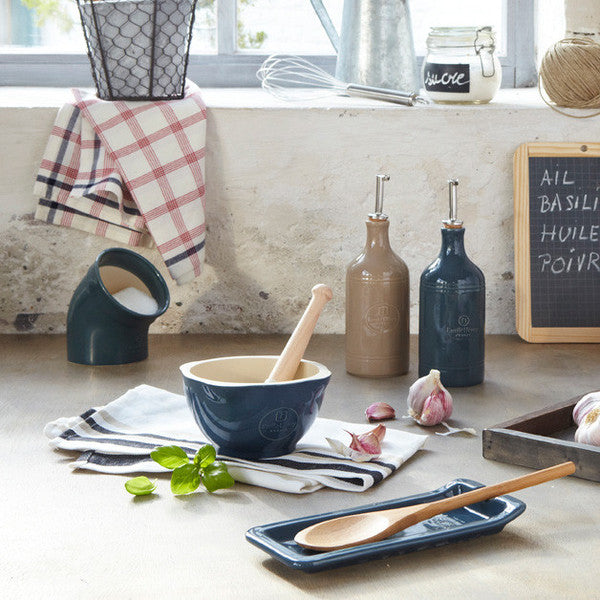
I would also like to highlight Emile Henry cookware such as the spoon rest, the salt shaker, the mortar or the oil dispenser. They are beautiful pieces, very durable and highly functional. The Emile Henry mortar, with its rough interior finish, is one of the best mortars we have tested. The oil cruet, besides being beautiful, has the big advantage is that it preserves all the oil’s flavor and properties because it prevents light from reaching it, one of the main enemies of oil.
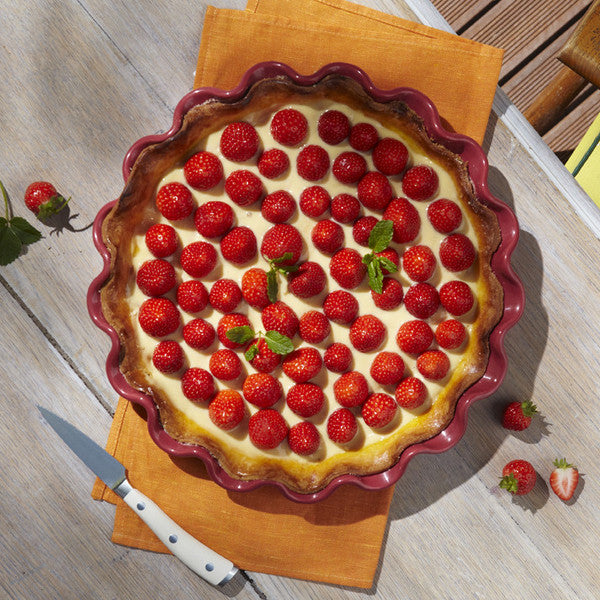
And for my bakers... How could I possibly forget about tart and cake molds! More than a few of you reading this post already have them at home, and I’d like you to tell us about your experience. I love it when you send me your recipes! It’s a joy and a great pleasure to work with these tools because, besides, they bake our cakes perfectly because they maintain a perfect moisture level, unlike silicone or aluminum pans.
Another characteristic of Emile Henry is innovation and its interest in designing utensils that help us to achieve perfect results in the kitchen. Emile Henry offers specialized utensils for making fondants, flans, tarte Tatin, crema catalana, caramel, soufflé, or cooking homemade pizza. My eldest son always asks me for my famous 4-cheese pizza—you can't imagine how it turns out! You can smell the Roquefort from here. Emile Henry's latest creation is a cloche for baking bread in our own oven. This cloche It recreates the humidity conditions of a traditional oven, so you get a perfect loaf, soft on the inside and crusty on the outside.

For now, these are some of the benefits I wanted to share with you about Emile Henry ceramics. If you have any questions, you can write to me below this post, on Facebook or Twitter @ClaudiaAndJulia


Comments
Elena said:
Quiero saber si también tiene hierro o son solo de cerámica
Claudia&Julia said:
Hola Mee,
Las cocottes cerámicas de Emile Henry son totalmente aptas para usar en vitrocerámica. En la única superficie que no pueden ser usadas es en inducción. Para el resto, ningún problema.
Muchas gracias y un saludo.
Mee MV said:
Cocotte
Mee MV said:
Hola. He comprado una cohorte pero leyendo este post, en la descripción del artículo no especifica “Flame”. No serviría para ser usada en mi vitroceramica?
Si podéis ayudarme, por favor. No sea que tenga que cancelar pedido.
Saludos
Maria said:
Hola!
Acabo de comprarme una cocotte de esta marca, por ahora la voy a utilizar para hacer guisos, pero quiero probarla para hacer pan también.
Pero no tengo mucha idea, tengo qur calentarla en el horno antes de meter el pan.
Gracias