
At home, a strong contender has emerged to traditional rice pudding, and this is because this coconut rice pudding recipe is just as delicious as the classic one, but with a coconut flavor that only adds to it. It stays just as fresh, creamy, delicious... but when you taste it, you wonder what it is that makes you want one more spoonful.
I think the coconut flavor gives the usual rice pudding a touch of lightness and a slightly exotic aroma. Exotic in the sense of curious, different, dangerously addictive (not in the sense of adding a tropical flavor).
When I talked about this recipe, some people asked me: "But what does it taste like?". It tastes exactly as its name suggests: it is the usual rice pudding, but with a hint of coconut. If you like coconut, you have to try it because you'll love it.
It's a very simple recipe. I make it in a pressure cooker, which saves a lot of time, but I also tell you below how to make it in a traditional pot.
Milk and rice ratio for rice pudding
The rice-to-milk ratio for traditional rice pudding is usually 100 g of rice per 500 ml of milk (in this case, milks, plural).
In this recipe, the ratio is a little lower because we're making a large amount of rice, and the level of liquid reduction is proportionally lower when we are adding 2 L of milk.
With the ingredient amounts in this rice pudding, you get a very runny rice pudding at first. That's how we've always liked it at home, but keep in mind that over the hours the rice will absorb that liquid and it will thicken. In "Notes" I tell you more about this.
Amount and type of sugar in rice pudding
I always make rice pudding with regular white sugar. It's a dessert, and I think rice pudding should be sweet, just enough to enjoy it to the fullest. For that reason, I recommend using 175 to 200 g of sugar, but if after tasting it you want it sweeter, you can add a generous spoonful more when you finish preparing it.
You can partially or completely replace the sugar with brown sugar or coconut sugar (to enhance the flavor), but keep in mind that it will be a little darker and lose that white touch of traditional rice pudding.
Below you have some more considerations, but I think it's time to get to the recipe.

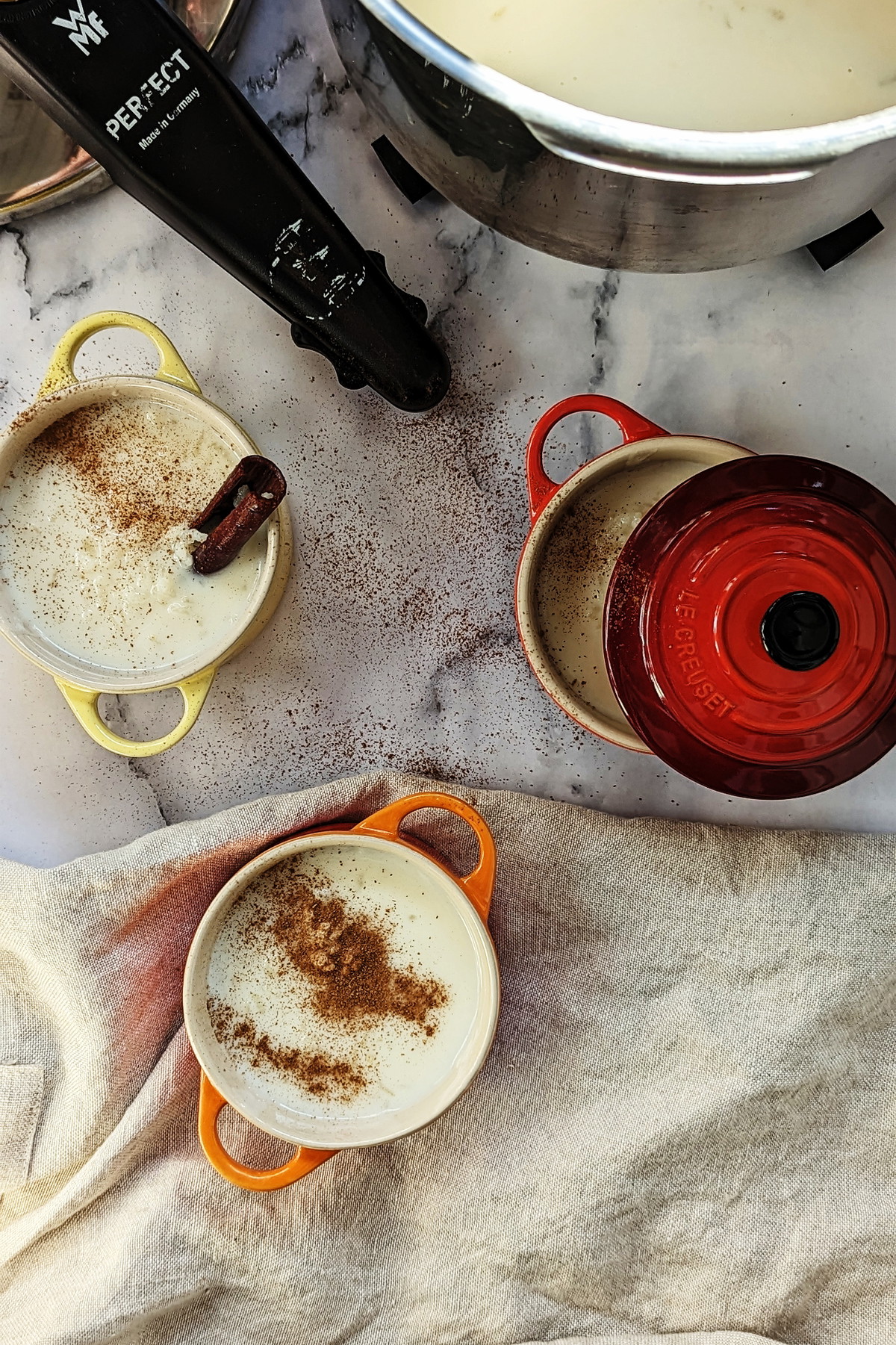
Perfect WMF Pressure Cooker and Le Creuset ceramic mini cocottes
Ingredients (for 8 servings)
- 1 l coconut water
- 1 l semi-skimmed or whole cow's milk
- 250 g bomba rice
- 190 g white sugar
- Peel of 1 lemon
- 2 cinnamon sticks
- For serving: ground cinnamon and, optionally, cocoa powder
Pressure Cooker Rice Pudding Recipe
- In the Perfect WMF pressure cooker, pour in both milks, the rice, the lemon peel, and the cinnamon sticks. Stir with a spatula, close the cooker, and put it on the heat.
- When the rings rise, start counting 12 minutes and after that time turn off the heat. Let it release pressure on its own.
- When the rings drop, that will be your sign that you can open the lid. Open it, add the sugar, stir, and leave it on the heat for 2 or 3 minutes more, with the lid off and stirring from time to time. Turn off the heat and let it cool down.
- Remove the lemon peel (otherwise, the rice may turn a little sour over the hours), transfer all the rice to a large airtight container so you can store it in the fridge or directly into mini cocottes (which have lids, so they'll already be ready to serve).
- Keep in the fridge for at least 3 hours, so it cools and the flavors settle.
- At serving time, sprinkle a little ground cinnamon on top.

Le Creuset ceramic mini cocottes
Traditional Pot Rice Pudding Recipe
The step-by-step method is exactly the same as above, but you'll need to leave it longer*: put all the ingredients in your pot except the sugar, let it cook for about 45 minutes, stirring from time to time, and when you see that the rice is cooked and the milk is thick (but still in a good amount), add the sugar.
Mix for a couple more minutes, turn off the heat, and let it cool down.
Keep it covered in the fridge for a few hours, and serve with cinnamon.
Notes
On how to get a runny rice pudding:
- At home we love rice pudding very runny, but if you want it thicker you can increase the amount of rice by 50 g, or reduce the amount of milk by 100 ml of each type of milk.
- Remember that the rice will continue absorbing some of the milk in the hours that follow. So, it may seem very runny at first, but as it cools and absorbs some of the liquid, it will end up denser and less runny than when you finish the recipe. That is why it's interesting to turn off the heat while there's still a good amount of liquid, or make it with a rice/milk ratio of approximately 1 to 3 (100 g of rice for every 300 ml of milk), to ensure there will be milk left unabsorbed.
- *Keep in mind that the pressure cooker helps you save about 65% of the time, but the cooking time is always estimated because depending on the milk and brand of rice you use, as well as the heat level you apply, cooking may vary by a few minutes. In any case, check the rice or taste it to make sure it's cooked (the grain in rice pudding should be very soft), and the amount of milk is still very important, but thick).
Other notes:
- You have to try coconut rice pudding with a little cocoa sprinkled on top! It's delicious: the coconut flavor pairs very well with the cocoa flavor, so coconut rice pudding mixed with cocoa becomes a delicious cocoa dessert.
- With the milk ratio at 50% (50% cow's milk, 50% coconut water), the rice pudding already takes on a very pronounced coconut flavor. That's how I like it, but you can vary these proportions to taste (30% and 70%, for example). I recommend trying it at 50% and from there deciding whether you want more or less coconut flavor.
- I used coconut water, but you can also use coconut milk. Since it's a bit thicker, it may suit you to reduce the amount of coconut milk slightly to 40%.
- Sweetness level: with that amount of sugar you get a sweet rice pudding like I remember from my grandmother's, but you may want to use less. If you want, you can use 175 g of sugar and taste it when you turn off the heat. If you want it sweeter, add the missing 25 g or a little more to suit your taste.
- You can replace some of the sugar with brown sugar or also coconut sugar. Keep in mind, though, that:
- These sugars are less sweet than more refined ones, so you'll need a larger amount. Try it to find the rice pudding you like.
- The color of the rice pudding will become a little darker.
 Perfect WMF Pressure Cooker and Le Creuset ceramic mini cocottes


Comments
keyra said:
me gusta mucho esta receta.
keyra said:
me gusta mucho esta receta.
keyra said:
me gusta mucho esta receta.
Claudia said:
Hola Pilar, me alegro que te animes con ella, y te animo encarecidamente a hacerte muy amiga de tu olla rápida :) son una maravilla!! Sobre el tema del fuego, lo ideal será bajar el fuego cuando ya has alcanzado la presión adecuada, porque en el momento en que las anillas están subidas significa que la presión ha alcanzado la presión adecuada, y lo único que requieres es de mantener esa presión (si pones mucho calor de llama te exdecerás de calor, y la olla soltará vapor para liberar esa presión, lo que no tienes porque llegar a eso)…. lo interesante es solo mantener las dos anillas arriba y con el fuego al mínimo debería bastarte).
¡Ya nos contarás qué tal te ha resultado!
Pilar de Paz said:
Claudia para el arroz con leche cuando suban las anillas bajo el fuego a mínimo durante 12 minutos ó lo dejo a fuego máximo??
Gracias
Pilar de Paz Toledo said:
Muchísimas gracias Claudia….lo haré de nuevo. Aún así salió exquisito👌
Claudia said:
Hola Lucas, sí, la verdad es que el arroz con leche de siempre está riquísimo¡Pero este con leche de coco le hace sombra! Me alegra de que te haya gustado, un saludo y gracias por tu comentario.
Claudia
Claudia said:
Hola Andrea, esta receta ya está pensada para más de una persona, da para 8 raciones (indicado en ingredientes), y son de hecho raciones generosas. ¡Verás que alimentas a un buen regimiento! :) Saludos, Claudia
Claudia said:
Ya verás Aitona lo rica que está :) ¡A por ella!
Claudia said:
¡Me alegro mucho Juan Carlos! La verdad es que queda genial con ese toque de coco, verdad? , me alegro de que te gustara y gracias por compartrilo aquí!
Saludos, Claudia
Claudia said:
HOla Down, muchas gracias! La verdad es que sale realmente deliciosa, te animo a probar.
¡Saludos!
Claudia said:
Hola Pilar, gracias por comentar tus dudas. Ese pitido que comentas se debería escuchar, pero normalmente debería ser un ruidito de cierre de la válvula, y sucede al coger la olla presión y subir las anillas de presión. Justo eso es lo que la cierra y ayuda a que no se escape el vapor, aumentando la presión y cociendo a mayor velocidad (solo se relajará si la presión sube demasiado, para controlar dicha presión). Es lo normal y lo que debe ser. Lo que te diría es que si no es un ruido “normal” o no crees que sea eso, mándanos un vídeo para observarlo a tienda@claudiaandjulia.com y lo vemos.
Sobre si una anilla o dos, puedes hacerlo perfectamente con 2 anillas, y de hecho es difícil controlarlo a una anilla con tanta cantidad de contenido. No lo recuerdo bien, puede ser que en el libro esté con 1 anilla por hacerse con menos cantidad, o a fuego más suave…. En todo caso lo revisaremos, pero esta receta está hecha a dos anillas y tal cual indicada, y sale estupenda :) ¡Te animo mucho a probar! Saludos y a disfrutar de olla!
anonimus said:
wooooowww deliciosa que buena piiintaaa
Andrea said:
hola, muy buena receta, aunque me gustaria saber las porciones para más de1 persona
Lucas said:
Buenos Días, el arroz con leche es una maravilla sigue así.
aitana said:
Muy buena pinta. Apuntado para hacerlo.
Juan Carlos said:
hice el arroz con leche de coco y me quedo sabroso
Antonio Javier Yebes Ruiz said:
Que rico.
Donw in Ohio said:
Esta muy chuuuuli esta receta
PD : Donw in Ohio
😭 said:
me hicieron poner esto por deberes
Pilar de Paz Toledo said:
Hola…..Compré la olla, de 8L. hace un mes. He hecho el arroz con leche. En la receta decís que cuando “suban las anillas” (entendí que las dos anillas) contar 12 minutos. Así lo he hecho y a falta de casi seis minutos para terminar la olla empezó a hacer un ruido,especie de pitido seco. La apagué inmediatamente. Mirando el libro veo que el arroz con leche se hace con sólo una anilla,no con las dos cómo hice yo. Es una equivocación de la receta ó del libro de la olla?Gracias
Claudia said:
Hola Susi, sin probarlo no me gusta mucho dar cantidades pero yo seguiría exactamente la misma receta, pero añadiría un poco más de leche (unos 50 o 100 ml más) , fácilmente el arroz integral requerirá de más líquido para hidratarse y quedar jugoso. ¡Saludos!
Susi said:
Hola , quiero hacerlo , pero con arroz integral . Sabrias decirme los liquidos , leche y agua coco , en que proporciones seria recomendable . Gracias Susi