
Last week Virginia, author of Sweet&Sour, gave us an introduction to jams and preserves, explaining the differences between jams, preserves and jellies, and describing how to make them.
But when making jams there is one very important thing to keep in mind: how to make them last a long time, since we often use seasonal fruit to make jam so we can enjoy it all year.
Well, today Virginia talks exactly about that: how to sterilize jam correctly in jars, and how to vacuum-seal so our preserves last 6 or even 12 months.
III.- STORAGE
The best way to store homemade jam is in “sound” glass jars that are properly sterilized.
The glass jar should be free of nicks or cracks and the lids should seal properly. In the kitchen utensils section of our shop, you'll find preserving jars with a French closure, which also have a lid you can remove completely, making them convenient to use and clean, and to present directly at the table (you can see them here)
The best way to know if a lid seals correctly is to fill the jar with water, close it and lay it on its side. If it leaks, that lid won’t do and you’ll need to replace it.
Once the jars are sterilized, the best way to fill them is with the help of a special funnel for preserves, which has an opening wide enough for the jam to go into the jar without problems, but narrow enough to fit the jar mouth. There are also ones with an adjustable neck, so they easily adapt to the mouths of jars of different sizes.

Glass jar with French closure; wide-neck funnel special for preserves.
IV.- STERILIZATION OF JARS
VACUUM AND PASTEURIZATION:
To sterilize the jars before filling them with jam, you can wash them in the dishwasher, which reaches high temperatures, but for greater safety I recommend the following method:
- Fill a large thick-bottomed pot with water and put it on the heat. Submerge the jars well covered by the water (about 3-4 fingers) with their lids loose. Use cloths to separate the base of the jars from the pot base and to separate them from each other so they don’t knock against each other while boiling, as they may crack.
- From the first boil, count at least 10 minutes. Let them cool inside the water to avoid sudden temperature changes that could break the jars.
- Remove them, preferably using special tongs designed to maintain sterilization and avoid burning yourself, and let them dry upside down on a clean cloth or on absorbent paper.
- Do not fill or store them in the pantry until they are completely dry.
Once filled with hot jam, we must create a vacuum to remove the air that allows the proliferation of undesirable enemies to safe preservation.
The quickest method is to put the hot jam into the dry, previously sterilized jars using a wide-mouth funnel, filling them almost to the rim. Seal the lids tightly, using tongs, and place the jars upside down until they cool.
This way we achieve a kind of vacuum that allows storing the preserve for 6 months. Preserves sealed this way are better kept chilled than at room temperature. In any case, always store in a cool, dry, dark place.
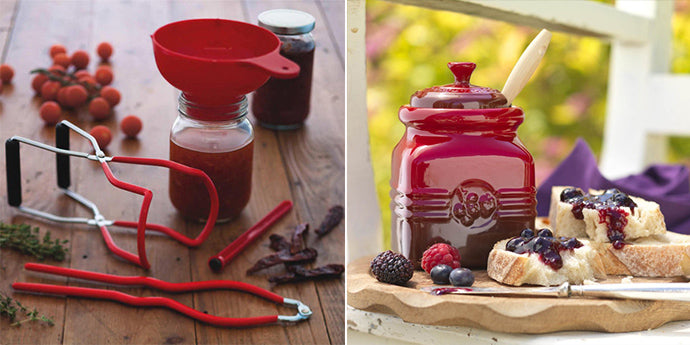
Preserves preparation set (left); Le Creuset jam jar
However, the most advisable method, if we want our jams to last longer safely, is to vacuum by pasteurizing their contents: once our jars are filled with the preserve and hermetically sealed, place them upright in a pot with cold water covering them about 3-4 cm above. Put cloths in the base and sides to separate them from each other so they don’t knock.
From when the first boil starts keep them for about 20-30 minutes for small and medium jars, since jams have a high sugar content, which itself acts as a good preservative, so the time is reduced. Other preserves require up to 45 minutes of cooking for complete pasteurization.
If the water bath is done in a pressure cooker, the time is halved. I use my pot WMF Perfect, which has two "rings". To give you an idea, I do the pasteurization with a single ring.
Once the time has elapsed, turn off the heat and leave them inside the pot until they are warm enough to remove. Take them out with the tongs, dry them and place them upside down until completely cooled.
When you turn them over, the lid should be slightly concave, that is, slightly curved inward. That will mean the vacuum was created correctly.
With this system, the preserve’s shelf life is longer, 1 year, and it can be kept without refrigeration in a cool, dry place protected from light.
V.- LABELING AND PRESENTATION
Jams prepared this way should be labeled with the preparation date so you always have them under control, and if you’ve prepared several jars, number each one, mainly to keep track of how many are left.
It’s advisable not to use excessively large jars, because once opened the air that enters tends to spoil them more easily if they’re not consumed within a certain time. From my experience the best are those from 200 ml to 500 ml.
If you’re going to use jams as gifts, I recommend putting some pretty fabric or paper toppers on the lid, and an attractive label... or a rustic-looking twine which also looks great!

NOTES: Remember that if you’re looking for inspiration to make your own homemade jams, you have several recipes you can try:
- Peach jam, in the almond cake with jam recipe
- Rhubarb and Banana Jam with Citrus
If you’re interested in making your own preserves, there’s a book you might like: From the Garden to the Pantry, by Mariano Bueno.


Comments
Claudia said:
Hola Adolfo, muchas gracias por tu amabilidad. Un saludo!
ADOLFO PRADO said:
excelente lA DESCRIPCION
Miquel said:
El quid de la conservación está en evitar actividad biótica. Hongos y bacterias principalmente. Hay parámetros de ph y de actividad de agua (o concentración de azúcar) que nos indican si es o no necesario esterilizar. Estoy investigando los límites a tal efecto. Si alguien conoce algún libro técnico… Por mi parte creo que el ph inferior a 4,2 y azúcar por encima del 50% hacen innecesaria la esterilización y duran mínimo un año. Gracias
ana said:
Hola, si lo que quiero es consumirla sobre la marcha, y me sobra algo. ¿ también tendría que hacerlo? o esto es solo para conservarla? muchas gracias
Claudia said:
¡Me alegra mucho que te sea útil, Virginia! Un saludo!
Virginia said:
Me ha parecido muy interesante, me encanta hacer conservas y hay cosas en este post que me resultarán muy útiles …gracias por compartirlo