
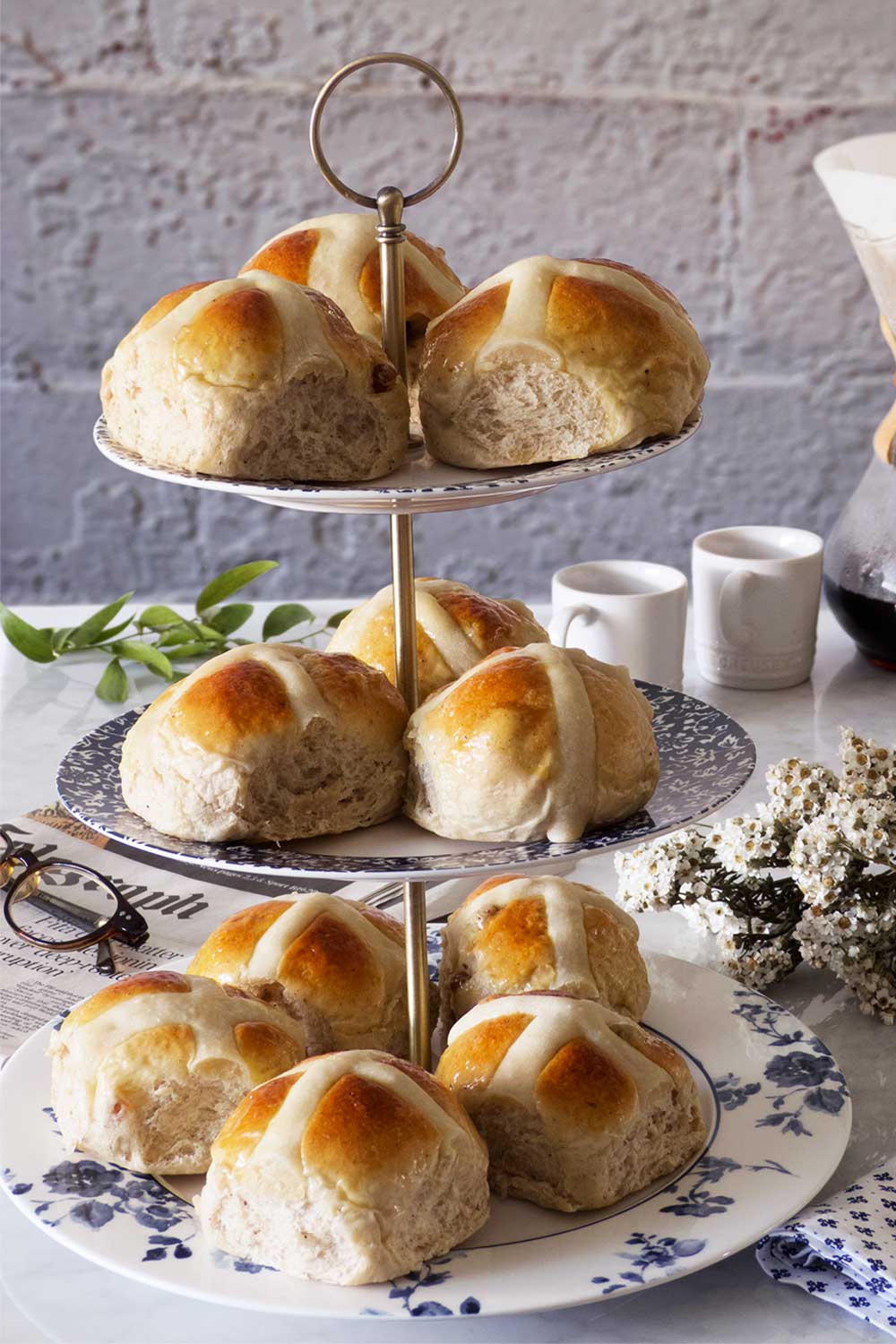
We couldn't get to this time of year without the Hot Cross Buns recipe, those delicious traditional Easter buns, filled with raisins and marked with that cross that makes them so recognizable, so beautiful and so tempting. The truth is that there are many stories surrounding them, Rosa (author of Pemberley Cup&Cakes) tells us about some of them -You'll see how beautiful they are!-, and brings us this delicious recipe so you can make them at home too. A very happy Holy Week!
I must tell you that on this occasion I'm especially excited to bring you this recipe and be able to share it with you. The hot cross buns, for those of you who don't know them yet, They are tender spiced buns, lightly sweet, studded with raisins and crowned with a distinctive cross-shaped mark on top. It is a traditional British recipe, typical of Easter, commonly eaten since time immemorial for Good Friday breakfast. But it doesn’t stop there.
As with most time-honored recipes, there are several versions today that attempt to explain their origin. One of the most popular refers to the custom of a 12th-century Anglican monk who began marking the buns he baked with a cross to celebrate Good Friday. Others maintain that this unmistakable cross has no connection to Christianity, but rather goes back to Celtic culture and represents the intersection of earth and sky, the human and the divine. It has even been said that it symbolizes the four elements of nature (earth, fire, water, and air), and even the four phases of the moon.
As a fun fact—I love this kind of thing—Queen Elizabeth I issued a decree in 1592 that prohibited their sale except on Good Friday, at funerals, or at Christmas (some say to curb Catholic references, others to prevent their supposed healing or beneficial properties from being depleted by overuse). If someone was found ignoring this measure, they were forced to donate all their "illegal" buns to the poor. So people got used to making them at home. But their popularity only kept growing and the law became harder and harder to enforce, so it was eventually repealed. Nowadays, they’re sold all year round.
Whatever their origin, symbolism or mishaps that occurred, these hot cross buns have always given rise to a whole series of superstitions and legends, such as that buns baked on Good Friday stay fresh all year, or that if they are hung in the kitchen, they will protect the house from evil spirits and fires. Sailors used to carry them when setting sail to protect themselves from shipwrecks, and even farmers hid them among their crops to drive away rats and other pests. It is also believed that sharing one of these buns with a loved one ensures a good relationship for a whole year.
Once properly introduced, I think it's time I leave you with the recipe for these iconic hot cross buns, based on that of one of the most followed and revered British bakers today, Paul Merry. I really hope you enjoy them!

Laura Ashley porcelain stand, Laura Ashley kitchen towels, Chemex coffee maker, Le Creuset espresso cups and Laura Ashley porcelain plates
Ingredients (for 15 buns)
All ingredients must be at room temperature, unless otherwise indicated.
For the preferment:
- 280gr of milk
- 14 g fresh yeast (or 4,5 g dry yeast)
- 120gr of bread flour
For the bun dough:
- 70gr raisins (I used sultanas)
- Sweet wine or rum, to soak the raisins
- 25gr of candied orange peel, in small pieces (optional)
- The previous preferment
- 400gr of bread flour
- 1 egg (L)
- 45gr of sugar
- ½ teaspoon of salt
- 15gr (3 teaspoons) of spice blend*
- 65gr of butter
- 1 egg + 1 teaspoon of milk, for brushing
For the crosses:
- 75gr of strong flour
- 60-75ml of cold water
For brushing (optional):
- 30gr of peach jam, hot
Preparation
Of the preferment
- In a large bowl (such as this glass from Mediterránea, in which I also performed the subsequent kneading) we combine all the ingredients of the preferment until we obtain a smooth, lump-free texture.
- Cover with plastic wrap and let it ferment for about 45 – 60 minutes, or until it takes on a light, fluffy texture (you’ll see tiny bubbles on the surface).
From the mass of the buns
- To begin, soak the raisins (and the chopped candied orange peel, if using) in the liqueur in a small bowl and set aside.
- Once our preferment is ready, we add the flour, sugar, egg, spices, and salt and mix with a spatula until the ingredients are more or less combined, although the mixture will still look quite rough. Next, we start kneading (in the same bowl, as I did this time, on a work surface or with the help of a electric stand mixer) until everything is well combined; the dough will still have a somewhat sticky texture.
- Next, add the butter in several batches, kneading well between each until fully incorporated, and continue kneading until you have a soft, elastic, and smooth dough.
- Next, we roll out the dough with the help of a roller on a lightly floured work surface, and scatter over it the raisins (and the candied orange peel, if using), well drained, fold the dough over itself with the fruit inside and knead again until it is well incorporated and evenly distributed throughout the dough.
- Finally, shape into a ball and place in a bowl greased with a thin layer of oil (sunflower, for example, which doesn’t add flavor). Cover with plastic wrap and let rise in a warm, draft-free place until it doubles in size, which can take about 1 – 1 ½ hours.
- Once our dough has risen, we divide it with the help of a knife large and very sharp or a baker's scraper into 15 equal portions (mine came out to approximately 65gr; it would also be very useful here to have a kitchen scale). Next, shape each of the rolls, rounding each portion well until the surface of the dough is smooth and even.
- We then place the buns already formed on a De Buyer nonstick tray, leaving a minimal gap between each one, so that they will later merge as they grow.
- Preheat the oven (electric, no fan) to 190ºC and place the rack in the middle position.
- In the meantime, make the paste for the crosses by combining the flour with cold water in a bowl. It should be a smooth, fairly thick paste, yet flexible; start by adding the water gradually until you reach the desired consistency.
- Once ours have visibly grown buns (it's not necessary for them to double in volume again), we brush with the egg and milk mixture with a pastry brush and we make the crosses with the help of a piping bag.
- We insert the tray with the buns in the oven and bake for about 18-20 minutes until they take on a nice golden color on the surface.
- Right after taking them out of the oven, we brush them this time with a little peach jam (previously warmed) to give them shine and let them cool on a rack.

Mediterranean Glass Bowl, Le Creuset ceramic spoon rest and Kitchen Craft measuring jug
I recommend eating them while still warm or, failing that, split in half, toasted, and spread with a little butter. The first day is the best to enjoy some hot cross buns extremely tender and fragrant, yet they still retain much of their tenderness for a couple more days when kept at room temperature and well protected from the air (though it’s advisable to give them a touch of heat before consuming after the first day to restore their tenderness).
Notes
- *To make your own homemade spice blend, you just need to combine, for example: 1 part ground cinnamon + ¼ part ground nutmeg + ¼ part ground ginger + ¼ part ground cardamom + part ground cloves. Still, you can try adjusting the proportions or the selection of spices to your personal preference.
- Instead of peach jam, you can use golden syrup (also hot) to give them that final touch of shine (careful because hot, the golden syrup it can burn a lot).
- If you use a conventional tray to bake your hot cross buns, remember to line the base with parchment paper.
- If the proofing times don't fit your schedule (for example, if you want to have a good breakfast hot cross freshly baked buns in the morning), you can start the process the afternoon of the day before and do the next-to-last rise (once the raisins have been incorporated into the dough) in the refrigerator overnight. Very early, take the dough out of the refrigerator, let it acclimate a bit, shape your buns and let them proof again until they rise (it's very likely that, following this method, this proof will take a bit longer).

De Buyer nonstick tray, Laura Ashley porcelain stand, Chemex coffee maker and Laura Ashley porcelain plates
Regards,
Pink


Comments
Claudia said:
Gracias a ti Elena, un saludo!
Elena said:
Me encanta esta receta, y tan bien explicada seguro que sale. Me la guardo para probarla. Muchas gracias !!!!!
Claudia said:
Oh sí, Yvette, no dejes de prepararla porque verás que no tiene complicación alguna! Y el resultado es espectacular!! :) Saludos
Yvette said:
Interesante receta con sus anécdotas. En principio parece fácil de preparar. Me animaré a probarla. :-)