
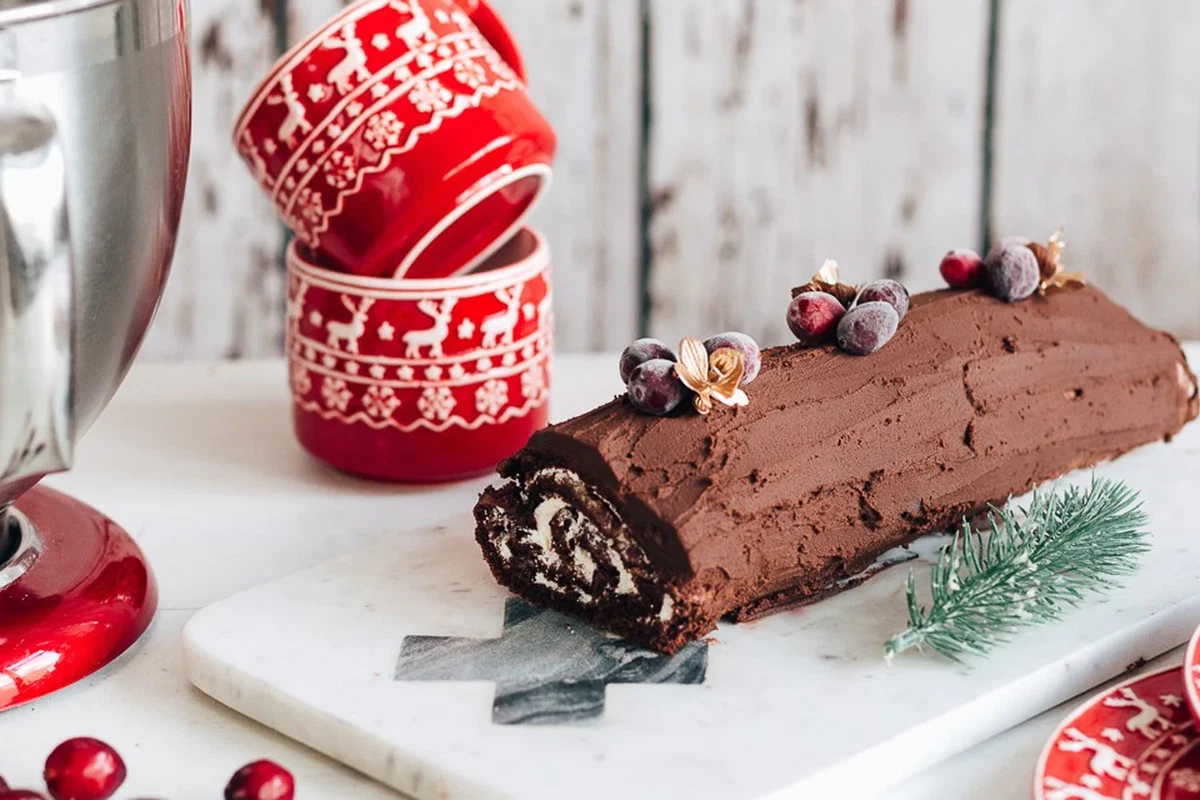
At Christmas, there are desserts that need no introduction, and the French Yule Log is one of them. A true classic, it stands out for its soft Genoise sponge, creamy filling and rich chocolate coating that resembles a log of wood – making it instantly recognisable on any festive table. Elegant, comforting and steeped in history, it’s a treat we always look forward to making during the holiday season.
Known as the Bûche de Noël, this dessert originated in France and has become a Christmas essential. Its creamy interior, wrapped in a light and flexible sponge, creates the perfect balance of textures, while the outer finish offers endless decorative possibilities tailored to your own festive style.
Watch the video recipe below for step-by-step instructions! While it may look elaborate, making a Yule Log at home is much easier than you think when you follow the steps calmly. It’s a great recipe to get into the festive spirit, enjoy the process, and impress your loved ones with a timeless Christmas dessert.
If you're after a traditional, striking Christmas dessert with a standout filling, this French Yule Log is a sure bet for your celebrations.

The Genoise sponge: the perfect base for your Yule Log
The Genoise sponge is the perfect base for a Yule Log because it's light, flexible and very fluffy – exactly what you need to roll it up without cracking. Unlike richer sponges, the Genoise relies mainly on well-whipped eggs, which provide volume and an airy texture without large amounts of fat.
Thanks to its fine and elastic structure, it wraps around the filling neatly, giving clean and attractive slices when served. It also absorbs moisture well without becoming soggy, staying soft even the next day.
Its other strong point is its delicate, neutral flavour, which makes it the perfect canvas for creamy fillings and chocolate toppings. That’s why it’s the most popular sponge for traditional Bûche de Noël and other French patisserie classics.
When baked properly and rolled while warm, the Genoise sponge guarantees a Yule Log with flawless texture and a result that’s both elegant and delicious.
French Yule Log recipe with filling
Ingredients
- 4 eggs, separated
- 100 g sugar
- 40 g plain flour
- 50 g unsweetened cocoa powder
- 1 tsp baking powder
- ¼ tsp salt
- 240 + 160 g whipped cream
- 175 g dark chocolate
- 1 tsp vanilla extract
- 1.5 tbsp butter
- 125 g icing sugar for the cream, plus extra for dusting
Method
- Place the egg whites in the bowl of a KitchenAid stand mixer with the whisk attachment. Whisk on speed 10 until stiff peaks form. Set aside.
- Add the egg yolks and sugar to the bowl with the whisk and mix on speed 4 until pale and fluffy.
- Add the flour, cocoa powder, baking powder and salt. Mix until smooth.
- Add a heaped spoonful of whipped egg whites to the yolk mixture. Mix on speed 2 for 1 minute.
- Gently fold in the rest of the egg whites by hand with a spatula.
- Spread the batter on a 20 × 30 cm silicone baking mat and bake for 7 minutes in a preheated oven at 220 °C.
- The sponge should be fully cooked but still soft to the touch.
- Dust a clean, dry tea towel generously with icing sugar.
- Place the warm sponge onto the towel, peel off the silicone mat carefully and roll the sponge up inside the towel. Let it cool completely.
- Heat 240 g of cream. In a separate bowl, combine the chocolate, vanilla extract and butter.
- Pour the hot cream over the chocolate and stir until fully melted and smooth. Let it cool completely.
- Whip the remaining cream with the icing sugar using the stand mixer on speed 8 until stiff peaks form.
- Unroll the sponge, spread the whipped cream evenly over it, and roll it up again – this time without the towel.
- Cover the Yule Log with the chocolate ganache and decorate as desired.


Comments
Claudia&Julia said:
Hola Sílvia,
Gracias por avisarnos. Tienes razón, había un error y ya lo hemos corregido.
Esperamos que te guste la receta.
¡Saludos!
Sílvia said:
Esta receta está mal. Dice mezclar las yemas de huevo y el azúcar glas cuando deberia ser el azucar normal. El azúcar gls es para montar la nata, tal como pone en el punto 12. Lo pongo porque puede llevar a confusión ta que no son las mismas cantidades se azúcar glas que normal.