

Today we have Julio, a chef from Galicia, to bring us the authentic Galician-style octopus recipe in a pressure cooker (or pulpo á feira, as it is rightly called in Galicia). There's no one better than him to tell us how to make the traditional recipe!
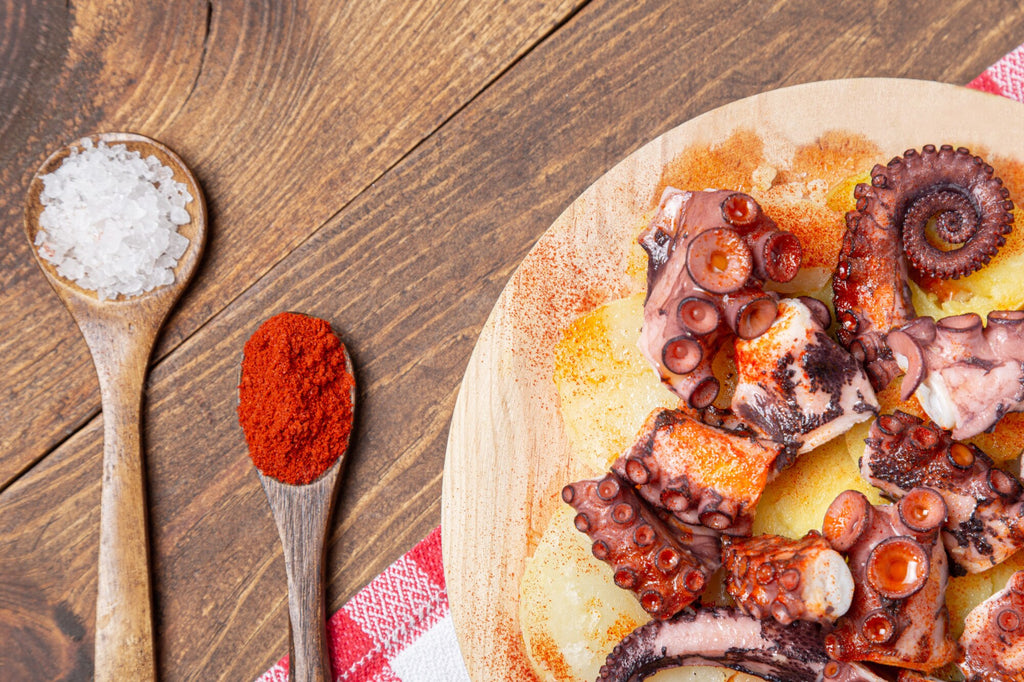
Julio gives us some tips to make it perfect, from showing how to shock it so the skin doesn't peel, to considerations like not adding salt or bay leaves to the water if we want to do it right. We naturally serve the octopus with boiled potatoes, and make sure they are well covered in paprika!
A good octopus made in no time thanks to the Perfect WMF pressure cooker. We prepared it in the larger pot, the 8,5L one (you can see it here individually or in Set with the 4,5L body), although you can make it exactly the same in the most common 6,5L Set.
Ingredients (for 8 servings with an 8.5 L. pot)
- 1 frozen octopus of 2.5 Kg
- 1.5 Kg of potatoes for boiling
- Quality paprika
- Extra virgin olive oil
- Sea salt flakes
Preparation
- Thaw the octopus in plenty of water (NOT HOT).
- Pour 5 liters of water into the WMF pressure cooker and put it on maximum heat until it begins to boil WITHOUT SALT.
- Meanwhile, clean the suction cups and tentacles well and remove the mouth or beak from the center-under the head.
- Peel the potatoes and cut them into large pieces
- When the water in the pot begins to boil, put the octopus in and leave it in the boiling water for 1 minute, take it out, keep it out for 1 minute and start again, 1 minute boiling and 1 minute out. Repeat this operation 3 times; on the fourth time leave it in the water, close the pressure cooker lid and keep the heat at maximum. When the valve has risen to the second ring, lower the heat and cook with the second ring up for 7 minutes.
- Let it depressurize without forcing so the lid comes off easily. Remove the octopus and reserve in a container, pouring in 3/4 of the hot cooking water as well, cover it so it doesn't cool
- With the remaining cooking water in the pot, add the potatoes; close the cooker again and put the heat on maximum, when the valve has risen to the second ring, lower the heat and cook with the second ring up for 3 minutes.
- While the potatoes cook, cut the octopus into bite-sized pieces.
- Let the cooker depressurize without forcing until the lid comes off easily.
- Remove the potatoes from the water and drain them; place them next to the already-cut octopus and dress everything in this order: sprinkle the paprika, then the salt and finally drizzle generously with olive oil.


Comments
Claudia&Julia said:
Hola Alberto,
Muchas gracias por la explicación de las diferencias entre ambos. Nos quedamos con ella ;)
¡Un saludo!
Claudia&Julia said:
Hola E. Souto,
Tal como lo explicas, seguro que debe estar delicioso ;)
¡Un saludo!
E. Souto said:
El pulpo a feira, en las ferias de ganado de Galicia, se come con pan de petada (hogaza), nunca con cachelos, invención de los restaurantes para poner menos pulpo y ¡cobrar las patatas a precio de pulpo!
Concepcion said:
En la olla se ven rodajas de limón y laurel. Cuando se le ponen?, o es para la fotito?
Alberto said:
Muy buenas!! Unas recetas estupendas y super sabrosas. En este caso el pulpo a feira es un pulpo que se prepara únicamente con aceite, pimentón y sal, y la forma de cocción es directa.
En el pulpo a la gallega se tiene que “asustar” al pulpo en su cocción y se introducen los cachelos como mayor diferencia entre ambos. Un saludo!!!
Cecilia said:
He preparado hoy la receta para mi familia, nunca había cocinado pulpo y ha quedado estupenda. Muchas gracias por compartirla!