

In recent years we have seen how Japanese kitchen knives have become very popular in Spain and Europe in general. Although I am not a huge fan of Japanese knives, I understand the interest they have sparked, since they bring different characteristics compared to European knives and some models are truly interesting.
After the posts I made about types of kitchen knives and stainless steel knives, I would like to talk today about the main distinguishing points of Japanese knives compared to European ones, and the different types of knives we can find. What they offer us and which knife to buy depending on the needs we have.
The quality of Japanese knives is marked by Japan's relationship with steel and its obsession with constant improvement. For centuries, Japan has handcrafted swords (katanas), saws, knives and all kinds of cutting tools with exceptional durability and edge.All the tradition and knowledge about cutting tools, together with the innovation and technology that the Japanese apply to their production processes, make Japanese kitchen knives for many the best in the world.
The most important differentiating characteristics of Japanese knives come from the manufacturing process and the design of the knife itself. Japanese knives are made with a high-quality steel alloy, so they have a higher degree of hardness than European ones and keep their edge longer. They are usually lighter than European knives and have a thinner blade and an extremely sharp edge, designed to cut food while preserving all its properties.
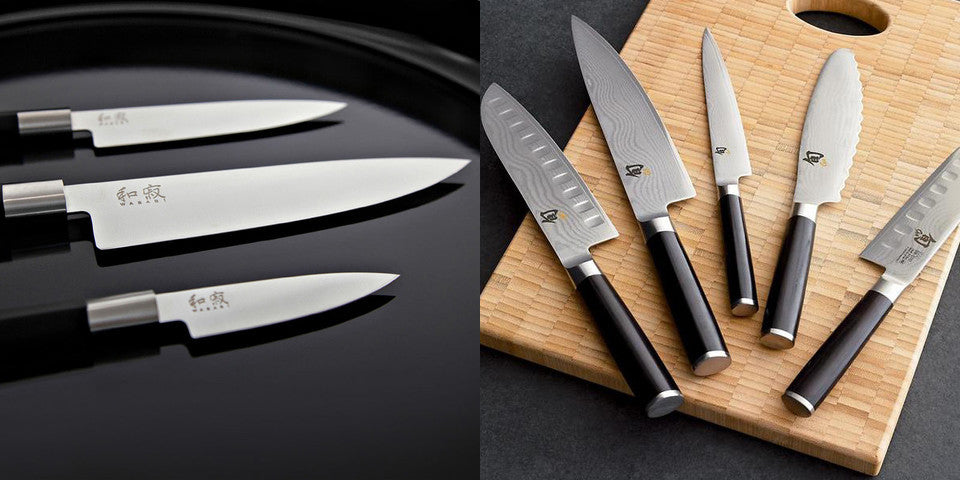
Kai knives: on the left, collection Kai Wasabi Black; on the right, Kai Shun Damasco
At Claudia&Julia we have chosen to offer KAI kitchen knives because we think it is one of the manufacturers that best represents the tradition in Japanese knives today. KAI was born in 1908 in Seki, a city world-famous for producing high-quality knives for more than 800 years. KAI manufactures knives while maintaining the artisan spirit of traditional blacksmiths but with an innovative mindset and the most advanced manufacturing technology.
Kai presents different series or models of knives, but we want to highlight two of them: one is the Wasabi Black series, Kai's knife series that, with all the characteristics of Japanese knives, can be obtained at a very good price. The other series is the Kai Shun Damasco, the top range, with a beautiful design, damascus steel and an exceptional cut.
There are a multitude of types of Japanese kitchen knives, but some in our opinion are almost essential. As versatile knives, you can find chef's knives like those we normally use in Europe. In the shop we have everything from 8,5cm paring knives for peeling vegetables to chef's knives of 10, 15 and 20cm. These knives are ideal as multi-purpose knives, the popular 'onion' knives we normally use at home.
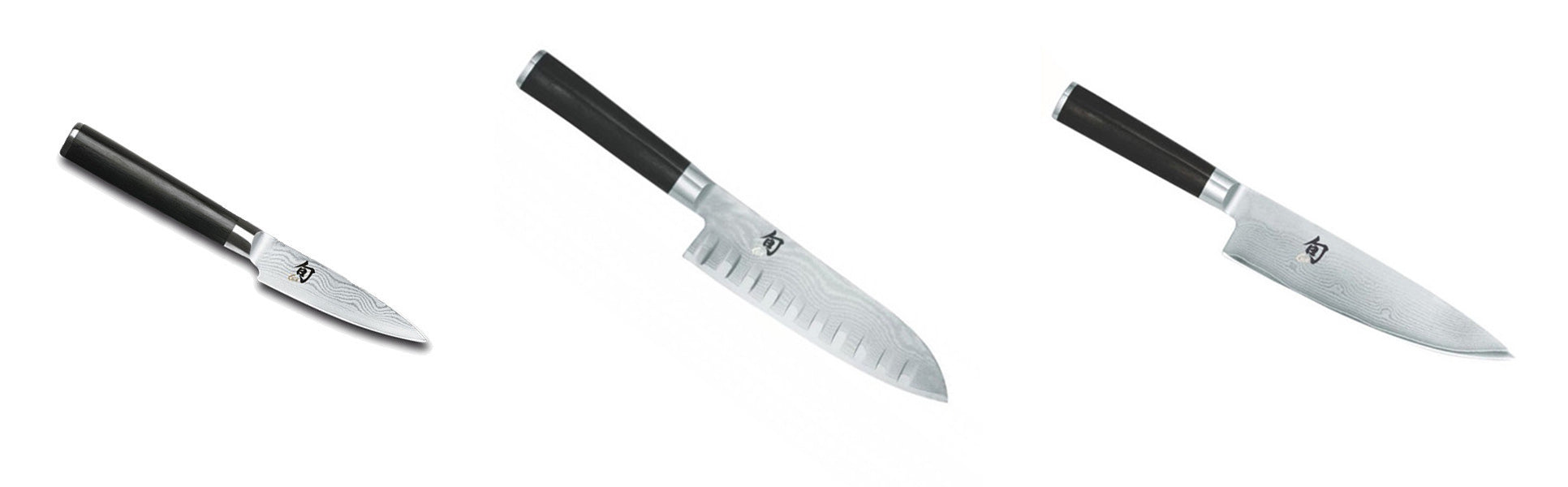
8.5cm paring knife, hollow-ground Santoku and 20cm Chef knife, all from the Kai Shun Damasco series
We also have the popular Santoku knife, both standard and hollow-ground. The Santoku owes its name to the three tasks it must perform in Japanese cooking: cutting, chopping and slicing. It is the equivalent of the European chef's knife, as it can be used for almost all cuts, even crushing or carving.
Other knives more specific to Japanese cuisine are the Deba, the Yanagiba and the Nakiri. The Deba is a short, sturdy knife used by professionals to clean and prepare fish. The Yanagiba is a knife for sashimi and sushi, with a longer, thinner blade that allows an excellent cut. The Yanagiba is a Kataba knife, it has an edge only on the right side of the blade unlike Ryoba knives which have edges on both sides of the blade. The Nakiri is a traditional double-edged, Ryoba, knife used for cutting and chopping vegetables.
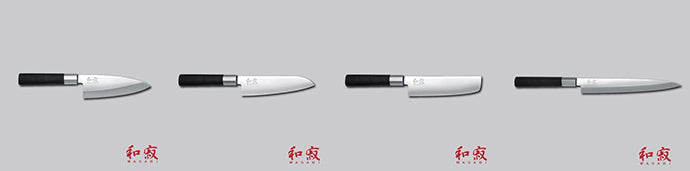
From left to right, Deba, Santoku, Nakiri and Yanagiba knives from the Kai Wasabi Black series
If you want to buy a Japanese knife, for your own use or as a gift, my recommendation is to buy a Santoku or a Yanagiba. A Santoku is a versatile knife that you can use for almost everything, ideal for a normal kitchen. If you regularly prepare Japanese cuisine at home, then a Yanagiba will allow the perfect cut that sushi, sashimi or maki requires.


Comments
Raquel said:
Hola,
Estoy buscando un cuchillo Deba, a ser posible de la marca Kai (shun damasco). En la web no lo veo, lo tenéis en tienda? y si es que si, en que medidas y precio?
Gracias