

Whether it's to decorate some cookies or write a nice message on a cake, sometimes we wonder if we will be able to write, decorate, or draw clearly in our homemade baking and achieve a clean line and a beautiful finish.
The truth is that writing a message on a cake or sweet that we’ve made at home is a great way to personalize it, give it a romantic finishing touch, or bring a smile with a special or funny word. But when you picture that personalized sweet expectations are high -we imagine perfect lettering, perfect decoration, or a divinely written message; and we want to get it right.
Keep in mind that, regardless of the final outcome, if it's made with love, the person who receives it will love it. So... no more nerves or pressure! The only pressure is the one you put on yourself. From here on, since we certainly want it to turn out as well as possible, I hope you succeed and leave it just as you imagine with these tips for writing on cakes and cookies in a clear and elegant way.

Choose the coating the message will be made with
You can write the message with several ingredients. The most common ones and what you should take into account when choosing are:
- With icing: It should be at room temperature so that it flows properly. If you take it out of the fridge, beat it with the KitchenAid (using the paddle attachment) so it warms up a bit. If you've never made it before, it might be a good idea to read this post, in which we tell you how to make icing.
- Royal Icing: it is a mixture of beaten egg whites with sugar, and it may solidify relatively quickly. It requires some skill to handle, but it can be done (if it hardens, stir it well in a bowl).
- Melted chocolate: a classic that never fails, but it can be hard to hit the right temperature for clean writing: if it’s too hot, it comes out of the piping bag too quickly and you end up with very thick pieces, or the chocolate will flow once applied, resulting in an unclear message; and if it’s too cold, it’s hard for it to come out and to write. You’ll need to find the right temperature to match your writing speed. *You can melt the chocolate in the microwave; you’ll save time and it has its advantages.
Why melt chocolate in the microwave
The truth is that melting chocolate in the microwave is really practical, and while there are plenty of recipes and preparations that we insist on making using traditional methods, I must admit that when it comes to melting chocolate, using the microwave has great advantages, such as:
- Save time: it melts quickly, and you save time just at the thought of having to boil water for a bain-marie if you were to use that method. By melting the chocolate in the microwave, you'll save more than half the time compared to melting it on the stove.
- It's more efficient, because the microwave heats all the chocolate at once, uniformly, whereas in a saucepan over heat, the heat is concentrated at the base.
When it comes to getting glossy, perfectly melted chocolate for frostings and decorating cakes and cookies, you can melt it in the microwave with great results in record time.
Choosing the right tool for writing on cakes and pastries
Nowadays you have at your fingertips various highly efficient tools for decorating and drawing on cookies and cakes. The most common are the piping bag and the icing gun:
1. Piping bag:
A classic that never fails. You can use sleeves disposables, or reusable (nylon or cotton). One of the ones we sell the most in the store is the Kaiser sleeve, which includes several basic bits with a very good quality/price ratio, and the classic De Buyer. The interesting thing is to have a narrow tip, which you can always buy separately (the De Buyer piping tip Set includes a narrow tip that works great for writing).
Things to keep in mind when writing with a piping bag:
- To write, do not fill the bag more than halfway of its capacity, you will have greater control.
- Choose the tip you use carefully: if it’s a cake with a large area, you can choose a wide tip, but if you have a small area or you're writing on cookies, choose a narrow tip.
- If you’re using disposable piping bags without a nozzle, it’s important to make a very small cut at the end of the bag to ensure a fine line (and remember you can always make it a little bigger).
2. Gun with tank:
The De Buyer pressure gun has become an indispensable accessory for many bakers. It is comfortable to use, it has a large dough capacity and turns out much easier to clean. Apart from its multiple uses, it comes with various nozzles, including a narrow one that's perfect for writing. In addition, the trigger lets you apply a very precise control when it comes to stopping writing. To write, you can either choose the PRO model, which includes narrow nozzles and several tanks, or choose the standard model and buy the nozzles for the gun what do you need separately.
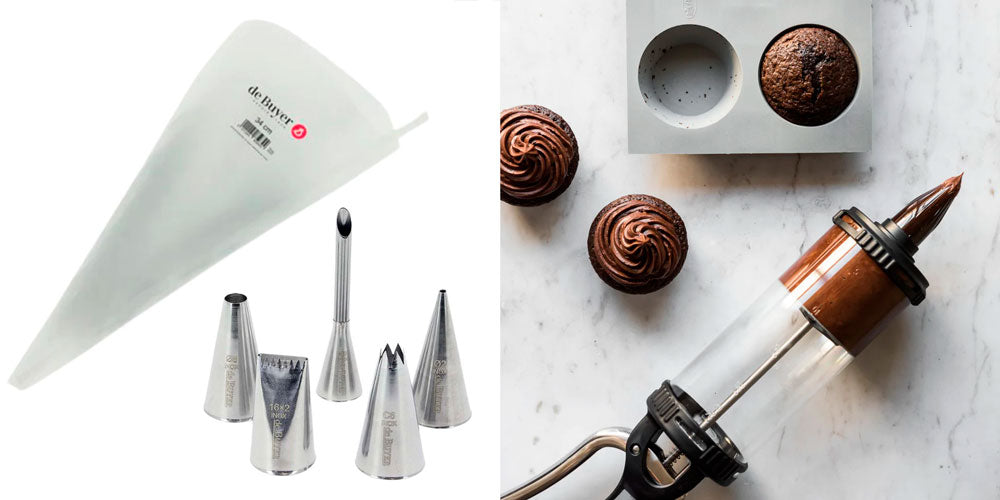
De Buyer piping bag and piping tip Set, and De Buyer pressure gun
Tips for writing on cakes and cookies
Now you're all set: you're equipped, you have the star ingredient to write your message, and only the essential is missing... Take the plunge and do it! To write your message on cakes and cookies successfully and neatly, keep these tips in mind:
- Make sure the cake or cookie has cooled: if it's still warm, the icing will melt; it won't set and be well-defined. So let your baked goods cool completely on a cooling rack and that there is no heat inside before you start writing.
- Position yourself on a high and wide surface: where you feel comfortable, there’s enough room to place the cookies or cake, you can open and rest your arms comfortably, and the table is at the right height for proper writing.
- Uppercase or lowercase? You have to decide, which isn’t that easy: uppercase letters seem easier to do, they’re simpler, clearer strokes and they give you a breather between one letter and the next. The downside of uppercase letters is that you start and finish writing with each letter, which can lead to possible buildups of coating (think about how at the beginning and at the end is when you have the least control over how much coating falls).
In the case of drawing lowercase letters, you need to have a lot of control over the hose or gun and a comfortable, steady position maintained for a longer period of time... because once you start, ideally you keep linking the stroke and the letters until you finish the word. The tricky part is writing cleanly drawn letters, but you only have a beginning and an end of the word.
- Make sure there are no air bubbles in the piping bag: to do this, pour a little filling onto a sheet of parchment paper or onto a plate, so there aren't blobs or splatters when you write.
- Hold the sleeve in the most appropriate way: Ideally, hold the tip the tip at 90 degrees and about 1,5 cm above the surface where you want to draw (any closer and you could touch and damage the cake's surface, and any farther and you won't properly control where the icing falls).
One hand should be at the very top of the piping bag (or on the trigger if using a gun), and it will be in charge of letting the chocolate or coating flow from top to bottom in a steady, even stream. The other hand should be closer to the tip and should gently guide the line. Hold the tip at a 90-degree angle about ½ inch above the cookie or cake and gently squeeze your piping bag. A little closer and you could damage the surface; farther away and it’s hard to control where the icing lands.

- Apply constant, even pressure, to ensure a steady flow of icing and a uniform thickness in the line you write. The hand that holds the piping bag at the top is also important; it should be well open to guide all the icing downward (and so it doesn’t go back up inside the bag, or you’ll run out of icing to write with halfway through a stroke).
- The spacing between letters and between words must be uniform: otherwise, apart from not looking very elegant, it won't be read correctly.
- Start writing farther to the left than you think you should: if you end up with some space on the right because you started more to the left, it will be easy to fill that space at the end with a little drawing or detail (a heart, a number, a star...); but if the problem is having started too far to the right or centered and you run out of space to finish writing... there’s no remedy for that.
- Try it first! Do several tests. First, pretend to draw your message on the cake or tart without touching it and without squeezing the piping bag so nothing comes out, just to get an idea of what your message might look like, how big you can make it, and whether your initial idea will fit or not. Then, practice on a plate or on parchment paper: get a sense of how much cake area you have relative to a plate, or draw a cookie at actual size on parchment paper, and practice there with the piping bag. Does what you want to write fit? Is the tip the right one? Are you holding the bag properly? Uppercase or lowercase?
- Keep a toothpick handy: a toothpick can help you correct some mistakes, especially with icing or royal icing; you can reposition the icing when it doesn't land where you want it, or remove any stray peak that has come out of the piping bag.
- After applying the text or decoration, do not move or cover them: let the decoration set and cool on a flat surface, and don't move it (especially with chocolate, it can still be liquid and run, smudging the lines). With cookies in particular, don't lift them vertically. Don't cover with plastic wrap either; it would touch the text and smear it, pulling off some of the icing or chocolate as it sticks to it.
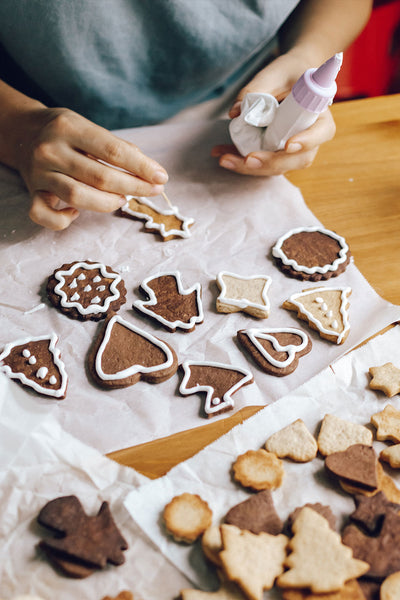
I hope these little tips help you perfect your writing and decorating of cakes, tarts, and cookies. And don't forget to stop by the post "How to make icing for cookies: recipe and tips" to round out the experience.
Source: Pastry teacher Carolyn Grillo from ATK Reviews and Dan Souza, chef at ATK.


