

Many of us want to make our own bread at home , but we have many doubts about kneading, for example (how to do it, how will I know when it is ready...), we do not have the necessary kitchen utensils or we are not very clear about some terms when we try to follow a recipe to make our homemade bread.
Virginia, author of the blog Sweet and Sour , has prepared this introduction to bread concepts. I dare say it's a quick guide to learn all the basics! I suggest you read it carefully, and very soon we'll give you a recipe so you can put into practice the knowledge you learn today. Enjoy!
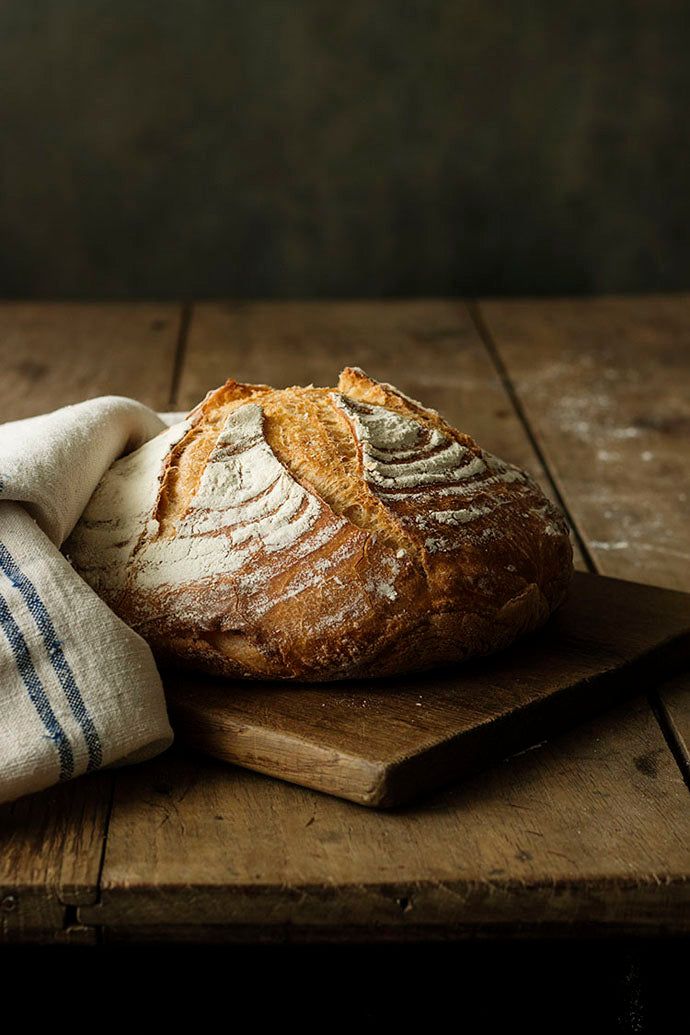
Perhaps one of the things that puts us off the most when we think about making bread at home is kneading. We're afraid of not knowing how, of not getting the right method, of getting our hands covered in dough and finding that an alien has invaded our kitchen.
There is no doubt that kneading bread well requires practice , but it is also true that it is essential to be clear about a series of basic questions, which will help us get off to a good start in our journey as home bakers.
What does kneading bread mean ? Kneading is the part of making bread after mixing, and in which what we do is mainly develop the gluten contained in the flours, making the dough elastic and incorporating air. Ultimately, it is responsible for, among other things, creating the structure of the bread. For the dough to be able to withstand the tension that will be generated inside it with the expansion of the gas.
There are certain flours that contain very little or no gluten and therefore these breads do not require kneading, as is the case with 100% rye breads or breads with gluten-free flours. In this case, just a proper mixing and fermentation time will do the trick. But breads with common wheat flour do require kneading .
What will tell us that the kneading of a wheat dough is correct? The membrane test . It consists of removing a small piece of the dough that we are kneading and stretching it between the fingers, so that if it is correctly kneaded it will not break, but will stretch like gum forming a small translucent membrane. This test will be the one that will guide us on the kneading state of our dough.
However, if we are going to carry out a long cold fermentation, it will not be necessary for the kneading to reach that point of perfection, since we must know that the doughs also self-knead with rest .

What types of kneading can we do?
We can distinguish between kneading with a mixer or manual kneading.
If you have a mixer like the Kitchen Aid , it's perfect. It will allow you to mix with the paddle at low speed 1-2, and after obtaining a cohesive and homogeneous dough, knead with the dough hook , which twists the dough to develop the gluten, give it elasticity and fill it with air.

In this regard, it should be noted that no matter how much we place the kneading hook and turn on the motor, kneading does not start until the dough is attached to the hook.
The kneading time in the mixer is usually shorter than if we follow a manual technique, because the mixer is more energetic and capable of maintaining constant intensity, which our arms cannot.
Kitchen aids are a huge time saver , as they allow you to do other tasks while your bread is kneading. I make bread every week, and there are days when I either don't feel like kneading or I don't have enough time, which is often the case, but I still want to enjoy my homemade bread. In this case, the Kitchen Aid is my personal helper.
But if you like to feel the dough in your hands and learn with it, or you do not yet have a Kitchen Aid type mixer , you should know that there are two main types of manual kneading , depending on the type of dough we have obtained:
Traditional kneading produces a less hydrated dough, which will be pleasant and above all easy to knead, and will not stick excessively to our hands.
And the French kneading , for a more hydrated dough, for the bravest or for the most accomplished home bakers.
The manual technique
If we opt for the manual technique, we will first proceed to mix: in a large bowl, we add the basic ingredients for bread, which are flour, yeast, water and salt. We mix well until we obtain a cohesive dough, from which we will begin to knead.
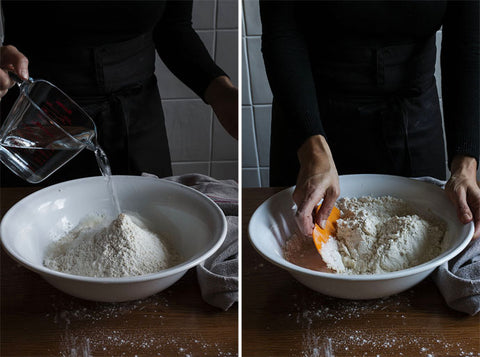
If we want to make kneading easier, however, I recommend mixing in two phases to practice the so-called autolysis . First, mix only flour and water , cover and let it rest for half an hour, and only then add the yeast and salt. This is what is called autolysis, which, with the mixture of water and flour resting, allows us to save effort in kneading, since based on a chemical reaction that occurs, the dough softens and is prepared for easier and more comfortable kneading.
Once our dough is ready, we can now start kneading it. If we have chosen to leave the dough less hydrated, it will be less sticky and will allow us to do the traditional kneading: we will place our dough on a lightly floured table. With one hand we will stretch it to fold it over itself and trap the air. We will turn the dough a quarter turn and repeat the operation, stretching and folding, and so on.
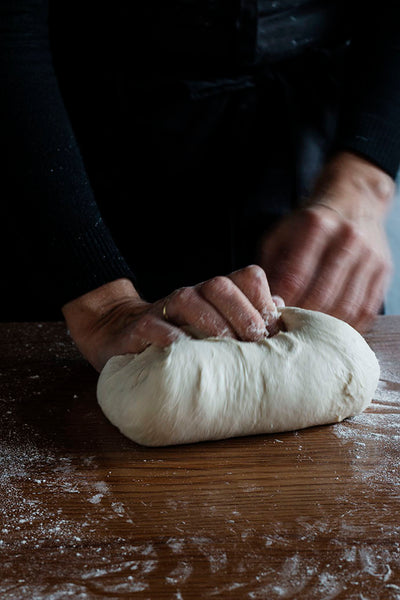
If we have chosen to add more water and leave a more hydrated dough, it will be stickier, so we will use the French kneading technique :
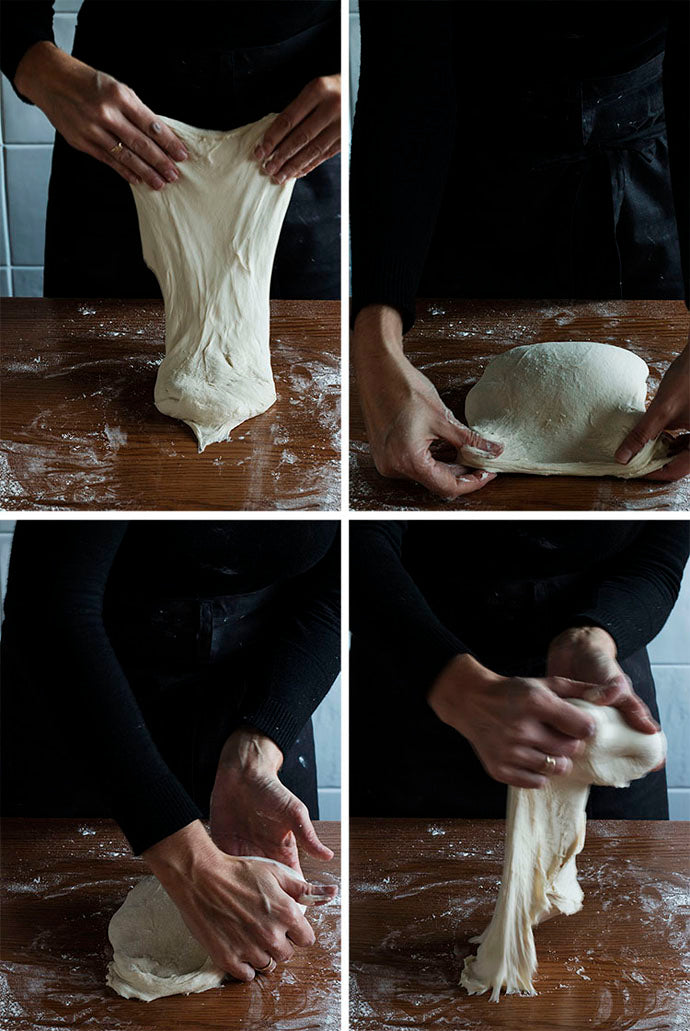
It consists of taking the dough with your hands like shovels in the air, and with a sharp blow on the table, stretching it (photo 1), folding it over itself so that it traps the air (photo 2 right), picking it up by the side again with your hands like shovels (photo 3) and lifting it (photo 4) to repeat the operation, stretching it again with a sharp blow on the table.
In both cases we can knead directly for about 10 minutes, or we can do short kneading sessions of 1 minute and five minutes of rest, two or three times. As explained, during the rest a kind of self-kneading occurs.
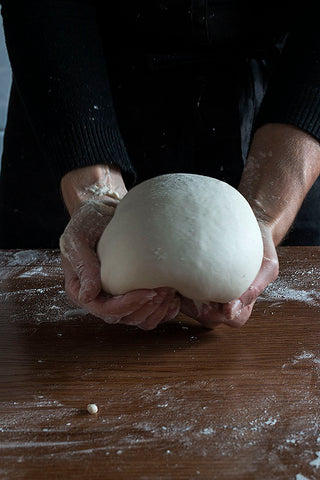
The dough we should obtain will be a smooth, soft and elastic dough, like the one shown in the image.
Fermentation
After kneading, we must let the dough ferment, so that the yeast does its job and develops it. As a general rule, two fermentations are carried out, the initial and the final, the latter with the bread already formed in its final form.
In this regard, for doughs that are not very hydrated and that incorporate sourdough, banettones are often used. These are baskets made of wicker or wood pulp that help to keep the shape of the dough, since doughs prepared with sourdough do not usually have the strength of those that incorporate yeast and have difficulty keeping their shape during rising. They are also used to leave beautiful patterns on the crust that would otherwise be impossible.
When using a banneton, it is important to remember that it must be thoroughly floured , otherwise the dough could stick to it and tear when you remove it, with the consequent loss of air. They are not recommended for very hydrated doughs, since no matter how well they are floured, with so much moisture they tend to stick.

After fermentation, all that's left to do is bake it, and your bread will be ready and your house will be filled with that traditional aroma of freshly baked bread. Keep in mind that the fermentation and baking times will vary depending on the recipe you choose (types of flour, quantities...).
If you want to know more about bread, I recommend the book Pan Casero by Iban Yarza , a must for all bread lovers. Soon, a recipe from the book will be here on the blog.


Comments
Angela (www.postresdelocura.com) said:
Fantástico el post de Virginia, yo soy una de esas personas a las que le encantaría hacer su propio pan, pero mis conocimientos sobre el tema aún no son los suficientes. Pero hoy podido aclarar varias dudas y además las fotos son de gran ayuda para ver la textura que debe ir adquiriendo la masa. Gracias!