

Today we welcome Raquel Carmona, whom you will not only know from her food blog Los Tragaldabas, but also as co-author of the book La Mesa del Pecado, which was recently awarded the "Best Innovative Cookbook" (Spain), a prize granted by the Gourmand World Cookbook Awards 2014.
In her first post on our blog, Raquel presents a very versatile, homely recipe: some blinis that you can serve with elaborate accompaniments for a special meal, or with a sweet treat for the kids' snack.
Welcome, Raquel! And to everyone, enjoy these delicious blinis!

Blinis are pancakes of Russian origin made from wheat flour, milk and yeast; they can be eaten fried or baked. It is one of the most typical recipes of Russian cuisine, known in different countries under different names; in our cuisine it is roughly equivalent to a pancake or crepe.
This type of preparation is very old; their round shape and golden color represent the Sun, which is why they were one of the main dishes of pagan festivals. They were also given to women who had just given birth and served at weddings and funerals.
Blinis were present in their lives from beginning to end. Blinis serve as a base for different savory and sweet preparations; the most well-known recipe is to accompany them with crème fraîche, smoked salmon and caviar. But they admit endless combinations, with different smoked fishes like herring, trout, sturgeon with jams, compotes, and even filled with fruits. As you can see, it’s a recipe we can use to present any appetizer or a tasty snack.
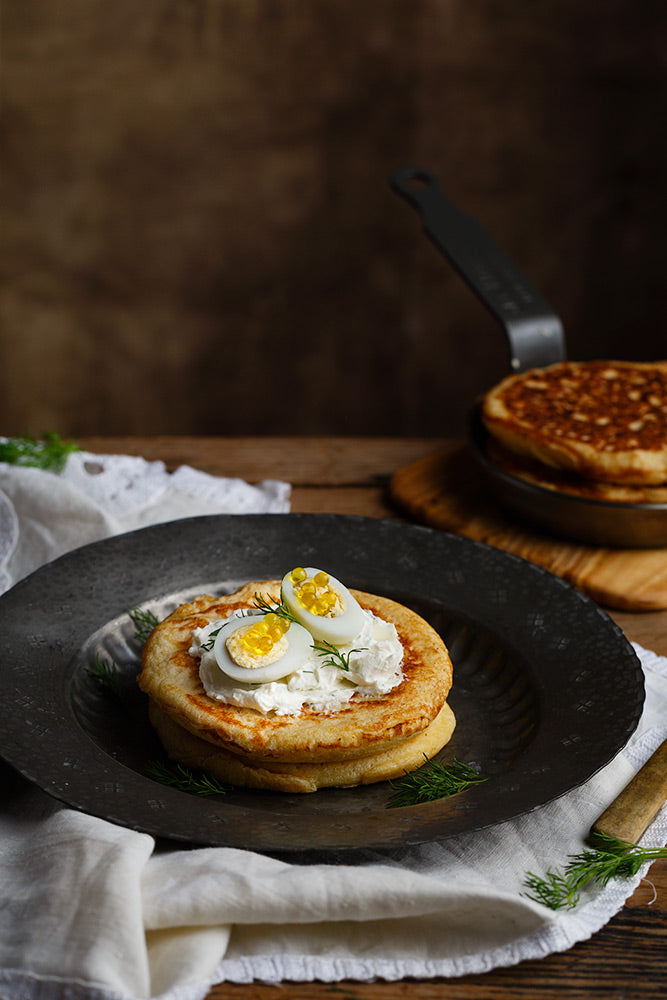
To make my blinis I used the sartén Mineral De Buyer which is designed for this type of preparation; at 12 cm diameter it's perfect so they all come out exactly the same. It’s the best option for healthy cooking, handcrafted with natural iron and without chemicals or coatings. De Buyer pans have a layer of natural beeswax that protects and helps the pan develop a naturally non-stick surface.
There are many blini recipes but I chose one I knew couldn’t fail: that of the great baker Richard Bertinet, known worldwide for his bread kneading technique and his numerous books. The accompaniment is somewhat different but delicious, and you’ll tell me. Let’s get to the recipe.

Ingredients:
150 g of flour
150ml of milk
2 eggs
15gr of fresh yeast (half the amount if dry yeast)
100 g of fresh cream or sour cream
1 teaspoon of salt
Butter (for greasing)
150gr of creamy-style cheese
Fresh dill
12 quail eggs
Sturgeon roe or spherifications

In the photo, Bérard olive wood cutting board.
Recipe preparation
We separate the egg whites from the yolks and reserve.
We warm the milk a little without letting it boil; once warm we add the yeast and stir well until dissolved. Next we incorporate the fresh cream, the yolks, and beat.
In a bowl we put the flour and the salt.
We slowly add the milk mixture to the flour, beat until all ingredients are well integrated and a thick batter remains. Cover with a cloth and let rest at room temperature for about an hour so it increases in volume. It’s ready when we see the surface full of little bubbles.
We whip the egg whites to stiff peaks and fold them into our batter with gentle folding movements, then let rest again for two hours.
Meanwhile, we prepare our filling: finely chop the fresh dill and mix it with the creamy cheese (if you want to lighten the cheese a bit you can add two teaspoons of fresh cream), stir well to distribute the herb and set aside.
Put the quail eggs in a saucepan, boil in plenty of water for 4-5 minutes, remove, cool under the tap and peel.
After the resting hours grease the pan with a little butter and start making our blinis. I personally like them a bit thick; depending on how you like them you should put more or less batter to get the desired thickness. Once the batter is in the pan you have to wait for bubbles to appear on the surface; once you see them it’s time to flip, leave it a minute or two approximately and remove. The heat should not be too high; cook them over medium heat.
With our blinis made, now it’s time to add the topping: using two spoons we will spread the cheese with the dill, add the quail egg cut in half and crown with the sturgeon roe or, as in my case, these little pearls of olive oil that were gifted to me and I thought this dish was perfect to use them.
Blinis are tastier if eaten hot once made.


Comments
BEATRIZ JACQUEMIN said:
Me recuerdan a unas tortas que comía cuando era niña hechas por mi abuela húngara. Por suerte fui a Hungría el año pasado y pude comer una frita con un queso riquísimo y verduras. La receta está clara y fácil de hacer, así que a trabajar. Gracias
Carmen said:
Tienen una pinta increíble! !