
Today, the author of The Winter Guest, Miriam gives us some really useful tips on how to properly cook a cut of meat such as a rib steak or a steak. Because although cooking on a grill is something anyone can do, it also has its tricks if you want to do it well!
We’re entering barbecue season and lighter cooking season, and for this, grills are the perfect tool for cooking with little fat, little hassle, and relatively quickly. There’s barely any prep needed, and the meat can be made as light as we want, with almost no added fat and no sauces.
In the summer heat, a cut of meat served with a good salad makes an excellent, balanced meal.
Nothing is easier than cooking a good cut of meat, like the classic charcoal-grilled ribeye steak, on a heavy iron grill. The tips I give you below for achieving a perfect grilled cut of meat are valid not only for preparing an entrecote on the barbecue, but also for any cut of beef such as a good rib steak or a good sirloin, varying the cooking times depending on the size of the cut, of course.
- First and foremost, the meat has to be good quality. That usually means the price won’t be especially low, but every now and then we can treat ourselves.
- It is advisable to take the cuts out of the fridge ahead of time so they can come to room temperature and the grill does not have to work as hard to raise the internal temperature of the cut of meat as it would if we put it on straight out of the refrigerator. The heat the cut receives on the surface has difficulty progressing inward, so it is not the same for the center of the cut to be at 12°, for example, as at 25°. There are even those who advise placing the cuts near the grill or barbecue while it is heating up, so they gradually warm up.
- The grill will need to be very hot when you put the meat on it, so it gets a nice golden crust on the outside.
- It is preferable to brush the cut with oil before placing it on the grill instead of greasing the grill itself, because by greasing it, the oil is already somewhat burnt when the cut is placed on it. The easy thing is to pour a drizzle of oil on top, but it is also advisable to brush it with a kitchen brush.
- It is not necessary to keep turning the meat over continuously; it is better to leave it still on each side until it is nicely browned, so the heat from the grill is used more effectively.
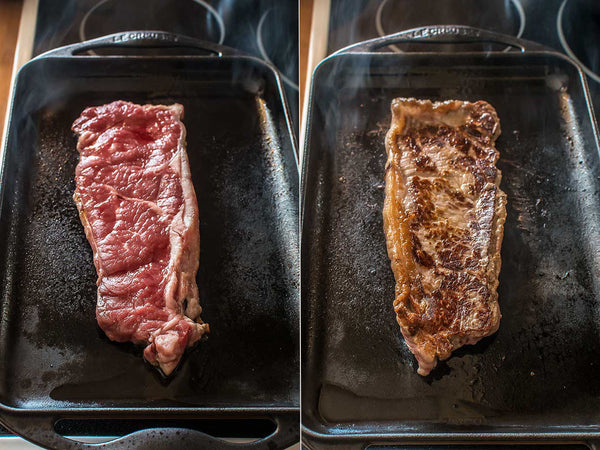
- The cooking time depends, of course, on how done you want the meat, although it shouldn’t be excessive. For pieces like the one in the photo, about a finger thick, one to one and a half minutes should be more than enough to get a nice sear on the outside and a juicy center.
- It is preferable to salt the meat once it is done, when taking it off the grill, because if we salt it beforehand, the salt may cause it to lose more juices.
- To carve the meat, use sharp knives that cut well (How little this is used in our country!) and preferably not serrated ones (these tear the fibers, which is why the traditional Pallarès knives are now becoming very fashionable, with the stainless-steel version for the table).
You may also be interested in learning more about iron grills, how to cook on them, and how to care for them. I talked about them here.
With all these tips, you have no excuse not to make some seriously meaty dishes this spring-summer season. Enjoy.

In the photo, Pallarès knives. You can learn more about them by clicking here.


Comments
Claudia&Julia said:
Hola Mar,
Sí, puedes hacer la carne de la misma forma, ya que ambas son piezas de hierro. Los consejos para cocinarla son los mismos, y lo más importante es que la sartén esté bien caliente y lo esté de manera uniforme. Debe calentarse a fuego medio/bajo, para que pueda repartir el calor que recibe en la base a toda la sartén. Cuando pongas la carne, no hay que darle la vuelta hasta que no haya sellado (verás que, cuando ya está sellada, se desprende fácilmente).
¡Saludos!
Claudia&Julia said:
Hola Eva,
Gracias por avisarnos. Ya lo hemos corregido.
¡Saludos!
Claudia&Julia said:
Muchas gracias, Marga. Siempre nos alegra saber que os gustan nuestras recetas y consejos :)
¡Saludos!
Claudia&Julia said:
Hola Marta,
Si te sigue sucediendo, por favor, para que podamos ayudarte, escríbenos a: tienda@claudiaandjulia.com indicando de qué parrilla se trata.
¡Saludos!
Claudia&Julia said:
Hola Mónica,
Puedes ver todas las tablas de madera que tenemos en Claudia&Julia en el siguiente enlace:
https://claudiaandjulia.com/collections/tablas-cortar
Respecto a la salsa chimichurri, es ideal para acompañar cualquier carne, pero no disponemos de la receta.
¡Saludos!
Claudia&Julia said:
Hola Javier,
Muchas gracias por avisarnos. Ya está corregido :)
¡Saludos!
Claudia&Julia said:
Hola Begoña,
La parrilla de Le Creuset es una gran pieza a la que puedes sacarle mucho partido y en la que la carne queda de maravilla ;)
Muchas gracias por tu amable comentario.
¡Saludos!
Mar said:
Hola! Recientemente os compré la sartén buyer, es aconsejable una vez curada hacer el entrecorte de esta manera?
Como conseguir q no se pegue?
Eva said:
Echar se escribe sin h (hechar un chorro de aceite…)
Marga said:
super interesante me encanta leeros
Marta said:
Le regalé a mi marido una parrilla de esta página. Le echaba mucho humo. Les consultamos, seguimos sus indicaciones, y siguió humeando. No la ha vuelto a usar. Una lástima.
MÓNICA said:
Perdón la talla de madera sobre la que. Esta la carne , de que marca es? La venden ustedes?
MÓNICA said:
Y la salsa chimichurri?
Javier said:
Muy interesante pero, por favor,corregid la h que sobra en:
“Lo fácil es hechar un chorro de aceite "
Gracias.
BEGOÑA said:
Me encantan estos consejos, son muy útiles. Yo tengo esta parrilla de Le Creuset y a veces puedes no llegar a estar satisfecha con tus utensilios de cocina si no les das el uso correcto, así que os agradezco siempre vuestros consejos y recomendaciones. Muchas gracias.