

In my latest post I told you about the three types of blade we can find in kitchen knives and the advantages and disadvantages of each: ceramic, carbon steel, and stainless steel (the most popular).
Going back to the question we raised at the start of the previous post, which knives to buy, and having already talked about ceramic and carbon iron, I’d like to explain the different types of stainless steel knives we can find on the market and how to choose the one that best fits our needs.
TYPES OF STAINLESS STEEL
The quality of a kitchen knife is determined mainly by the material used to make the blade. There are many types of steel with different compositions, manufacturing techniques, and sharpening types. A good kitchen knife is costly, but it will be in our kitchen for many years and will keep its edge much longer.
Both the KAI Japanese knives and the German Wüsthof use very high-quality steel alloys and excellent sharpening to make their knives. Special mention should be made of the KAI Shun knives and Le Creuset made of Damascus steel (for their manufacture, different layers of steel are folded, achieving an extremely hard steel and a unique look due to the patterns we see in the blade).
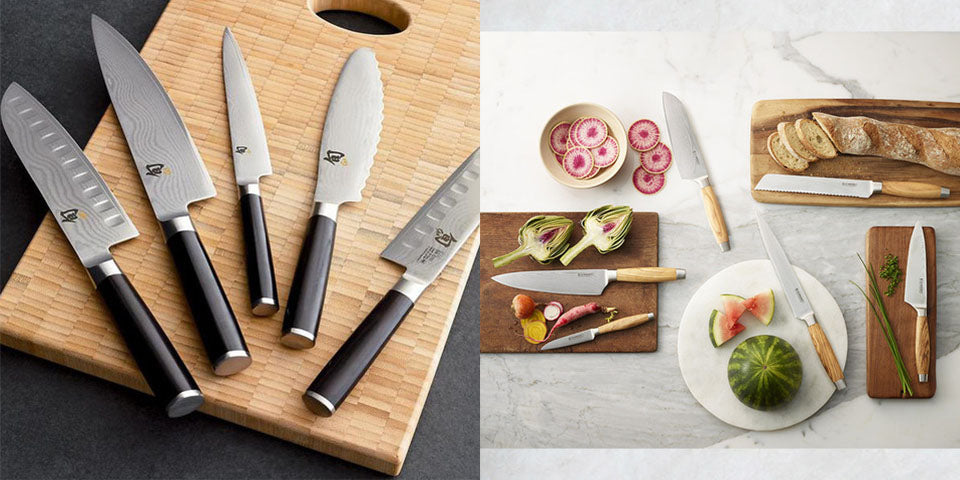
Damascus steel knives Kai Shun and Le Creuset
BASIC KITCHEN KNIVES
Many times we’re not sure what type of knife to buy for the intended use, or how many knives we should buy for the most common cuts in the kitchen.
In my opinion, the basic Set of knives should consist of a small knife (blade 8 to 10cm) for cleaning and chopping fruits and vegetables, a narrow-blade knife of 16 to 18cm for precisely cutting meat or fish, and a larger-blade knife of 18 to 20cm mainly for chopping and dicing vegetables.
If we want to get these basic kitchen knives, the best option is to buy one of the sets offered by the manufacturers, since they are more economical than buying individually. In our store you can find the Set of 3 Wüsthof Gourmet knives with an excellent price-quality ratio, the Set of 2 knives plus Wüsthof Gourmet sharpener and the Set of 3 forged Classic Ikon knives from Wusthof, which is already the highest range from this German manufacturer.
It’s also worth mentioning a Set which I personally love; it consists of 3 knives and a peeler from the French manufacturer Opinel. At a very keen price, we find a 7,5cm curved-blade knife for fruits and vegetables, a knife with a micro-serrated blade for soft-skinned fruit or meat, a 10cm knife for slicing or shaving meat or fish, and a peeler for vegetables. You can see it here.
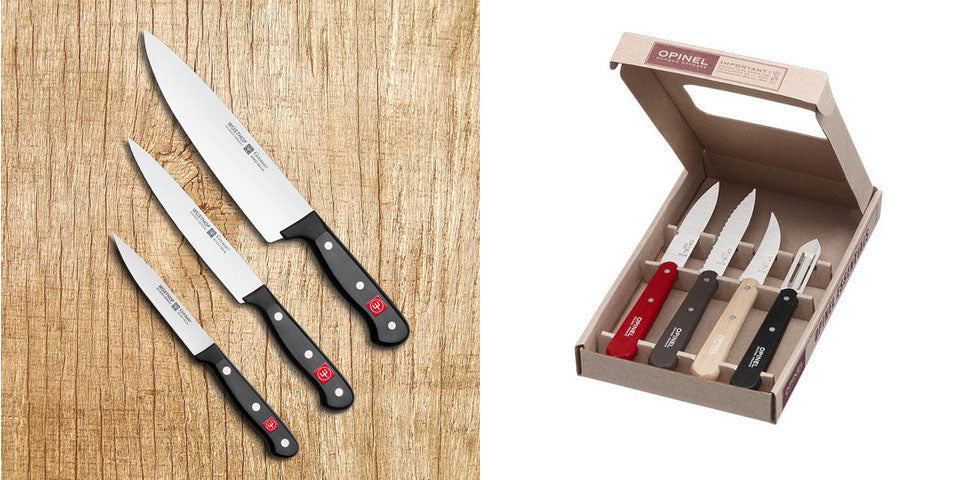
Set of 3 Wüsthof knives and Set of Opinel basic kitchen knives
JAPANESE KITCHEN KNIVES
When considering the purchase of quality kitchen knives, it’s worth taking Japanese knives into account. In Japan, hundreds of years of knowledge have accumulated in the making of kitchen knives, so some of the best knives in the world are made there.
The company KAI is one of the main exponents of this expertise and makes exceptional kitchen knives, such as the Kai Shun Damascus, its most emblematic collection; the Kai Magoroku Vintage, with its traditional handle in birch wood; or the newly added collection Wasabi Black, with an excellent price-quality ratio.
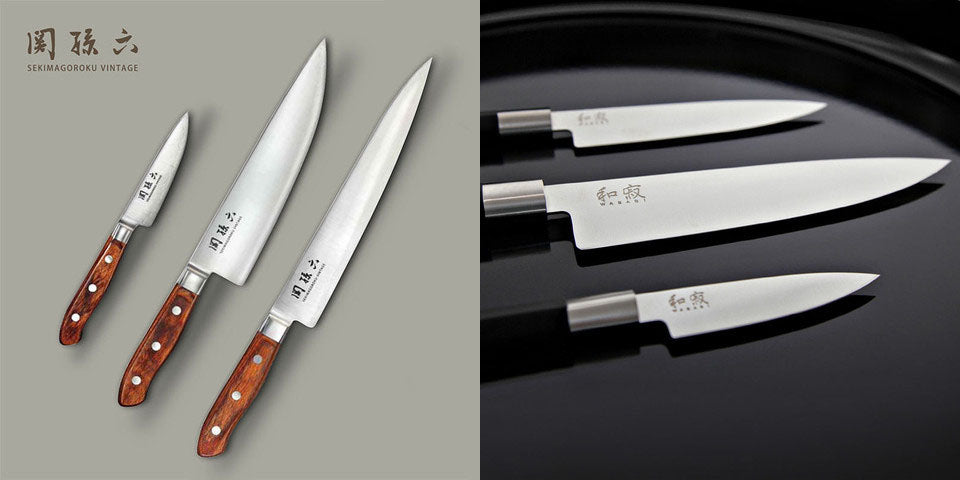
Knives Kai Magoroku Vintage and Wasabi Black
I’d also like to clarify that it isn’t necessary to spend a lot to enjoy a good kitchen knife. Obviously, Damascus steel kitchen knives, Wüsthof forged knives, or KAI Japanese knives are exceptional if we want to buy the best in kitchen knives, but we have alternatives from these same manufacturers or from other makers with a long tradition in cutlery that will also offer excellent cutting and will be in our kitchen for many years at a much lower cost.
We can start with the already mentioned KAI Wasabi Black knives that allow us to enjoy the experience of a quality Japanese knife but at a very tight price. Also noteworthy is the Wusthof Gourmet series, the Spanish manufacturer 3 claveles with its Forgé collection (here) and the Opinel kitchen knives (here), with a wooden handle and a blade with the characteristic cut of the popular pocketknives.


Comments
kassadin said:
Los comentarios de Jorge me parecen de lo más desacertados. Aparte de que la web que menciona es confusa y poco fiable, me parece una competencia desleal de lo más cutre. Y no tengo que ver nada las chichas de esta web.
Jorge said:
Gracias por el articulo.. tenia dudas sobre que cuchillos me irían mejor pero me queda bastante claro después de leer tu artículo. Me quedo con estos https://www.cuchilleriabarcelona.com/marca-kai.html
Jorge said:
Gracias por el articulo.. tenia dudas sobre que cuchillos me irían mejor pero me queda bastante claro después de leer tu artículo. Me quedo con estos https://www.cuchilleriabarcelona.com/marca-kai.html
Jessy said:
mis favoritos son los de karmin :D
Javi said:
Permitidme una pequeña curiosidad sobre los cuchillos de cocina. La mayoría de aceros, cuchillos y elementos cortantes se someten a un test de dureza denominado Hard Rockwell Control (HRC) en el que una pequeña puntita de zafiro golpea la hoja hasta determinar el límite de su posible ruptura.
El cuchillo de combate del Ejército Español (uno de los mejores del mundo) alcanza un nivel de 55 HRC de dureza de hoja.
Pues bien; una hoja de Damasco como las que aparecen en la parte superior llega fácilmente ¡a los 58! y una hoja al carbono como la de los clásicos Pallarés u Opinel ¡¡ supera los 60 !!.
Son auténticas obras maestras (sobre todo las de Damasco, que me fascinan). Y muchas veces a un precio realmente de regalo para la calidad de los materiales empleados.
¿A que no lo sabíais? :-)