

It is important to take care of a kitchen knife since we use it continuously for any recipe we’re going to prepare. Also, if you know how to maintain and restore the edge, a good knife can stay in the kitchen for a lifetime. That’s why it’s worth having good knives, but also knowing how to take care of them.
Maintenance tips
Knives gradually lose their sharpness with regular use (from contact with foods, both hard and soft), but there are also other habits that speed up this wear. That’s why there are several important tips to help keep your knives sharp for as long as possible:
- Always use an appropriate cutting surface: often, for convenience or speed we cut small things on the kitchen marble countertop. Big mistake! Marble is a very hard stone that damages the knife on contact. Always cut on a cutting board (you might be interested to see Which cutting board should I buy? to understand the different types of wood and which are the most suitable).
- Do not eat with the knife once cut; instead, opt to put the knife down and use a spatula, do it by hand or, another option, is to give a flick of the wrist and guide them with the knife, but using the non-cutting side of the blade.
- Avoid putting them in the dishwasher
- Try to use whenever you can the knife for the purpose for which it was made: don't cut meat with the vegetable knife, or vice versa; and don't use it to cut other things either.
- Store them properly: contact with the other utensils in the drawer damages them. Whenever you can, keep them separate -a knife block can help you toward that end, besides keeping them always at hand.
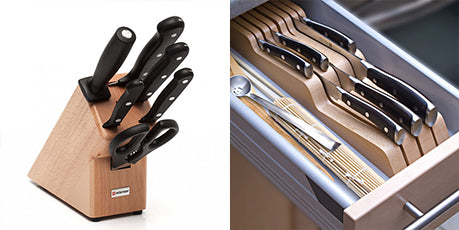
Wüsthof Knife Block and in-drawer block for the Wüsthof 3-knife Set
Knife sharpening
Over time, the blade wears down and loses its edge. There are three types of sharpening you might want to know about:
Sharpened with honing steel:
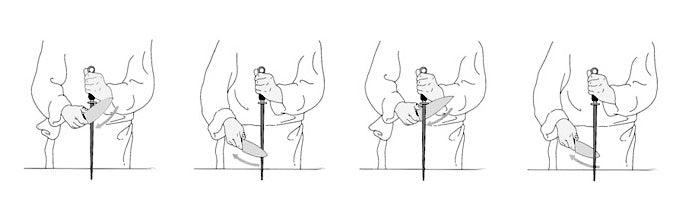
Although it can't be seen with the naked eye, the blade's finest edge bends. The honing steel it doesn't sharpen; instead, it helps you maintain that edge. That's why it should be used regularly in our kitchen, and it's actually very easy to use:
- Hold the honing steel in the air with your arm steady, or, if it’s more comfortable, place it vertically downward resting on the countertop. It must not move.
- Hold the knife at a 20º angle, and slide the knife along the honing steel while maintaining that angle. Run the entire blade along the honing steel, starting with the section closest to the handle and finishing with the tip of the knife.
- Repeat the process on both sides of the blade repeatedly, the same number of times on each side to maintain the blade’s symmetry. Do not apply force to it.
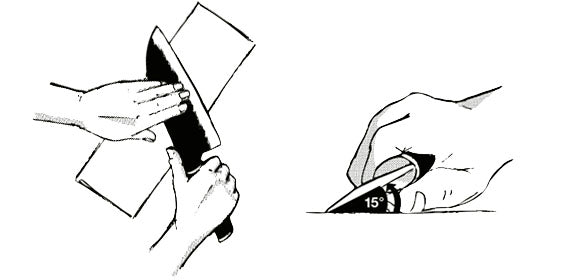
Sharpened with stone:
Each knife will have different sharpening needs. Similarly, there are different types of stones: coarse-grit stones for edges that are damaged, chipped, or dull, or finer-grit stones to achieve more precise edges.
In the store we have two types of stones that Pallarès provides us, the pink and the green. Both are suitable for carbon steel (iron) knives and stainless steel knives, but the green stone, of artificial origin, is ideal for grinding and restoring the edge of fairly worn or chipped knives with ease. For its part, the pink stone is a fine-grained natural stone whose origin is one of Pallarès' best-kept secrets, but it truly performs exceptionally well. It is without a doubt the best we have tried. It can be used both to restore a knife's edge and to perform a fine sharpening of our knives.
In all cases, the sharpening method will be the same:
- During the sharpening process, always keep the stone moistened so it works properly.
- We sharpen one side of the blade by sliding the blade over its center and all the way to its tip along the stone, moving it away from your body and pulling it back toward us again.
- We turn the knife over and work the other side of the blade.
- It is important to always keep the same angle of the blade on the stone (usually between 15º and 20º).
- Once the knife is sharpened, we will thoroughly clean the knife and the stone with water.
Sharpened with a knife sharpener
Another very convenient way to sharpen knives is with sharpeners. These have a slot to pass the knives through, with stones on each side that aid in sharpening. All you have to do is insert the knife straight and pull it from the base of the blade to the tip several times, and the stones do the rest of the work, leaving the knives perfectly sharp.
In the store we have two sharpeners: one, the Kyocera sharpener, it features ceramic stones ideal for restoring the edge on stainless steel knives. The second sharpener, is located in the Wüsthof Knife Set, it features two-stage sharpening: the first, to restore the edge on a completely dull knife (as if it were a hard stone); the second, for finer sharpening.
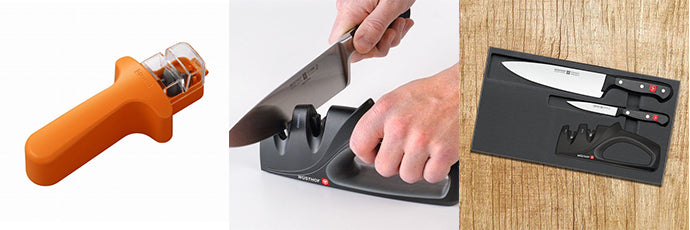
kyocera sharpener and Wüsthof Knife Set with sharpener, both for stainless steel knives


Comments
Trinidad said:
Hola como puedo hacer una devolución ?
Claudia said:
Hola Mireia,
Los cuchillos dentados son más delicados de afilar que los normales por lo que mi primera recomendación seria llevarlos a alguna tienda o afilador en caso de que tengas alguno cerca. Para hacerlo en casa normalmente se usa papel de lija fina y se pasa entre los dientes con la ayuda de algún objeto que se adapte al tamaño entre dientes. Yo no lo he hecho nunca por lo que no te puedo recomendar hacerlo pero si te atreves, es importante mantener el angulo de corte que ya tienen los cuchillos cuando pases la lija.
Saludos!!
mireia said:
Sois los mejores sacando temas de interés para los “cocinillas”.
Precisamente hace poco iba pensando en cómo afilar mis cuchillos, especialmente los que son buenos. Tengo un afilador que hace su función con cuchillas lisas pero no me atrevo a pasarlo por los cuchillos dentados como los que os compré de Opinel en Navidad.
Qué afiladores recomendáis en estos casos?
Gracias
Antonia Medina Soto said:
Muchas gracias por estos consejos yo tengo una blanca,y mi problema es que me da dentera utilizarla, pero es verdad que se nota bastante cuando mi marido me los afila, pero según veo debería afilarlos mas a menudo
Claudia said:
Hola José,
gracias a ti por seguirnos y escribirnos! Espero que así sea, y que haya resultado útil. Un saludo!
Claudia said:
Hola Mª Pilar, me alegro que lo hayas encontrado interesante. Estoy totalmente de acuerdo, creo que mucha gente tiene una chaira pero queda a menudo olvidada en el cajón, cuando se debería usar semanalmente :) Saludos, y muchas gracias por tus palabras!
jose Alvarez said:
Gracias por ser minunciosos con sus consejos me va a servir de muchos bendiciones..
sigan adelante
Saludos desde la distancia
Mª Pilar Noval Vallina said:
Me pareció muy interesante porque normalmente no sabemos sacar partido a la cheira y a la priedra de afilar. Gracias por los consejos