
Making jam is a pleasure, and enjoying it is a real delight. The main process to prepare it is really simple, but there are many points that are important to know. That is why we asked Virginia, author of Sweet&Sour, to tell us a little more about them, hoping you find it interesting (*post updated in June 2018).
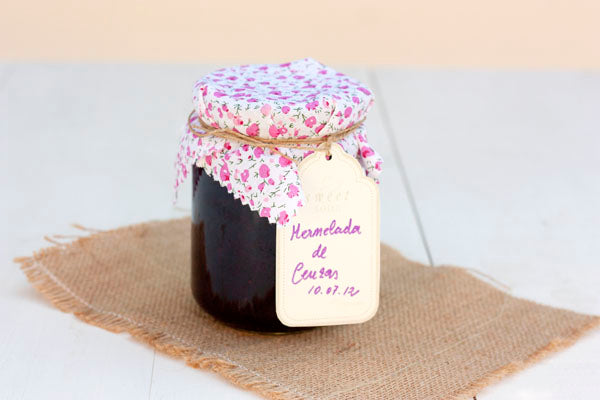
At the end of summer, fruits and vegetables are abundant and inexpensive, which makes those of us who enjoy cooking and homemade preparations rush to make home preserves.
Making jams at home is simple, but it is important to know a number of basic points that will help our preserves have a pleasant texture and flavor, not lose color, and last in the pantry without unnecessary health risks.
Across two posts, we will examine, from the different types of preserves, through the basic ingredients and their preparation, to sterilizing jars, pasteurization and emptying their contents.
We start at the beginning: We are used to calling jam practically all preserves made from fruit and/or vegetables with sugar. However, not all are jams, and not all are the same. Let's take a look:
I.- JAMS, PRESERVES AND JELLIES:
Within fruit and vegetable preserves with sugar we basically find 3 types of preserve: jams, preserves (confitures) and jellies.
As Jam is understood the preserve of fruit and/or vegetables previously chopped and macerated in sugar for a few hours, with a sugar addition that usually ranges between 45% and 100% of the weight of the cleaned fruit.
Jams are cooked for a prolonged time, until the fruit practically becomes purée. It is advisable to stir the preparation often, to prevent it from sticking to the bottom of the pan with so much sugar.
Note, the English term "marmalade" is used only for citrus preserves.

(Left) Example of jam texture; (Right) Example of jelly
The Preserves are prepared from whole fruit and sometimes also from chopped fruit, but instead of with sugar directly, with a syrup of about 250 ml of water per kilo of sugar, until achieving a thick texture.
Preserves are cooked for a shorter time, since in this case the fruit must retain a certain shape and consistency.
In short, the most visual difference between a jam and a preserve is in the texture. Jam is essentially a purée and in preserves we will find pieces of fruit, not to mention, of course, the different proportion of sugar and the different way it is incorporated into the fruit.
The Jellies are, by contrast, fluid and almost transparent preserves and are made with sugar and concentrated fruit juice. The tastiest are those made with fruit that contains a lot of pectin. Their use is basically as a dessert itself or for glazing puff pastries and tarts, since it prevents the pastry base from becoming soggy with the filling, and it also helps, for example, the marzipan to adhere better.
To obtain fruit juice, a small fruit juicer is very useful, which will allow us to get the concentrated juice of the fruit.
II.- PREPARATION, INGREDIENTS AND THE JAM POINT
1.- For making fruit preserves, it is advisable to use fruit at the right stage of ripeness, neither too green nor too ripe. In fact, very ripe fruit contains less pectin, a fundamental element in making these kinds of sweet preserves that allows them to gel with the effect of heat.
Fruits should be washed well beforehand, especially if using fruits with skin or peels that may contain pesticides. Washing should be done very carefully so as not to damage them, so they do not lose their juices. Also they should be dried thoroughly so as not to add more water than strictly necessary to the preserve. We should also discard damaged parts or fruits, since they can spoil our jam or preserve.
For stone fruits, such as cherries, using a good pitter is extremely useful (I recommend the Oxo one), besides saving you time and keeping the fruit in shape, it will prevent you from getting your hands too messy.

Small fruit juicer and Oxo cherry and olive pitter
2.- Sugar is a fundamental element, not only as a sweetener but also as a preservative.
We must bear in mind that the fruit should never boil before the sugar has dissolved. That is why the fruit is left to macerate with the sugar so that it dissolves slowly in jams. And in preserves and jellies, sugar is incorporated previously dissolved in water, in the form of syrup.
The proportion depends a bit on the type of preserve, the type of fruit and taste, even on how long we want to keep them, but averages about 700 gr to 1 Kg of sugar per kilo of chopped and cleaned fruit.
You can use either white sugar or cane brown sugar. There is also special jam sugar on the market, which has pectin incorporated.
3.- Lemon is also usually a common ingredient, since in addition to helping preservation, it adds pectin and compensates for the lack of acidity in some fruits.
4.- Another fundamental element in making homemade jam is, as we have seen, Pectin, as a gelling agent: pectin is a natural substance contained in some fruits, to a greater or lesser extent, and which when cooked becomes a gelatin that makes the jam “set”.
The fruits that contain the most pectin are apples, quince, citrus and red fruits such as currants or plums.
When a fruit does not contain pectin, there are several solutions, from combining them with other fruits that do contain this element, adding pectin in commercial preparations, and even including peels, seeds or apple cores in a cheesecloth during cooking and then removing them.
It should be noted that overly prolonged cooking destroys pectin. Therefore it is not advisable to overcook our fruit preserves.
Another issue to consider when preparing a fruit-and-sugar preserve is that with the heat of cooking, the preparation is much more liquid, and as it cools it thickens. Therefore, to know the jam point, that is, to know when the jam is ready and we can remove it from the heat, we should use a thermometer (you can see the ones we have here, although I especially recommend the Gefu digital thermometer, economical, precise and perfect for all types of foods and preparations). The jam will be at its point when it reaches a temperature between 104º-105º C.
Another more homemade option to verify the jam point if you do not have a thermometer, and which is usually infallible, is to put a small amount of the preparation you are cooking on a cold plate, cool it quickly by putting it in the refrigerator for 10-15 minutes. After this time, take it out and push the jam with your finger; if it “wrinkles” and stays stuck to the plate it will be at its point, otherwise it will need to be cooked longer.
Although making our own preserves may seem more romantic doing it with the most common method, on the stove and stirring, it is worth mentioning that today there is a really convenient option that many already take advantage of, and that is to prepare them with the bread maker: many bread makers, or at least surely one of the most popular which is the Moulinex bread maker, include a program that is specific for jams. So, you put the ingredients in the bread maker pan (for example, the fruit, sugar and lemon juice), press the button for program 15 (in the case of the Moulinex), and the bread maker does the rest. There is a great advantage in this process, and that is that you do not have to be watching to stir: the bread maker paddles stir the ingredients and ensure it does not stick while the machine provides all the heat the preparation needs.

Apricot jam recipe in a de Buyer pan, for the almond cake with jam
Finally we should bear in mind that the preparation of sweet preserves should be done weeks in advance of consumption, to give the ingredients time to settle their flavors.
For this it will be important to store them in jars properly sterilized or, if we are going to consume them soon, at least that they have been vacuum-sealed. This is what we will see in the second part that we will dedicate to preserves.
Finally, mention another utensil that will be very useful to you, the wide-neck funnel, perfect for pouring your jams into jars.
For now and until next week, if you want to start noting down some recipes to make your own jams, you can see the recipes for:
- Peach jam, in the almond cake with jam recipe
- Rhubarb and Banana Jam with Citrus
If you are interested in making your own jams and preserves, there is a book that may interest you: From the Garden to the Pantry, by Mariano Bueno (here).


Comments
Regalos Gourmet said:
¡Muy buenas consideraciones sobre las mermeladas artesanales! Sin duda, estas variantes son excelentes por su sabor exquisito, menor cantidad de añadidos y beneficios nutritivos. Una vez que se prueban es imposible resistirse a ellas. En https://regalosgourmetonline.com/es/ las recomendamos totalmente frente a las más comercializadas.
Carolina said:
Me gustaría hacer mermeladas muy naturales…si reemplazo el azúcar por Stevia gotitas, es recomendable? Le provoca algún cambio que no sea favorable para la preparación?
Y cuanto tiempo dura en conserva para vender?
Claudia said:
Hola Maria Carmen, en el post de este próximo miércoles verás respuesta a tu comentario :) Saludos, hasta pronto, Claudia
Maria carmen said:
La explicacion me parece bien espero su comentario de como cerrar los botes de la mermelada y si despues los vuelven a cocer como lo hacian nuestras abuelas y yo. A la antigua usanza.