
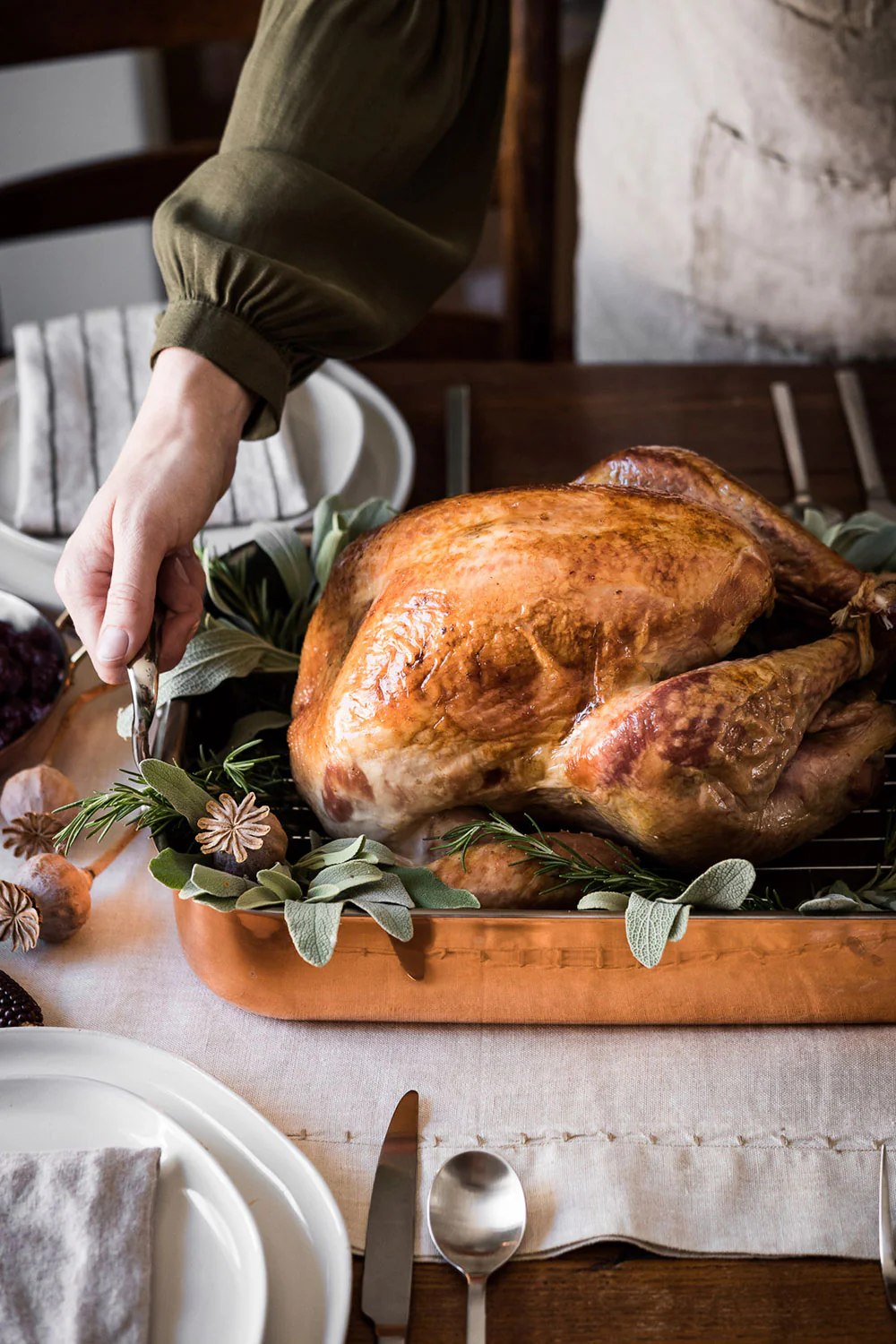
This recipe for roast stuffed capon is, without a doubt, one of my favorites for special occasions. The bacon, veal and mushroom stuffing is one of those that smells like home from the moment you start making it, and when you pair it with a creamy chestnut purée, it becomes a dish that has it all. Also, roasting it in the De Buyer two-handled copper roasting pan makes a difference: the meat stays juicy, the skin perfectly browned, and best of all, you can take it straight to the table with a presentation that always surprises! It's practical and beautiful—what more could you ask for?
And now that we're on the doorstep of Christmas, I like to think of dishes that not only feed, but create moments. This stuffed capon or chicken is one of those recipes you put in the center of the table and that bring everyone together eagerly, enjoying the flavor and the company. Because yes, it's an impressive dish, but it also has something comforting, something that invites you to enjoy it slowly, in good company. And that is, for me, what really matters at this time of year.
If you're undecided between making stuffed chicken or capon, be clear that either option will be a hit, but I hope the following notes help you decide.

Choose chicken or capon? What is the key and which will you choose for this recipe?
Chicken and capon are similar in essence, but they differ clearly in flavor and texture. Chicken has a milder taste and lighter meat, while the capon, being fattier and raised longer, offers more tender, juicy meat with a more intense, deeper flavor.
- Chicken: Perfect if you're looking for a lighter, more economical option. It's ideal for small gatherings or when cooking time is an important factor, as chicken needs less time in the oven than capon. Its meat is less fatty and has a mild flavor that pairs very well with aromatic stuffings.
- Capon: The choice for special celebrations or when you want a more flavorful, festive dish. The capon, being castrated and raised longer, has more tender, juicy meat with a deeper flavor. Its larger size (about 2.5-3 kg) makes it ideal for larger groups. It does, however, require more cooking time and is a somewhat more expensive option.
If you're undecided between chicken or capon, choose according to the occasion: chicken is perfect for lighter, quicker meals, ideal for small gatherings; while the capon, with its more tender, juicy, and flavorful meat, is the ultimate festive option, ideal for celebrations and large groups. Looking for practicality or a more special dish? That's the key!
Ingredients
For the stuffed chicken or capon*:
- 1 whole chicken or, if you prefer, a capon of approx. 2.5 kg
- 20 g butter
- 1 onion
- 150 g smoked bacon
- 150 g veal escalope or eye of round
- 6 large mushrooms
- 1 egg
- 4 tbsp breadcrumbs
- 1 handful fresh cilantro leaves (or parsley)
- A few sprigs fresh thyme
- 2 garlic cloves
- 4 tbsp olive oil
- 1 tsp honey
- 1 tsp ground ginger
- 1 tsp ground paprika
- 1/2 tsp Espelette pepper
- Salt and pepper
For the chestnut purée:
- 450-500 g preserved chestnuts
- 200 g milk
- 50 g double cream
- 25 g butter
- 1 teaspoon ground ginger
- Salt and pepper
Preparation
To make the stuffed chicken:
- Leave the chicken or capon at room temperature half an hour before you start, so it comes to room temperature.
- Clean it. Personally I like to quickly pass the kitchen torch over the skin to burn off the bird's hairs—I find it much more hygienic (if you do it, do it quickly so you don't dry out the skin). Wash it and pat dry with kitchen paper. Set aside.
- In a large frying pan, melt the butter over medium heat.
- Add the finely chopped onion and, after 1-2 minutes, add the bacon cut into small pieces.
- Peel the mushrooms, cut them into cubes and add them to the pan with a pinch of salt.
- Cook everything over medium heat for 6-7 minutes. Remove and set aside.
- Preheat the oven to 210 °C.
- Let's prepare the stuffing. Chop the veal escalope very finely (as if it were a brunoise) and put it in a large bowl.
- Add the egg, chopped cilantro, grated garlic, thyme leaves and breadcrumbs. Mix gently with a spatula.
- Add the onion, bacon and mushroom mixture to the bowl. Mix well and season with the spices: add the ginger, paprika, Espelette pepper and pepper. Adjust with salt to taste.
- Stuff the capon with this mixture, and close the rear opening with kitchen twine if possible (you can use this poultry needle and kitchen twine).
- In a small bowl, mix the olive oil with the honey.
- Place the capon in a roasting pan (you can use the De Buyer copper roasting tray, or the Affinity stainless steel tray, both are wonderful, offering perfect cooking for this type of recipe, and the presentation, as you will see, is unbeatable on the table).
- Brush the oil and honey mixture all over its surface using a pastry brush.
- Salt and pepper the outside of the bird.
- Place the pan in the oven and begin roasting.
- After 30 minutes, pour a glass of warm water over it (I tell you more about this in Notes).
- Reduce the temperature to 180 °C and continue cooking for another 45-55 minutes, basting the capon regularly with its juices (add a little more water if necessary, or in this last stage you can baste with cognac, brandy or sweet wine).
- Finish cooking at 130 °C for another 45 minutes. If you have a thermometer, make sure the stuffing reaches at least 63 °C.
IMPORTANT NOTE: This recipe was developed using capon, and the times should be reduced slightly if you use chicken. Watch the meat and shorten each oven step by about 5 minutes if using chicken.

For the chestnut purée
- Place the chestnuts in a saucepan or Shallow Casserole and cover them with milk.
- Cook for approximately 20 minutes, until you can easily insert the tip of a knife.
- Blend the chestnuts with an immersion blender until you obtain a smooth purée.
- Add the cream, butter, ginger, salt and pepper.
- Mix everything well with a spatula.
- Place the purée in a piping bag (or in the Le Tube De Buyer gun) and serve it elegantly on the plate, on the side or as a base to place the appropriate portion of the stuffed chicken on top.
Ready to enjoy! This stuffed capon accompanied by chestnut purée will be a perfect delight for a special occasion.

Frequently asked questions
Why baste the capon or chicken with water during roasting?
Basting the capon with warm water during roasting has several important reasons related to the final result of the dish:
- Maintain juiciness: As a large piece of meat like a capon tends to dry out during prolonged cooking. The water helps create a more humid environment in the oven, preventing the meat from drying out.
- Promote even cooking: By adding moisture to the surface of the capon, the risk of the exterior cooking too quickly is reduced, which could leave the interior undercooked or dry.
- Prevent the skin from burning: During roasting, the most exposed areas of the capon (especially if well browned) could toast too much. Warm water helps regulate the skin's temperature and prevent burning.
- Improve the texture of the skin: If you're aiming for crispy but not burnt skin, occasionally basting it with water maintains the balance between moisture and browning.
- You can take the opportunity to slightly flavor it, if you want: If instead of just water you use a light stock or water with herbs, spices or wine, you can give an extra touch of flavor to the surface of the capon.
It is important to use warm water and not cold, so as not to abruptly lower the oven temperature and avoid interruptions in cooking. Also, this is done only once or twice during the process, so as not to open the oven too much and lose heat.

Can it be made with boneless chicken?
What is the disadvantage and how to fix it? The disadvantage of using boneless chicken is that it loses structure, so it is important to tie it well with kitchen twine and make sure the stuffing is compact, to recover that structure and prevent it from opening during roasting.
Does the cooking time vary a lot?
Is it better to do it bone-in or boneless?
It depends on what you're looking for:
- Capon or bone-in chicken: The result is usually juicier because the bones help keep the meat moist and add flavor during cooking.
- Boneless: More practical to serve and eat, ideal if you have many guests or prefer to make carving and plating easier.


Comments
Claudia&Julia said:
Hola Rita, en respuesta a tu pregunta, que encuentro muy interesante, debo decirte que sí, los tiempos de cocción varían cuando se utiliza un capón o pollo deshuesado, ya que este tiene menos volumen y carece de huesos, que suelen absorber y distribuir el calor durante el horneado. En general, un capón con huesos puede requerir entre 2,5 y 3 horas de cocción (dependiendo de su tamaño), mientras que un pollo deshuesado se cocina más rápidamente, en aproximadamente 1,5 a 2 horas a 180 ºC, según el relleno y el peso. Para asegurarte de que está perfectamente hecho, es recomendable usar un termómetro de cocina y verificar que la temperatura interna en el centro del relleno alcance aprox. los 75 ºC.
Espero que te resulte interesante y conveniente la respuesta. Añadiré esta información al post ahora mismo. ¡Saludos!
Claudia&Julia said:
Hola José, gracias por tus preguntas!! Las encuentro tan interesantes que añadiré el tema del pollo deshuesado en el post ahora mismo. Aún así, te dejo si te parece las respuestas a tus preguntas aquí mismo:
1) ¿Se puede hacer con pollo deshuesado?
Sí, se puede hacer perfectamente con un pollo deshuesado, y de hecho, es una opción muy práctica. La principal ventaja es que es más fácil de cortar y servir, ideal si buscas una presentación más limpia y cómoda para los comensales. La desventaja: Si utilizas pollo deshuesado, pierde algo de estructura, por lo que es importante atarlo bien con hilo de cocina para que el relleno quede compacto y no se abra durante el horneado.
Sobre cómo deshuesarlo, me temo que no tenemos ningún post explicándolo, tal vez puedas buscar algún vídeo en la red… O una opción práctica es pedir al carnicero de facilitártelo ya deshuesado. ¡Saludos y muchas gracias por tu interés!
Rita Aguinaga Armendariz said:
Con pollo deshuesado varían mucho los tiempos? O no es recomendable hacerlo así?Muchas gracias por ser tan buenas profesionales
José said:
BD.
Dos dudas.
El pollo va tal cuál, sin deshuesar, ¿no?
¿Hay algún post que explique cómo deshuesarlo?
Se comerá mejor.
Paso 8.
La ternera se mete en el pollo cruda, ¿no?
Gracias.