
There are moments in the kitchen you never forget: the sizzle when the meat hits the pan, the steam rising, the aroma filling the kitchen. That magical moment has a scientific name —the Maillard reaction— and one essential ally: the mineral iron skillet.
If you have ever wondered why restaurant meat tastes different, the answer is almost always the same: the skillet material and the temperature. Here we explain how to recreate it at home.

"Iron holds heat better, so the magic can happen: the Maillard reaction. That golden crust that changes everything."
What is the Maillard reaction?
The Maillard reaction is a chemical reaction that occurs between amino acids and sugars in meat when it reaches temperatures above 140–165 °C. The result is that golden, crispy crust that concentrates flavor, aroma, and texture in every bite.
The science behind the crust
When the surface of the meat exceeds 140 °C, hundreds of aromatic compounds are generated at the same time. This is what sets seared meat apart from meat that is simply cooked. Without enough temperature —and keeping it there— the meat will sweat instead of searing: the result is gray and crustless.
Why the mineral iron skillet makes the difference
Not all skillets are the same. Mineral iron stands out for one property that changes the result on the plate: its ability to retain and distribute heat evenly and consistently.
| Feature | Mineral iron | Nonstick (PTFE) | Stainless steel |
|---|---|---|---|
| Heat retention | ✔ Excellent | ✗ Low | Medium |
| High-temperature resistance | ✔ Unlimited | ✗ Max. ~230 °C | ✔ High |
| Maillard crust | ✔ Optimal | ✗ Limited | Good |
| Durability | ✔ Lifetime | ✗ 2–5 years | ✔ High |
| Improves with use | ✔ Yes (seasoning) | ✗ No | ✗ No |
When the nonstick skillet meets cold meat, the temperature drops sharply. The result: the meat "sweats" and loses juices before searing. Mineral iron, on the other hand, holds the heat and returns it to the surface with sustained power.

The other secret: quality meat
The best skillet in the world can't save poor-quality meat. For a perfect result, look for cuts with visible intramuscular fat (the "marbling"): ribeye, entrecote, tenderloin. That fat is what melts during searing and adds juiciness and flavor.
Take the meat out of the refrigerator 30–45 minutes before cooking. Meat at room temperature sears faster and more evenly. If it is cold, it lowers the skillet temperature and ruins the Maillard reaction.
How to make the perfect steak: step by step
-
Heat the skillet dry
Place the iron skillet over high heat for 3–4 minutes, without oil. It should be smoking hot. You can check the temperature by bringing your hand closer: the heat should be intense several centimeters away. -
Add a drizzle of high-smoke-point oil
High-oleic sunflower oil, avocado oil, or even clarified butter. Add it just before the meat, not before. The oil should not smoke excessively. -
Place the meat and do not move it
The most common mistake is moving the meat constantly. Let it rest in the skillet for 2–3 minutes without touching it. You will know it is ready to turn when it releases on its own from the bottom. -
Turn it only once
Using tongs (never a fork, which would pierce the meat and let juices escape), flip it and repeat on the other side. For a thick ribeye, sear the edges too by standing the cut on its side. -
Let it rest before slicing
This step gets skipped far too often. Remove the meat from the skillet and let it rest on a board for 3–5 minutes. The fibers relax and the juices redistribute. Cut it too soon and you will lose half the work.
"Seared on the outside. Juicy on the inside… just as it should be. Perfect."

Take care of your iron skillet: seasoning
A mineral iron skillet gets better with every use. The secret is seasoning: a layer of polymerized oil that forms on the surface and, over time, creates a natural nonstick coating far more durable than any artificial finish.
After each use, clean the skillet with hot water and a brush (no soap). Dry it well and apply a very thin layer of oil with paper towel. Over time, its surface will turn black, smooth, and almost naturally nonstick.
Unlike conventional nonstick skillets, which degrade their coating with heat and metal utensils, a good mineral iron skillet can last for decades —or generations— if properly cared for.
Conclusion: three ingredients, one perfect result
The secret to perfect meat is not complicated tricks. It comes down to three elements:
-
A mineral iron skillet that holds and transfers heat with power.
-
High, sustained temperature to activate the Maillard reaction and create that golden crust.
-
Quality meat with good marbling, at room temperature before cooking.
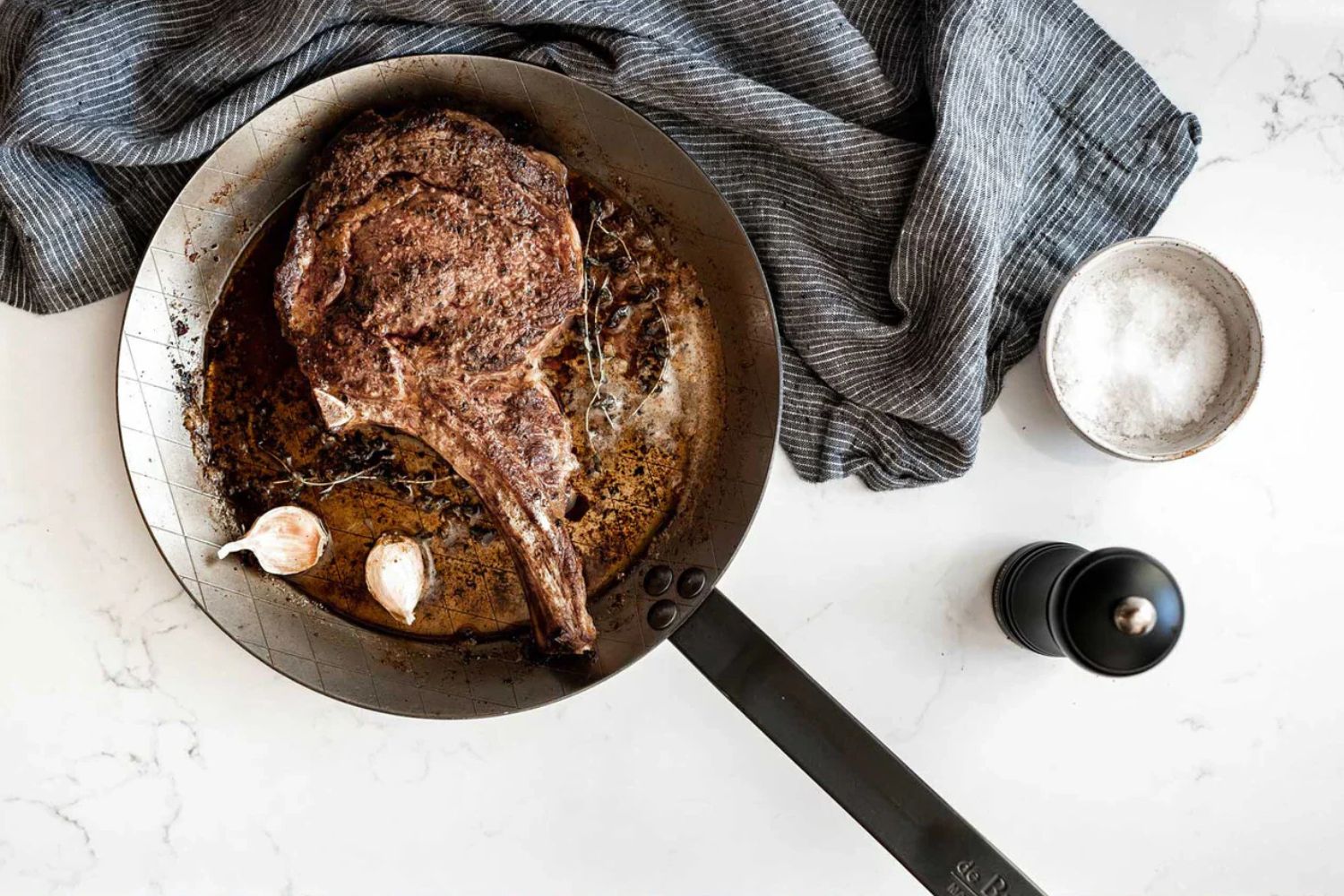
When all three line up, the result is what you see in the skillet: steam, aroma, perfect crust. And on the plate: seared on the outside, juicy on the inside. Exactly as it should be.


Comments
Claudia&Julia said:
Hola Josefa,
Lamentamos que estés teniendo problemas al cocinar con tu sartén de hierro Mineral B, pero puede ser normal, sobre todo al principio, ya que estamos acostumbrados a cocinar con sartenes antiadherentes y las de hierro son muy distintas. Además de curar la sartén, has de seguir algunas indicaciones para evitar que los alimentos se peguen.
El hierro retiene y reparte el calor de forma excelente. Todo el calor que recibe, se lo queda, por lo que se puede cocinar a altas temperaturas con estas sartenes, sin tener que calentarlas a potencias altas (de hecho, no se han de calentar a potencias altas). Si la comida se pega suele ser porque la sartén no está lo suficientemente caliente, o porque queremos dar la vuelta al alimento cuando aún no se ha sellado.
Para que puedas ver toda la información sobre el curado, el uso y mantenimiento de las sartenes Mineral B te dejamos los enlaces a las entradas de nuestro blog en las que hablamos de ellas:
https://claudiaandjulia.com/blogs/general/curado-y-cuidado-de-las-sartenes-de-hierro-mineral-de-buyer
https://claudiaandjulia.com/blogs/general/mi-experiencia-con-la-sarten-de-hierro-de-buyer
Esperamos que esta información te sea de ayuda y no dudes en escribirnos a: tienda@claudiaandjulia.com si tuvieras alguna otra consulta.
¡Un saludo!
Josefa Ruiz said:
Curé mi sartén de hierro mineral con aceite, tal como me habían indicado. La comida se pegó y quemó totalmente la primera vez que cociné con ella. El fondo quedó irregular y no he vuelto a utilizarla. ¿Tiene alguna solución?