
Although they have been on the market for some time, the arrival of ceramic frying pans is relatively recent. Until not very long ago, they were fairly unknown, but they have gradually earned an important place in many kitchens, especially among those looking for healthy, chemical-free options without giving up the convenience of cooking with non-stick frying pans where nothing sticks!
Those are some of their benefits, but they have more. The best manufacturers know this, as demonstrated by the wide variety of ceramic frying pans that can already be found today. At Claudia&Julia, we opened the door to them some time ago, giving them the prominence they deserve, which is why we stock the best ceramic frying pans.
In this post, we explain why they are proving so popular and cover:
- Advantages and disadvantages of ceramic frying pans
- Ceramic frying pans vs Teflon
- How to cook with ceramic frying pans
- How to clean and care for ceramic frying pans
- Which ceramic frying pan to choose

1. Advantages and disadvantages of ceramic frying pans
Let us find out more about them, starting with the advantages of ceramic frying pans:
- Without a doubt, their greatest advantage is that ceramic frying pans are good for your health; they are healthy frying pans. Their ceramic coating is completely free from PTFE, commonly known as Teflon, which is the name of one of the brands of this material, as well as PFOA and other PFAS. High-end ceramic frying pans are also free from lead and cadmium.
- These substances are not required during manufacture, so the production process is much more environmentally friendly, as persistent pollutants in the environment and in living organisms are avoided. Their environmental impact is considerably lower, making them more sustainable and more environmentally friendly.
- Another advantage is their high resistance to heat. Many models can withstand temperatures of up to 400°C, unlike traditional non-stick frying pans, which tolerate a maximum temperature of between 220°C and 260°C.
- The ceramic coating is harder and more resistant to wear and abrasion. However, as we always recommend with all frying pans, it is advisable to protect them when storing them and not to use metal utensils while cooking, in order to avoid scratches and scuff marks.
- Their non-stick performance. You will see that we also consider this a disadvantage. Why? Manufacturers use different technologies both when producing their frying pans and when hardening the ceramic surface. This finish affects non-stick performance. For example, ceramic frying pans made using sol-gel technology or water-based ceramic frying pans are known for their excellent non-stick properties.
- They are very easy to clean. Their smooth surface is undoubtedly a major advantage and makes cleaning very easy and convenient. You only need a soft sponge and a non-abrasive washing-up liquid.
- Despite being relatively new to the market, there is a wide variety of models to choose from. This is a sign of the extraordinary reception they have received among people looking for an alternative to traditional non-stick coatings. Manufacturers have put considerable effort into continuing their research and innovation in order to meet this demand.
As you can see, they have many advantages, but they also have some disadvantages:
- Their non-stick performance. As already mentioned, we believe it is important to highlight this point under both the advantages and disadvantages. Although the ceramic surface is non-stick, it does not offer the same level of non-stick performance as frying pans with a traditional coating. It is important to use oil when cooking with them so that food does not stick. It is worth noting that use benefits them: every time we cook with them, we make them slightly more non-stick. As mentioned above, there are also models with excellent non-stick performance.
- Although they are more resistant than traditional non-stick frying pans, they are less resistant than cast-iron or stainless-steel frying pans. It is important to bear in mind that, if dropped or knocked, they are less robust than these two materials, so cracks may appear.
- They are relatively new to the market, so we cannot yet know how long they can last or what the lifespan of a ceramic frying pan is. Manufacturers are continuing their research to improve their properties, so new models appearing on the market may offer greater durability. Even so, to care for them and keep them in the best possible condition, it is important to cook with and clean them according to the manufacturer’s instructions.
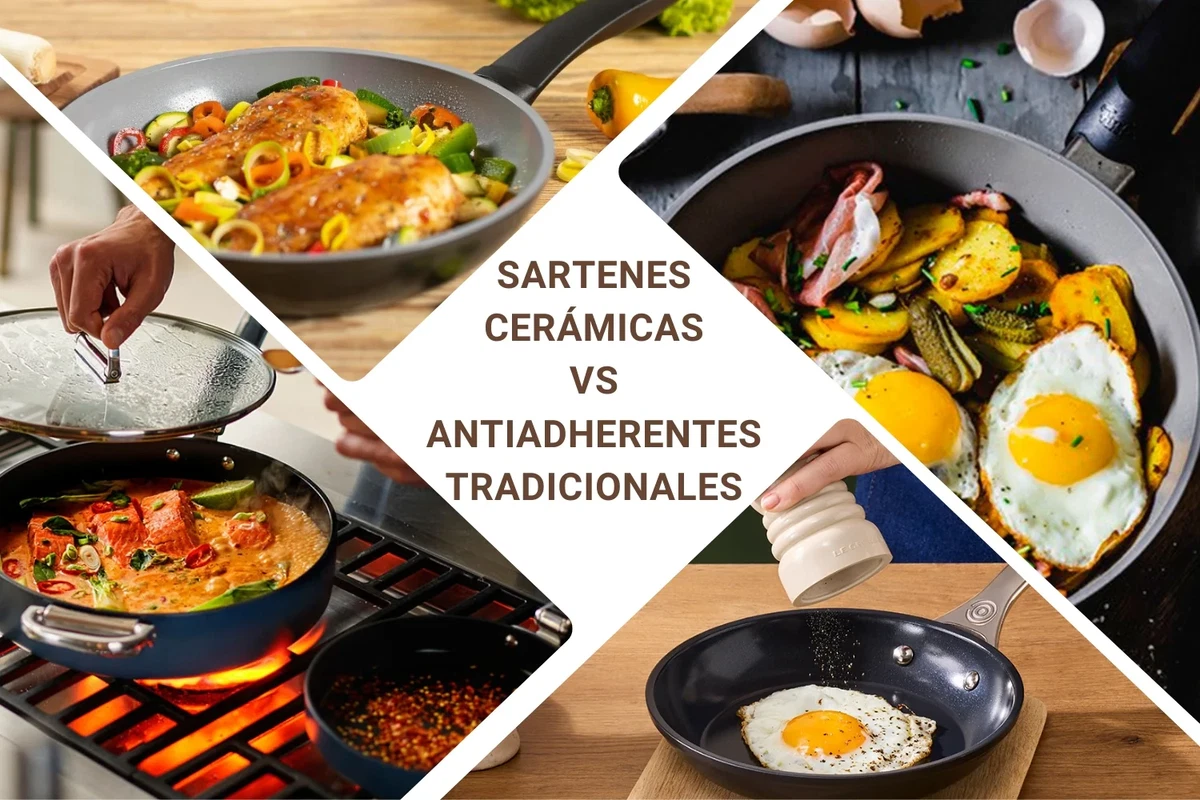
2. Ceramic frying pans vs Teflon
Both options are ideal for cooking delicate foods or foods requiring gentle cooking, as they do not stick and treat ingredients carefully. However, when it comes to non-stick performance, Teflon frying pans still offer the best non-stick properties, which means that, in general, food sticks less to Teflon. This is an inherent characteristic of the coating material, PTFE.
Ceramic coatings do not possess this same property, although some ceramic frying pans offer excellent non-stick performance. In addition, all brands are engaged in a constant process of research and improvement, so these frying pans are not a passing trend; they are here to stay.
They also have other qualities that make them an excellent choice when looking for an alternative to Teflon. They are much more sustainable and environmentally friendly, tolerate much higher temperatures, and are harder and more resistant to abrasion and wear.

3. How to cook with ceramic frying pans
At Claudia&Julia, we place great importance on the care and maintenance of all cookware, especially frying pans. They are undoubtedly among the kitchen utensils we use most often every day, and it is in our hands to make them last as long as possible and remain in the best possible condition. This is how we ensure that, as well as buying healthy frying pans, we keep them healthy.
Should you be wondering how to season ceramic frying pans, there is no need. Ceramic frying pans do not require seasoning. As soon as one arrives at home, all we need to do is clean it with a soft sponge and a little washing-up liquid, and we can begin cooking with it straight away, without any seasoning. As an alternative to traditional non-stick coatings, ceramic frying pans are an excellent choice for cooking delicate foods or foods that tend to stick, as well as foods requiring gentle cooking.
When we buy our first ceramic frying pan, the question is always how to use a ceramic frying pan for the first time. The most important tips, many of which apply to all types of frying pan, are as follows:
- To ensure it lasts a long time, we should never use it over a high heat, either the first time or on subsequent occasions. Overheating or excessive heating can damage the coating and cause it to lose its non-stick properties.
- We should allow it to heat up gradually, from a lower to a higher temperature.
- Ceramic heats up very quickly and transfers heat across the entire cooking surface, so it is important not to overheat the frying pan in order to prevent food from burning.
- Cook with a little oil to prevent food from sticking.
- Do not add food straight from the fridge while it is still cold. Allow it to come closer to room temperature before cooking, as cold food will lower the temperature of the frying pan.
- Wait until the food has cooked before turning it over or removing it from the frying pan.
- Once it is ready, remove the frying pan from the heat and allow it to cool before cleaning.
- Always use silicone, nylon or wooden utensils, and never cut food directly on the surface of the frying pan.
4. How to clean and care for ceramic frying pans
Once we have cooked with one for the first time, a new question arises: how should ceramic frying pans be cleaned and maintained?
To guarantee their durability and ensure their properties remain intact, it is advisable to always wash them by hand once they have cooled. Use a soft sponge and a non-abrasive washing-up liquid to avoid scratching the surface. Washing them in the dishwasher is not recommended, as this cleaning method is more aggressive and may shorten the lifespan of the frying pan.
Should any food residue remain stuck to the surface, you can leave the frying pan to soak in warm water for a few hours before cleaning it with a sponge and a little washing-up liquid.
As mentioned above, they do not need to be seasoned. However, should they lose some of their non-stick performance, it is said that ceramic frying pans can be reconditioned. The process is very simple: simply heat oil over a low heat for approximately 15 minutes.
5. Which ceramic frying pan to choose
As you will already have seen, there are many varied options, so we know that choosing can be difficult. Should you not yet own a ceramic frying pan and be considering buying one, you will find a wide selection of the best ceramic frying pans in our Ceramic frying pans section.

Among them all, we must highlight the Fissler Ceratal® water-based ceramic frying pan, one of Europe’s best-selling ceramic frying pans, as well as the GreenPan Essence ceramic frying pan, with its Thermolon™ ceramic coating reinforced with diamond particles. For those looking for a more affordable ceramic frying pan with excellent value for money, the Bra Hybrid Cell frying pan is a great option. Its ceramic coating is reinforced with stainless-steel cells, or a honeycomb structure, in the same way as the WMF Ultimate Profi Resist frying pan.
For those who value both quality and an incredible design, as well as the added benefit of a folding handle that saves space, the Joseph Joseph Space ceramic frying pan is undoubtedly an excellent choice. For anyone looking for the convenience and versatility of a removable handle, the Ceranoa frying pan from de Buyer’s Loqy collection is an excellent alternative.


Comments
Claudia&Julia said:
Grazie Naty,
Siamo lieti che le informazioni contenute nel post ti siano state utili.
Cordiali saluti.
Naty Fieramosca said:
Grazie dei consigli ora ho le idee più in chiaro