
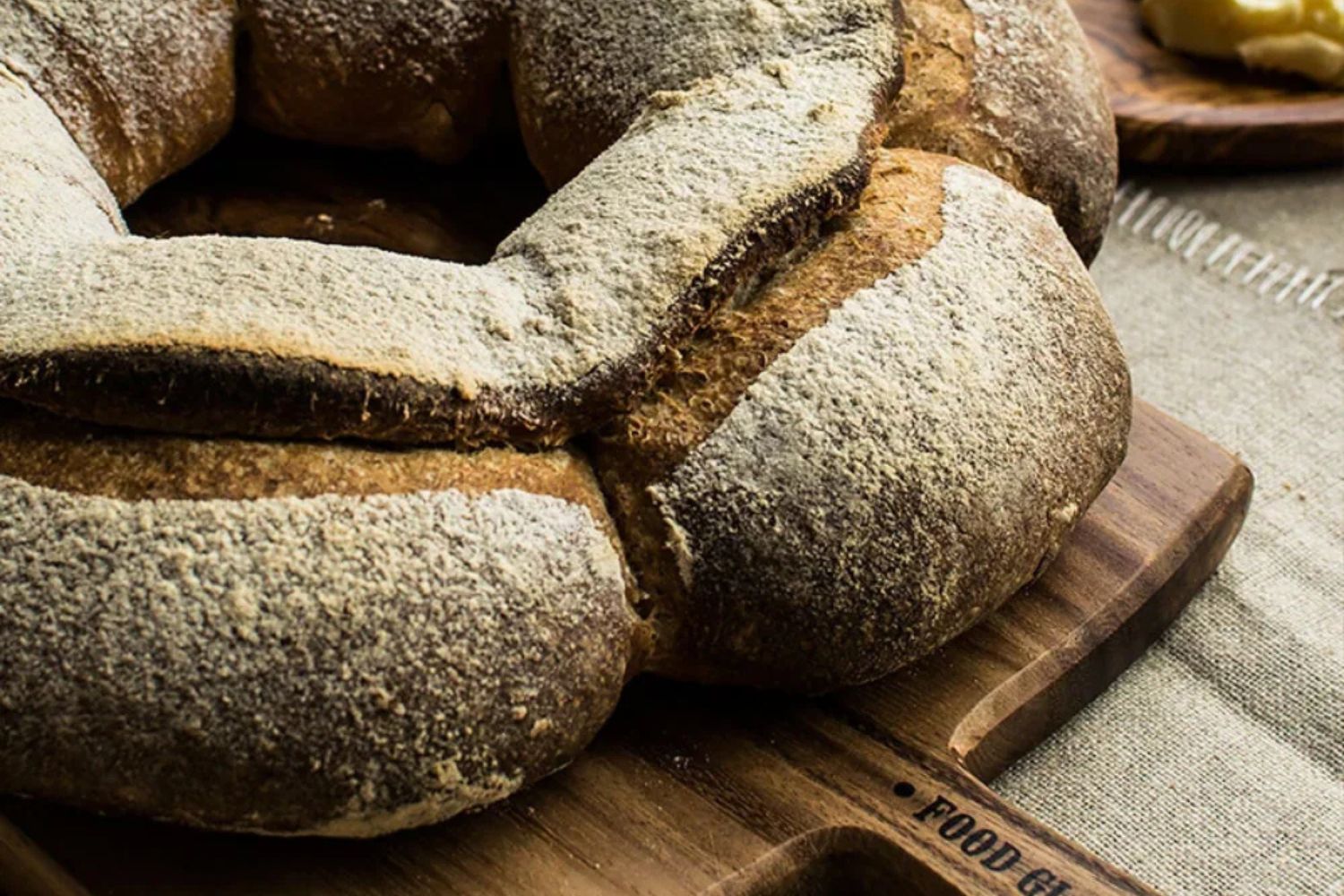
Today we're going to see how to make a Bordelaise crown, or the Crown of the Kings of Bordeaux. The recipe for this delicious loaf of bread, very eye-catching yet easy to make at home, comes to us from Eva, author of Bake-Street. Take her good advice—her hands have touched a lot of dough!
The Bordelaise Crown (Couronne bordelaise) is a festive bread typical of Bordeaux, in southwest France. Traditionally, it is made with 8 or 9 balls joined together, with a small flounce on top. It is said that when it is made with only 6 balls, it is called a Gascon crown.

T&G cutting board, Le Creuset mini spatula and Le Creuset jam jar
I'll show you how to make it with 6 pieces, but if you prefer, you can increase it to 8 or 9.
Originally, this bread was made with the same dough used for country bread, pain de campagne. A white wheat dough with a small amount of wholemeal flour or rye flour added, and usually made with sourdough or old dough (dough from the previous bake), plus a small addition of yeast.
It is a very striking bread thanks to its shape, which may also remind us of the structure of a flower.
INGREDIENTS
For the preferment:
• 100 g strong bread flour
• 50 g whole rye flour
• 1,2 g dry yeast / 3,6 g fresh yeast
• 150 g water
• 3 g salt
Final dough:
• 200 g strong bread flour
• 200 g bread flour
• 50 g whole rye flour
• 50 g whole wheat flour
• 3 g dry yeast / 9 g fresh yeast
• 300-350 g water
• 9 g salt
• All the preferment
Preparation
The night before: We make the preferment.
- In a bowl, mix the flours with the water, the yeast, and the salt. Remember that we should not add the last two ingredients together; it is better to add them separately.
- Mix well until you get a smooth mixture. Cover with cling film and place in the refrigerator overnight.
- If we're doing it during a cold spell, we can leave it in the coldest part of the house at room temperature overnight.
The next day: We prepare our bread.
- Take the preferment out of the fridge 60 minutes before using it.
- In a large bowl, add all the preferment along with ¾ of the water. Whisk well until completely dissolved.
- Add the flours and begin mixing with a flexible dough scraper. Fold the dough to combine the ingredients as you gradually add the remaining water little by little, mixing at the same time.
We will watch the texture of the dough to know whether we need to add more or less water. It should not be stiff, but it also shouldn't be overly hydrated. It will stick to your hands because of the rye, but it should feel somewhat soft to the touch.
It's better to fall a little short on water and adjust later if needed. Bread is always adjusted with water, never with flour.
4. Once the ingredients have come together, cover with a cotton cloth and autolyse (let rest so the flour hydrates) for 20 minutes.
5. After this time, add the yeast and mix. Add the salt and mix again.
6. Turn the dough out onto a work surface and begin kneading. Because it contains rye, it will be a very sticky dough; ideally, knead it using the French kneading method.
We will combine kneading with resting. Knead for 4 minutes and let rest for 5 minutes. Continue until we see the gluten network has developed by doing the windowpane test.
Take a small piece of dough and stretch it between your fingertips; if it stretches without tearing, then the dough has developed well. This test should always be done after a rest; otherwise, the dough will be tense and more likely to tear.
7. Prepare the container where we will leave it to rise. Lightly grease the entire surface with olive oil, place our dough inside, and cover. Let it rise until it doubles in size or a little more; at 24º-25ºC, this will be around 1 hour.
Prepare the mold where the bread will rise.
2. Place the ramekin in the center of the pan and cover with the cotton cloth. Adjust the cloth, as much as possible, so there aren't too many folds inside; generously dust with rye flour. Set aside.
Divide the dough and shape it
1. To make this crown, we need to divide the dough into 7 equal portions. Pre-shape the pieces, cover, and let rest for 10 minutes.
2. After that time, take one of the portions and roll it out with a rolling pin into a circular shape. We need to form a disc that does not reach the diameter of the pan; there should be about three finger widths of space left.

3. Place it over the mold, covering the mound we created with the ramekin.
Shape our portions, round them, lightly oil the side that touches the disc, and place them inside the mold around the mound. Once all our balls are shaped and in the mold, cut the disc-shaped dough over the mound.
4. With a lame or sharp knife, cut the dough so that each cut starts from the join between two pieces. This will leave us with triangles, which we will fold over the dough pieces.
5. Press lightly to join them and cover with cling film to let it complete its final rise.
6. Let it proof until it doubles in volume, about 1-2 hours.
7. Preheat the oven to 220ºC with top and bottom heat 30 minutes beforehand; if you have a stone or steel griddle, preheat it with that inside. If not, you can bake on a tray with no problem.
8. We will bake with steam for the first 10 minutes, so place a container with volcanic stones, if you have them, to generate steam. If not, we can place a small tray or container there and pour water into it.
Remove the bread from the pan
Heat half a cup of water to pour over the container with stones. Prepare a peel/board lined with baking paper.
Place it over the pan and, very carefully, flip it as if it were a tortilla. Lift the pan carefully, remove the ramekin and the cloth.

Baking
- Place the bread in the oven on the lowest rack, pour the boiling water into the container, and close the door. Bake for 20 minutes at 220ºC.
- After this time, remove the steam container and close the oven again. Lower the heat to 210ºC and leave it for 10 more minutes. Reduce the heat to 190ºC and bake for 10 minutes, finishing the last 10 minutes at 190ºC with fan.
- When the baking time is over, turn off the oven and leave the bread inside with the door slightly open for 15 more minutes. This will help create an even crispier crust.
- Remove and let cool completely on a wire rack.

Butter board and acacia wood cutting board Glorious Food T&G
Storage
Before eating the bread, it is best to let it cool completely. This type of bread stays soft for 1-2 days, although I recommend eating it the same day it is baked.
This is a bread that, despite not seeming so at first, is very easy to make and delivers fantastic results. It has an intense, distinctive flavor thanks to the rye, with a fluffy, very tender crumb accompanied by a crisp, fragrant crust. Without a doubt, it's a perfect option to impress at home.
Served with good homemade butter and our favorite jam, it is an absolute delight.


Comments
Fco Jaramillo said:
hola. mañana sabado 12 mayo realizare el pan corona bordalesa, pero me es imposible en León Gto encontrar centeno
Eva {Bake-Street} said:
Muchas gracias Concha! Es menos laborioso de lo que puede parecer (ya nos contarás!) y es una variedad de pan muy agradecida ;)
Jajaja me alegra mucho saber que te vas a animar con él! No me cabe duda de que te quedará estupenda!!
Besos grandes y deseando saber que tal fue todo el proceso!
Eva {Bake-Street} said:
Mil gracias Laura!! Me alegra mucho que te haya gustado ;)
Besos!!
Concha said:
Lo veo un poco laborioso pero no tengo más remedio que ponerme “manos a la obra” y comprar el lunes la harina de centeno y hacerla, porque la pinta que tiene y con lo “panera” que soy no me puedo resistir a no sacar esta rosca de mi propio horno.Totalmente irresistible!!!.
Laura said:
Absolutamente maravillosa Eva!